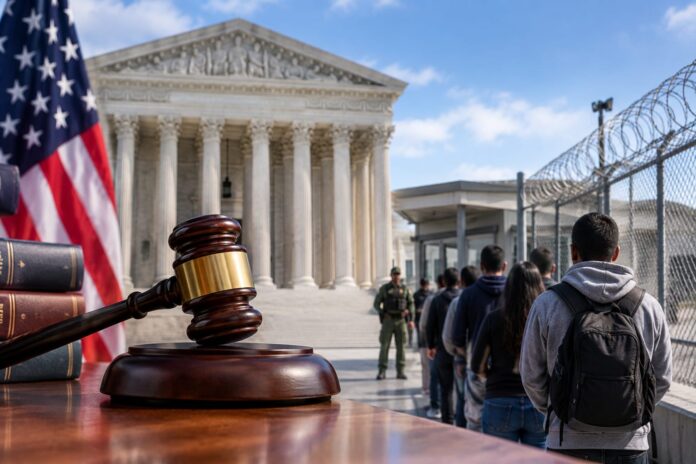
Story Highlights
- The Supreme Court will hear a challenge to the Trump administration’s mandatory detention policy.
- This case could redefine the rights of criminal noncitizens awaiting deportation.
- The outcome may set a precedent for bond hearings and immigration law enforcement.
- Legal battles over immigration continue to shape the landscape of U.S. policy.
What Happened
The Supreme Court has agreed to hear a significant challenge to the mandatory detention policy implemented during President Trump’s administration. This policy has been a cornerstone of his administration’s strict immigration enforcement strategy, aimed at ensuring that criminal noncitizens are detained while awaiting deportation proceedings. The case, which has garnered considerable attention, will determine whether these individuals are entitled to bond hearings after being held for extended periods without a hearing.
The legal challenge comes in the wake of lower courts blocking the enforcement of this policy, raising questions about the rights of noncitizens under the Due Process Clause of the Fifth Amendment. The Trump administration’s appeal to the Supreme Court signals its commitment to uphold its immigration policies, despite opposition from various state and advocacy groups.
- The Supreme Court agreed to hear the case following a request from the Trump administration.
- Democratic New York Governor Kathy Hochul attempted to undermine the case by pardoning a criminal alien in August.
- Solicitor General John Sauer acknowledged the challenges in pursuing the case but remains committed to finding a resolution.
- The case will be heard in the Supreme Court’s new term, which begins shortly.
Why It Matters
This case is crucial as it could redefine the legal landscape for criminal noncitizens in the United States. The Trump administration’s policies have consistently aimed at tightening immigration enforcement, and the outcome of this case may have far-reaching implications for how immigration laws are interpreted and enforced. If the Supreme Court rules in favor of the administration, it could solidify the practice of mandatory detention without bond hearings, reinforcing the administration’s stance on immigration and public safety.
Moreover, the decision could set a precedent for future cases involving the rights of noncitizens, particularly those with criminal records. The implications extend beyond the immediate case, potentially influencing how lower courts handle similar challenges in the future. The administration’s approach to immigration has always been about prioritizing public safety and ensuring that those who pose a threat to society are dealt with swiftly and effectively.
- A ruling in favor of the Trump administration could lead to stricter enforcement of immigration laws.
- It may limit the rights of criminal noncitizens, affecting their ability to seek bond hearings.
- The decision could influence future immigration policies and legal interpretations.
- Public safety concerns will remain a central theme in the ongoing immigration debate.
Political and Public Context
The legal battle surrounding immigration enforcement has been a contentious issue in the United States, particularly during and after the Trump administration. The mandatory detention policy is part of a broader strategy aimed at addressing illegal immigration and ensuring that those who violate immigration laws face appropriate consequences. This policy has faced numerous challenges in lower courts, with various advocacy groups arguing that it violates the rights of noncitizens.
In August, Governor Hochul’s actions to pardon a criminal alien were seen as an attempt to undermine the administration’s efforts to have the case heard. This move highlights the ongoing political divide over immigration policy and the lengths to which some officials will go to protect certain individuals from deportation. The Supreme Court’s decision to hear this case underscores the importance of the issue and its potential to shape the future of immigration law in the United States.
- The Trump administration’s immigration policies have faced numerous legal challenges since their inception.
- Lower courts have issued conflicting rulings on the mandatory detention policy.
- Advocacy groups continue to push back against strict immigration enforcement measures.
- The political landscape surrounding immigration remains deeply divided, influencing policy decisions at all levels of government.
The US Supreme Court agreed to hear a dispute over a policy by the Trump administration that subjects millions of immigrants in the US illegally to mandatory detention during their deportation proceedings https://t.co/BknxqBvSf6 pic.twitter.com/1w1QrL6rmZ
— Reuters Legal (@ReutersLegal) October 1, 2026
What Happens Next
As the Supreme Court prepares to hear this pivotal case, several key questions remain unanswered. The justices will need to consider the implications of their ruling not only for the individuals involved but also for the broader immigration system. The outcome could either reinforce the Trump administration’s policies or lead to a reevaluation of how noncitizens are treated under U.S. law.
In the coming months, legal experts and advocates will closely monitor the proceedings, as the implications of the Court’s decision could resonate for years to come. The administration’s commitment to strict immigration enforcement will likely remain a focal point of discussion, especially as the nation continues to grapple with issues related to border security and public safety.
- The Supreme Court will hear the case in its new term, which begins soon.
- Legal experts will analyze the implications of the Court’s ruling on future immigration policies.
- Advocacy groups will continue to mobilize in response to the case and its potential outcomes.
- The political ramifications of the decision will likely influence upcoming elections and policy debates.