Story Highlights
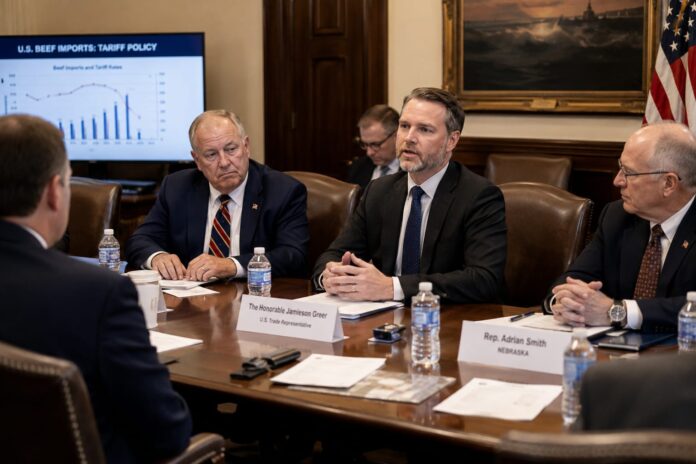
- U.S. Trade Representative Jamieson Greer faced scrutiny from House Republicans regarding beef import policies.
- Concerns were raised about the impact of lowered tariffs on local ranchers and the cattle industry.
- Greer reassured lawmakers about potential country-of-origin labeling for imported beef.
- The meeting underscored ongoing trade tensions with Canada and the implications for various industries.
What Happened
During a closed-door meeting on Wednesday, U.S. Trade Representative Jamieson Greer was questioned by House Republicans about the Trump administration’s recent decisions regarding beef imports. The discussion centered on the controversial lowering of beef import tariffs, a move that has raised concerns among local ranchers and lawmakers alike. This meeting, part of a regular weekly lunch gathering, highlighted the unease felt by many members of Congress, including those who typically support the administration’s trade agenda.
In August, President Trump made the decision to temporarily suspend certain tariffs on imported beef, which allowed for the influx of hundreds of thousands of tons of foreign beef into U.S. markets at lower prices. While this move was intended to benefit consumers by providing cheaper options, it has sparked significant backlash from ranchers and even some of Trump’s allies in Congress, particularly those representing cattle-heavy states.
- U.S. Trade Representative Jamieson Greer attended a weekly lunch meeting with House Republicans.
- President Trump suspended some tariffs on imported beef in August.
- Concerns were voiced by Rep. Eric Burlison (R-Mo.) regarding the cattle industry’s reaction.
- Greer indicated the administration’s openness to country-of-origin labeling for imported beef.
Why It Matters
The implications of the Trump administration’s beef import policies extend far beyond the immediate concerns of ranchers. The decision to lower tariffs has the potential to reshape the landscape of the U.S. beef market, affecting not only local producers but also consumers who may be unaware of the origins of the beef they purchase. By addressing the issue of country-of-origin labeling, the administration is taking a step toward transparency that could help American consumers make informed choices.
Moreover, the ongoing trade stalemate with Canada adds another layer of complexity to the situation. Republicans generally support the narrative that Canada has rejected favorable trade deals due to domestic political pressures rather than economic reasons. This perspective underscores the challenges faced by the Trump administration in navigating international trade relations while also addressing the concerns of domestic stakeholders.
- Lowering beef import tariffs could lead to increased competition for U.S. ranchers.
- Consumers may benefit from lower prices but could be unaware of the beef’s origin.
- Country-of-origin labeling could enhance transparency and consumer choice.
- The trade stalemate with Canada complicates the administration’s trade agenda.
Political and Public Context
The backdrop of this meeting is a broader context of trade relations that have been contentious under the Trump administration. The president’s ‘America First’ agenda has prioritized domestic industries, but the complexities of international trade often lead to difficult decisions that can alienate key supporters. The beef industry is just one of many sectors affected by these policies, and the repercussions are felt across various agricultural and manufacturing sectors.
In addition to beef, other industries such as timber and wine have also been impacted by tariffs, leading to a chorus of concerns from lawmakers representing those sectors. The reciprocal tariffs imposed by Canada have further strained relations, affecting a range of industries and raising questions about the long-term viability of trade agreements. As the midterm elections approach, these issues are likely to become even more pronounced, with Republicans facing pressure to address the concerns of their constituents.
- The Trump administration’s trade policies have faced scrutiny from various sectors.
- Reciprocal tariffs from Canada affect multiple industries, including steel and dairy.
- Lawmakers are increasingly vocal about the need for stakeholder engagement in trade decisions.
- The upcoming midterm elections may influence the administration’s trade strategy.
White House defends Trump’s beef import plan after report on billionaire’s influencehttps://t.co/weM7N3FWbI
— The Hill (@thehill) September 3, 2026
What Happens Next
Looking ahead, the future of beef import policies and trade relations with Canada remains uncertain. The administration’s willingness to consider country-of-origin labeling is a positive sign for ranchers, but it will require congressional action to implement. This presents an opportunity for lawmakers to engage with the administration and advocate for policies that support local producers while balancing consumer interests.
As the trade war with Canada continues, it is crucial for the Trump administration to navigate these challenges carefully. The potential for further reciprocal tariffs could exacerbate tensions and impact various industries, making it imperative for lawmakers to work collaboratively with the administration to find solutions that benefit all parties involved. The coming weeks and months will be critical in determining how these trade issues evolve and what steps will be taken to address the concerns raised by lawmakers.
- Congress may take action on country-of-origin labeling for imported beef.
- Lawmakers will likely continue to press the administration on trade policies.
- Further developments in the trade war with Canada could arise.
- Stakeholder engagement will be essential in shaping future trade decisions.