Story Highlights
- ICE arrests have surged as the Trump administration intensifies immigration enforcement.
- Trump nominated former Oklahoma state trooper Lance Schroyer to serve as ICE director.
- The nomination could give ICE its first Senate-confirmed leader since 2017.
What Happened
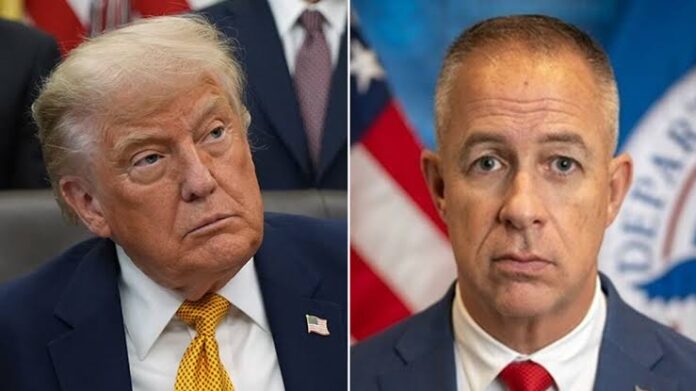
Immigration and Customs Enforcement arrests have surged as President Donald Trump pushes to install Lance Schroyer as the agency’s next permanent director.
Trump announced that he will nominate Schroyer, a former Oklahoma state trooper and U.S. Marine, to lead ICE at a time when the agency is carrying out one of the administration’s most aggressive immigration enforcement efforts.
DHS Secretary Markwayne Mullin praised Schroyer as a strong choice, saying his law enforcement background and work with local-federal immigration partnerships would help deliver Trump’s mandate on arrests and deportations.
- Schroyer has more than 29 years of law enforcement experience.
- He has worked on 287(g) partnerships linking local law enforcement with federal immigration enforcement.
- ICE has operated without a Senate-confirmed director for years.
According to reporting cited in the draft, ICE arrests have climbed to roughly 2,000 per day, marking a sharp increase in enforcement activity.
The surge comes as Trump’s administration seeks to expand detention capacity, strengthen deportation operations, and increase cooperation between ICE and state and local law enforcement agencies.
Why It Matters
The nomination matters because ICE has been central to Trump’s second-term immigration agenda, but the agency has lacked long-term Senate-confirmed leadership.
Putting Schroyer in charge would give ICE a clearer chain of command during a major enforcement expansion.
Supporters say Schroyer’s state law enforcement experience makes him well suited to improve coordination with local agencies, especially through 287(g) agreements.
- Trump is trying to put stable leadership over ICE.
- Schroyer’s nomination signals continued emphasis on local-federal enforcement partnerships.
- The Senate confirmation fight will likely become a broader debate over immigration policy.
For the administration, the arrest surge is likely to be presented as evidence that Trump is delivering on his campaign promise to restore immigration enforcement.
Critics, including civil rights groups, are expected to question whether the surge is properly focused on serious offenders and whether ICE has enough oversight during rapid expansion.
Political and Public Context
Immigration remains one of Trump’s strongest political issues, and the Schroyer nomination gives the White House a clear way to show action.
Republicans are likely to frame the nomination as a law-and-order move that puts a career officer in charge of an agency responsible for public safety and immigration enforcement.
Democrats are likely to use confirmation hearings to press Schroyer and DHS officials on arrest targets, detention conditions, use of local police partnerships, and recent controversies involving ICE operations.
- Trump wants the Senate to move quickly on the nomination.
- Republicans may argue ICE needs a confirmed director during a major enforcement push.
- Democrats may focus on accountability, detention standards, and civil liberties.
What Happens Next
Schroyer’s nomination will now move to the Senate, where lawmakers will decide whether to confirm him as ICE director.
If confirmed, Schroyer would oversee a large federal enforcement workforce, detention operations, deportation priorities, and partnerships with state and local law enforcement.
The arrest surge is expected to remain a central issue during his confirmation process, especially as ICE tries to maintain higher daily arrest numbers.
For Trump, the nomination offers a way to pair expanded enforcement with permanent agency leadership.
For voters, the debate will likely become part of the wider midterm fight over border security, deportations, public safety, and the proper limits of federal immigration power.
Sources
- Trump nominates Oklahoma law enforcement veteran Lance Schroyer to lead ICE as permanent director
- Trump says he will nominate Lance Schroyer as ICE director
- Secretary Mullin Praises President Trump’s Nominee for Director of ICE
- Trump says he will nominate Lance Schroyer as ICE director
- He Guarded His Boss’s Home. Now Trump Wants Him to Command ICE.