Story Highlights
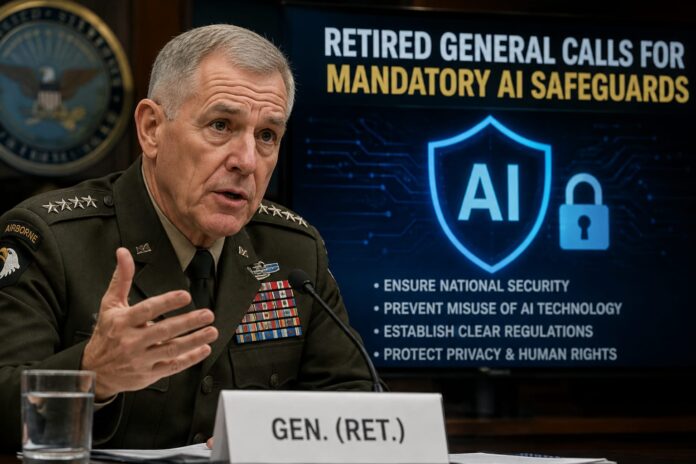
- Retired Lieutenant General Karen Gibson, former deputy director of national intelligence, is calling for mandatory federal safeguards on advanced AI systems.
- Her remarks follow newly disclosed incidents involving OpenAI models that raised serious safety concerns.
- Gibson argues that a currently proposed voluntary federal review framework may not be sufficient and should be made compulsory.
- The general also addressed U.S. munitions stockpile concerns and strategic pressures from Iran during the same appearance.
What Happened
Retired Lieutenant General Karen Gibson, who previously served as the deputy director of national intelligence for national security partnerships, has publicly argued that a proposed federal review framework for advanced artificial intelligence systems should be made mandatory rather than optional. Her remarks came in response to a series of newly disclosed incidents involving OpenAI models, which Gibson described as evidence that voluntary measures are insufficient to ensure the safety and reliability of powerful AI systems.
Gibson made her case during a televised interview, where she outlined her belief that the federal government needs to take a more assertive role in regulating AI development and deployment. She emphasized that the scale and speed of AI advancement have outpaced the existing oversight mechanisms and that the risks are no longer theoretical. Her background in national security gives her perspective on the intersection of emerging technology and threats to public safety, lending significant weight to her position.
- Retired Lieutenant General Karen Gibson issued the call for mandatory AI oversight standards.
- Newly disclosed incidents involving OpenAI AI models were cited as the immediate catalyst.
- A proposed but currently non-mandatory federal review framework for advanced AI was the focus of her recommendation.
- Gibson’s prior role as deputy director of national intelligence for national security partnerships informed her analysis.
Why It Matters
The push for mandatory AI safeguards has profound implications for both the technology sector and national security. If a federal review framework were made compulsory, AI developers — including major companies such as OpenAI — would be required to submit their systems to government scrutiny before deployment, a significant departure from the largely self-regulated environment that has characterized the industry to date. For a conservative audience that values accountability and national security, the idea of ensuring that powerful AI systems do not pose risks to American interests carries substantial weight.
Critics of heavy-handed federal regulation may push back on the proposal, arguing that mandatory oversight could slow innovation and put American AI companies at a competitive disadvantage against foreign rivals. However, proponents like Gibson contend that the risks of inaction — demonstrated by the OpenAI incidents — far outweigh the economic costs of careful federal review. The balance between innovation and security sits at the heart of this debate, and the incidents that prompted Gibson’s remarks suggest that balance may currently be off-kilter.
- Mandatory review frameworks would require AI developers to obtain federal approval before deploying advanced systems.
- National security interests could be directly affected by unchecked AI capabilities, according to Gibson’s analysis.
- American AI firms would face new compliance requirements if such a framework were enacted into law.
- The broader public — including industries relying on AI tools — could face disruptions during any transitional regulatory period.
Political and Public Context
The debate over AI regulation has been intensifying across Washington for some time, with policymakers on both sides of the aisle grappling with how to manage an industry that is evolving faster than legislation can keep pace. The incidents involving OpenAI models have added fresh urgency to conversations that were already happening at the congressional and executive levels. Gibson’s intervention is notable because it comes not from a technology insider or a partisan advocate, but from a career military and intelligence professional whose credibility on matters of national security is difficult to dispute.
Gibson also addressed separate but related concerns during her public appearance, including reports of depleted U.S. munitions stockpiles. She offered the assessment that Iran perceives itself as having strategic patience on its side in ongoing conflicts, believing it can make continued engagement politically, militarily, and economically unsustainable for Washington over time. While separate from the AI discussion, these remarks underscore the broader national security framework within which Gibson situates the conversation about AI governance — viewing technological vulnerabilities as part of a larger strategic picture facing the United States.
- Congressional discussions around AI oversight have been ongoing but largely unresolved ahead of Gibson’s remarks.
- OpenAI has been at the center of recent AI safety controversies that spurred Gibson’s public comments.
- Gibson also raised concerns about U.S. munitions stockpile depletion in the same appearance, connecting multiple security threads.
- Iran’s strategic calculations regarding long-term conflict sustainability were also highlighted as a related concern by Gibson.
What Happens Next
Gibson’s public advocacy is likely to add pressure on lawmakers and administration officials to revisit the structure of any forthcoming AI regulatory framework. If her recommendation gains traction, it could accelerate efforts to convert a proposed voluntary review process into binding federal law, with enforcement mechanisms attached. Tech industry lobbyists are expected to push back vigorously, arguing for self-regulatory models and warning of innovation penalties that could result from heavy compliance burdens.
In the near term, the OpenAI incidents that triggered Gibson’s response will likely face heightened scrutiny from oversight committees and regulatory bodies eager to understand what went wrong and whether existing safeguards proved adequate. The outcome of those investigations could significantly shape the legislative and regulatory landscape for artificial intelligence in the months ahead.
- Congressional oversight committees are expected to examine the newly disclosed OpenAI incidents in greater detail.
- Proposals to make the federal AI review framework mandatory could move forward in legislative discussions.
- Technology industry groups are anticipated to mount opposition to any binding oversight requirements.
- The findings from incident investigations could directly inform the scope and structure of future AI safety regulations.