Story Highlights
- A Marine One helicopter carrying President Trump came within 0.8 miles lateral and 700 feet vertical distance from a commercial aircraft over Washington D.C. due to air traffic control communications failure
- Air traffic controllers at Ronald Reagan National Airport failed to implement required ground stop procedures and did not clearly receive critical safety transmissions from Marine One’s crew
- The incident underscores systemic vulnerabilities in current air traffic communication protocols that demand immediate regulatory attention and modernization
- Federal aviation authorities have confirmed momentary loss of separation while emphasizing the president’s safety was maintained throughout the incident
What Happened
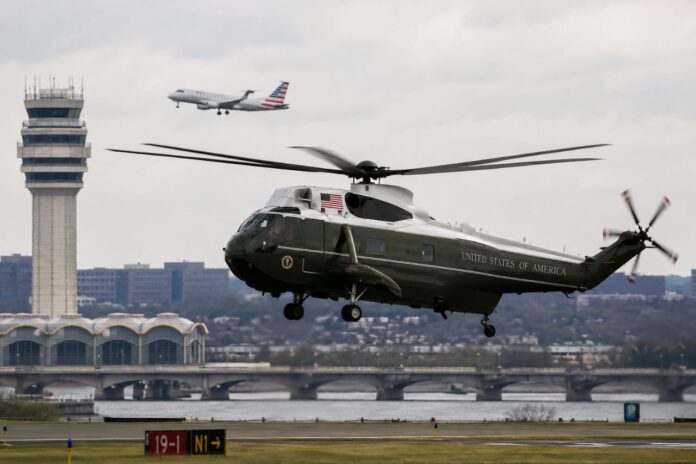
A significant near-miss incident involving Marine One occurred Tuesday afternoon when the presidential helicopter departed from the White House for Joint Base Andrews in Maryland. During the takeoff sequence, air traffic control communications broke down at a critical moment, creating an unsafe separation scenario between the helicopter and a commercial aircraft operating in the same airspace near Reagan National Airport. The helicopter carrying the 80-year-old president came within 0.8 miles of lateral distance and 700 feet of vertical distance from an Embraer E170 regional jet bound for Pensacola, Florida, according to multiple sources familiar with preliminary Federal Aviation Administration assessments.
The communication failure involved multiple transmission attempts from Marine One’s crew to notify Reagan National controllers of an imminent takeoff. Three separate attempts to convey the critical three-minute warning went unheard or were not clearly received by controllers. When the tower finally acknowledged one transmission, controllers indicated the message was broken and unreadable, necessitating a repeat. This breakdown occurred despite established protocols requiring controllers to implement mandatory ground stops when presidential or emergency flights operate across the Potomac River. The commercial aircraft, Envoy Air 3742 operated by a subsidiary of American Airlines, carried approximately 65 passengers.
- Marine One crew made three unsuccessful attempts to warn Reagan National controllers of imminent takeoff
- Helicopter came within 0.8 miles lateral and 700 feet vertical separation from Embraer E170 regional jet
- Air traffic controllers failed to implement required ground stop procedures at Reagan National Airport
- Controllers acknowledged one transmission but indicated it was broken and unreadable
Why It Matters
This incident represents a critical failure in the multilayered safety systems designed to prevent aviation accidents involving high-value or sensitive operations. The fact that mandatory ground stop procedures were not executed demonstrates a breakdown in adherence to established protocols that exist precisely for situations like this. Air traffic communication is the backbone of aviation safety, and when controllers cannot clearly receive or transmit critical information about presidential movements, the entire system’s integrity becomes compromised. The incident occurred in one of America’s busiest airspace corridors near the nation’s capital, where operational precision is paramount.
The near-miss highlights the vulnerability of current communication infrastructure and the consequences when systems fail to function as designed. While authorities have emphasized that the president’s safety was maintained throughout the encounter, the incident nonetheless reveals operational gaps that could have catastrophic implications in different circumstances. The existence of these vulnerabilities in airspace management directly adjacent to Reagan National Airport—one of the nation’s major commercial facilities—demands comprehensive review and remediation. Such failures underscore the necessity for enhanced redundancy in communication systems and stricter enforcement of mandatory safety protocols during presidential operations.
- System failures occurred in densely populated Washington D.C. airspace with high commercial traffic volume
- Mandatory ground stop procedures were not executed despite established protocols requiring them
- Communication breakdown compromised the fundamental safety system designed to separate aircraft
- Incident occurred during routine presidential travel, affecting both military and civilian aviation operations
Political and Public Context
This incident follows a concerning trend of aviation safety challenges in the nation’s capital airspace. Just weeks prior, in January 2025, a military helicopter and an American Airlines regional jet collided over the Potomac River, resulting in significant consequences and prompting the establishment of new safety protocols including the ground stop requirement that was not implemented during the Marine One incident. The recent near-miss demonstrates that regulatory frameworks established in response to previous accidents may not be consistently applied, raising questions about enforcement and adherence across all air traffic facilities.
The incident occurs during a period of heightened focus on presidential security and operational protocols. The administration has emphasized modernization of government operations and improvement of critical systems, and this event provides an opportunity to demonstrate commitment to upgrading the air traffic management infrastructure that protects both presidential operations and the traveling public. Federal aviation authorities, including the FAA and the National Transportation Safety Board, have initiated investigations to identify contributing factors and develop corrective measures. These agencies have authority to recommend procedural changes and technological upgrades that could prevent similar incidents.
- January 2025 midair collision between military helicopter and commercial jet prompted new ground stop requirements
- Recent incident suggests ground stop protocols are not consistently implemented across all facilities
- FAA and NTSB investigating preliminary safety review findings and communications failures
- Incident highlights need for regulatory consistency and enforcement of existing safety procedures
What Happens Next
Federal aviation authorities will conduct comprehensive investigations to determine root causes of the communication breakdown and identify systemic improvements necessary to prevent recurrence. The National Transportation Safety Board will lead a formal accident investigation despite the successful outcome of this particular incident, examining every aspect of the communications chain, controller training, and facility operations. Results from these investigations are expected to yield specific recommendations for procedural modifications, enhanced training protocols, and potentially technological upgrades to communication systems.
Implementation of findings from the investigations will likely result in stricter oversight of ground stop procedures and enhanced communication protocols at Reagan National Airport and similar facilities. The White House and relevant aviation agencies will coordinate to ensure that lessons learned translate into operational improvements across all presidential aviation operations. Enhanced training for air traffic controllers, particularly regarding communication redundancy and critical message transmission, will be evaluated and potentially mandated. Additionally, technological solutions including improved communications systems and enhanced radar/electronic separation assurance tools may be prioritized for implementation at facilities managing sensitive airspace.
- NTSB and FAA conducting formal investigations into communications failures and protocol violations
- Regulatory review of ground stop procedures and enforcement mechanisms across major facilities expected
- Enhanced training for air traffic controllers regarding critical message transmission protocols
- Potential technological upgrades to communication and separation assurance systems under consideration