Story Highlights
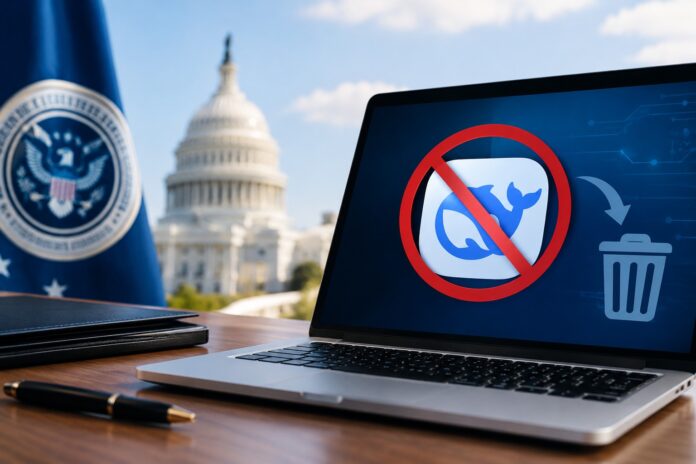
- The Department of Homeland Security has mandated removal of DeepSeek AI products from all federal agency IT systems and banned the Chinese startup from government contracting
- DHS identified multiple security threats including potential data collection, user fingerprinting, malware vulnerabilities, and unauthorized transfer of sensitive information to China
- The agency warned that DeepSeek’s applications could transmit sensitive government data to the People’s Republic of China, potentially creating actionable intelligence on U.S. persons and government programs
- DeepSeek’s R1 model gained significant attention last year for matching capabilities of leading American AI systems while using reduced-capacity chips at a fraction of typical development costs
What Happened
The Department of Homeland Security issued a directive requiring the removal of all DeepSeek AI products from federal agency information technology systems. The order, which was initially distributed in July, was officially published on the Federal Register website, formalizing the government’s position on the Chinese AI startup’s software and services across federal infrastructure.
DHS determined that DeepSeek’s artificial intelligence models present multiple security threat vectors that pose unacceptable risks to U.S. government operations. The agency emphasized that the Chinese government maintains extensive authority over private infrastructure within China, creating a pathway for potential unauthorized access to systems and data housed on American federal networks. The security assessment identified several specific vulnerabilities associated with the technology.
- DHS order initially distributed in July and published on Federal Register website on Monday
- DeepSeek’s AI models identified as presenting multiple threat vectors and security vulnerabilities
- Chinese government cited as having extensive authority to access private infrastructure and data
- Ban extends to removal from federal systems and prohibition from government contracting opportunities
Why It Matters
The DHS action reflects serious concerns about cybersecurity and data protection within the federal government’s technological infrastructure. DeepSeek’s AI applications can collect personally identifiable information from users and may engage in digital fingerprinting activities, tracking behavioral patterns and characteristics of individuals who interact with the systems. Beyond data collection capabilities, the models potentially contain malware or other undiscovered security vulnerabilities that could be exploited by hostile actors.
The most significant concern involves the prompt-and-response operational structure embedded in DeepSeek’s widely used applications. When these systems process queries and generate responses, the architecture could facilitate the transfer of sensitive information to the People’s Republic of China. If federal government agencies or their vendors used DeepSeek technology, such transfers could compromise classified or sensitive operational data. DHS warned that data transferred to Chinese authorities, either independently or when combined with publicly available information, could be synthesized into actionable intelligence targeting American persons and U.S. government programs, creating national security risks.
- Federal systems and sensitive government operations protected from potential data exfiltration to China
- Personally identifiable information and tracking capabilities prevent compromise of federal employee and citizen data
- Mitigation of malware and security vulnerabilities in critical infrastructure systems
- Prevention of intelligence synthesis operations that could harm U.S. persons and government initiatives
Political and Public Context
DeepSeek emerged as a significant player in artificial intelligence development when it released its R1 model, which generated substantial attention across Washington policy circles and Silicon Valley technology companies. The model demonstrated performance capabilities comparable to leading American artificial intelligence systems developed by major technology firms including OpenAI and Google. What distinguished DeepSeek’s achievement was the apparent efficiency of its development process—the Chinese company accomplished comparable results using reduced-capacity computing chips and at a substantially lower cost than typical American AI development efforts.
The emergence of DeepSeek technology intensified discussions about competition between the United States and China in artificial intelligence development. The company’s ability to produce cutting-edge AI systems with fewer resources raised concerns among American policymakers and technology leaders about the pace of Chinese technological advancement and the implications for U.S. technological leadership. This context informed the broader regulatory environment in which the DHS security assessment and removal order took place, as federal officials evaluated how to balance technological access with national security imperatives.
- DeepSeek R1 model generated significant attention for matching American AI capabilities at lower development costs
- Concerns raised about Chinese technological advancement and competition between U.S. and China in AI sector
- DHS action reflects broader federal scrutiny of foreign technology in government systems
- Security assessment part of wider policy discussion about technology access and national security balance
What Happens Next
Federal agencies must now undertake the practical work of identifying all instances of DeepSeek technology within their IT infrastructure and executing removal procedures to ensure complete elimination of the software from government systems. This process will require coordination across multiple agencies and departments to verify compliance with the DHS directive and document the removal of all DeepSeek products.
The ban extends beyond mere removal of existing systems to prohibition of future government contracts with vendors who integrate DeepSeek technology into products or services. Federal procurement officers will need to establish clear policies preventing any new arrangements that would introduce DeepSeek applications into government operations. Additionally, the DHS action may inform regulatory discussions about other foreign technology in federal systems and could influence broader policy conversations about technology vendor security assessments and national origin considerations in government purchasing decisions.
- Federal agencies must identify and remove all DeepSeek products from existing IT systems and verify compliance
- Prohibition on government contracting relationships involving DeepSeek technology going forward
- Potential expansion of security review procedures for foreign-origin technology in federal procurement
- Ongoing policy discussion about technology vendor security standards and foreign technology in government infrastructure