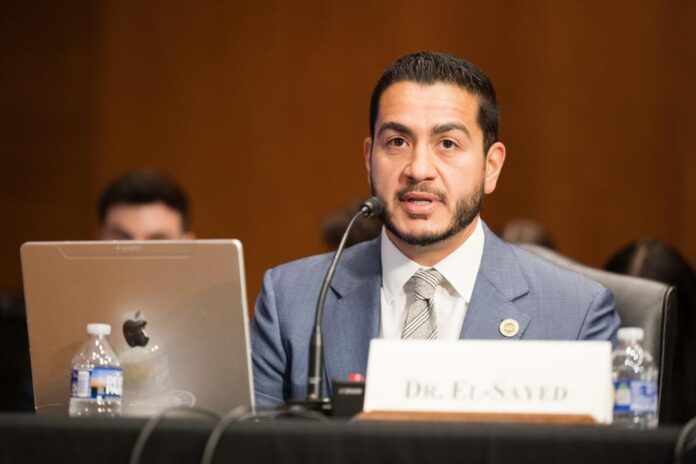
Story Highlights
- Michigan Democratic Senate candidate Abdul El-Sayed is employing a universalist campaign approach that avoids direct appeals to specific demographic groups
- Polling data shows 83% of Black voters support Democratic Senate control, but only 67% back El-Sayed specifically
- El-Sayed’s campaign website omits explicit references to minority groups and racial issues in favor of broader messaging
- Political analysts suggest this strategy risks alienating older Black voters who expect direct appeals to their community’s priorities
What Happened
Abdul El-Sayed, the 41-year-old Michigan Democratic candidate for U.S. Senate, is running a campaign centered on universal policy messages rather than targeted appeals to specific demographic groups. With credentials including Rhodes Scholar status, a professorship in epidemiology at Columbia University, and prior service as executive director of the Detroit health department, El-Sayed has positioned himself as representing a new generation of progressive politics. His campaign messaging remains disciplined around three core themes: removing money from politics, directing resources to working families, and implementing universal healthcare coverage.
Recent polling data reveals a notable gap between his overall Democratic support and his backing among Black voters. A Washington Post-Schar School poll showed that 83% of likely Black voters expressed support for Democratic control of the Senate, yet only 67% backed El-Sayed. This 16-percentage-point disparity suggests that his support among this crucial constituency is softer than Democratic performance overall would indicate.
- El-Sayed employs political universalism focusing on broadly resonant issues rather than group-specific concerns
- Washington Post-Schar School polling showed 83% Black voter support for Democratic Senate control versus 67% for El-Sayed
- Campaign website omits explicit references to minority groups and uses oblique language regarding racial issues
- Strategy represents departure from traditional Democratic targeted outreach to specific constituencies
Why It Matters
The divergence between El-Sayed’s campaign approach and traditional Democratic voter engagement strategies raises questions about universalist messaging effectiveness with core party constituencies. His decision to avoid explicit acknowledgment of specific demographic concerns represents a significant departure from conventional political practice, particularly regarding engagement with Black voters. The polling gap suggests this theory may not be translating into stronger support among Black voters accustomed to direct appeals addressing their community’s distinct concerns.
El-Sayed’s strategy also affects how he addresses issues traditionally important to other Democratic constituencies. His campaign website contains limited explicit mentions of women’s healthcare priorities, LGBTQ+ rights, or Latino and Hispanic community interests. For a Democratic candidate in Michigan with significant Black, Latino, and minority populations, this approach carries political risk during the general election phase.
- Polling gap indicates potential effectiveness issues with universalist messaging among Black voters
- Traditional Democratic constituencies may interpret absence of explicit group-specific messaging as lack of commitment to their priority issues
- Strategy particularly affects engagement with Black voters, Latino voters, and LGBTQ+ communities in Michigan
- General election performance could be affected if soft support among key demographics does not strengthen
Political and Public Context
El-Sayed’s universalist campaign approach reflects a broader Democratic Party conversation about messaging strategy and constituency engagement. Progressive candidates have increasingly debated whether traditional targeted appeals to specific demographic groups represent effective political strategy or whether universal policy messaging better serves party interests. Some Democratic strategists argue that emphasizing shared policy goals can broaden appeal, while others contend that ignoring group-specific experiences alienates core constituencies essential for general election victory.
Michigan’s electoral significance and demographic composition add weight to this strategic debate. The state contains substantial Black, Latino, and Arab American communities whose historical support determines Democratic performance. El-Sayed’s background as an Arab American politician with impressive credentials in public health initially suggested broad appeal. However, the disconnect between stated party loyalty and personal candidate support among Black voters reflects a pattern sometimes observed when candidates employ universalist messaging audiences perceive as insufficiently attentive to their circumstances.
- Broader Democratic Party debate exists regarding targeted demographic messaging versus universal policy appeals
- Michigan contains significant Black, Latino, Arab American, and working-class constituencies whose support historically determines Democratic performance
- El-Sayed’s background as Arab American Rhodes Scholar with public health expertise initially suggested broad appeal potential
- Pattern of gap between party support and candidate support has emerged in other contexts with universal messaging
Why Abdul El-Sayed might not be winning Black voters #TheGuardian https://t.co/vWDRkhjced
— #TuckFrump (@realTuckFrumper) October 11, 2026
What Happens Next
El-Sayed’s campaign faces a critical period in which polling data and constituent feedback will determine whether adjustments to messaging strategy become necessary. Campaign representatives are reportedly working to address the perception gap among Black voters, though whether they will modify the universalist approach remains to be determined. The coming months will reveal whether continued emphasis on universal themes can narrow the 16-percentage-point gap between Black voter support for Democratic Senate control and their support specifically for El-Sayed.
The outcome will have implications beyond this single race. If El-Sayed’s universalist approach succeeds in narrowing the polling gap and connecting with Black voters, it could influence how other progressive Democrats approach constituency engagement. Conversely, if the gap persists, it may reinforce arguments that targeted, explicit appeals to specific demographic communities remain essential for Democratic electoral success.
- Campaign actively working to address perception gap among Black voters through continued engagement efforts
- Decision approaching regarding whether to maintain universalist messaging or pivot toward more explicit group-specific appeals
- General election results will test viability of universalist campaign strategy with core Democratic constituencies
- Outcome may influence how other progressive Democratic candidates approach voter engagement in future races