Story Highlights
- WinSenate, a super PAC linked to Senate Democratic leadership, is withdrawing approximately $550,000 in combined television and digital advertising from North Carolina this week
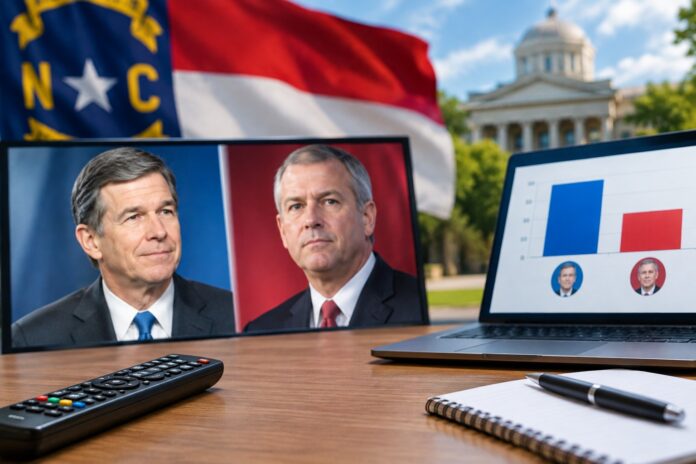
- Recent polling indicates former North Carolina Governor Roy Cooper maintains a substantial lead over Republican Michael Whatley in the Senate race
- Republicans have similarly adjusted their advertising strategies, with the Senate Leadership Fund pausing $30 million in North Carolina spending
- Democrats view the North Carolina contest as their strongest opportunity to gain a Senate seat while pursuing expansion into Iowa, Kansas, and Alaska
What Happened
A super PAC aligned with Senate Democratic leadership announced the withdrawal of significant advertising resources from the North Carolina Senate race this week. WinSenate, which receives funding from Senate Majority PAC, the primary super PAC for Senate Democratic leadership, is pulling approximately $500,000 in television advertising and roughly $50,000 in digital advertising from the state. The decision comes as internal polling data shows former North Carolina Governor Roy Cooper maintaining a commanding position against his Republican opponent, former Republican National Committee chair Michael Whatley.
The advertising pullback reflects broader strategic shifts by both major parties in response to evolving electoral conditions. Republicans have simultaneously made notable adjustments to their own spending priorities. The Senate Leadership Fund, the primary super PAC supporting Senate Republican leadership, recently announced a pause on $30 million in North Carolina spending while shifting resources to other competitive races.
- WinSenate is withdrawing $500,000 in television ads and $50,000 in digital advertising from North Carolina
- Roy Cooper leads Michael Whatley by single to double-digit margins in recent polling surveys
- Senate Leadership Fund paused $30 million in North Carolina spending
- The advertising adjustments occurred this week as both parties reassess competitive battlegrounds
Why It Matters
The reallocation of advertising resources carries significant implications for the broader Senate landscape and electoral strategy. When super PACs reduce spending in specific races, it typically signals confidence in a candidate’s positioning or a judgment that resources would be more effectively deployed elsewhere. For Democrats, the decision to reduce advertising in North Carolina suggests internal assessments that Roy Cooper’s polling advantage is substantial enough to withstand reduced outside spending, allowing party resources to be redirected toward races with tighter margins or greater uncertainty.
For Republicans, the pause in North Carolina spending reflects a strategic pivot toward states where the electoral picture appears more contested. The shift indicates Republican strategists believe resources are needed elsewhere. These dual adjustments demonstrate how both parties dynamically respond to polling data and electoral metrics, constantly recalibrating where finite campaign resources can achieve maximum impact.
- Democratic confidence in North Carolina allows party resources to be redirected toward expansion opportunities in Iowa, Kansas, and Alaska
- Republican reallocation signals strategic recalibration across multiple contested states
- Super PAC spending adjustments reflect real-time assessments of candidate viability and electoral competitiveness
- The decisions impact campaign messaging saturation and voter exposure to candidate positioning in contested markets
Political and Public Context
The Senate campaign landscape has evolved significantly in recent months, with several races shifting in ways that defy traditional partisan expectations. The 2024 Senate election cycle presents both major parties with complex strategic calculations involving limited budgets, numerous competitive races, and uncertain voter sentiment. Democratic strategists identified North Carolina as a potential pickup opportunity earlier in the cycle, and subsequent polling developments have validated that assessment.
Election forecasters maintain that the Senate majority remains genuinely competitive between the two parties. Decision Desk HQ projections indicate Democrats face a 56 percent probability of securing Senate control, reflecting genuine uncertainty about the final outcome across multiple contested seats. These forecasts directly inform super PAC spending decisions, as organizations allocate resources to races where marginal spending can theoretically influence outcomes.
- North Carolina emerged as Democrats’ strongest pickup opportunity based on Roy Cooper’s polling strength
- Decision Desk HQ forecasts show Democrats with a 56 percent probability of taking Senate control
- Both parties are pursuing expansion strategies into traditionally non-competitive states
- Super PAC spending decisions serve as market signals about candidate viability and electoral conditions
The top Republican super PAC involved in Senate races is planning to spend $5 million in South Carolina, a source familiar with the spending confirms to NBC News. https://t.co/3SzuuLAt3a
— NBC News (@NBCNews) October 6, 2026
What Happens Next
The advertising landscape in North Carolina will likely remain fluid as the election approaches. While WinSenate has withdrawn significant resources, Democratic super PACs will likely redirect withdrawn North Carolina resources toward Iowa, Kansas, and Alaska, where party strategists believe pickup opportunities exist or where vulnerable incumbents require defense.
Republican responses in North Carolina remain to be seen. The party may maintain reduced spending levels if internal polling confirms Cooper’s strength, or reverse course and reinvest if subsequent polling suggests movement toward their candidate. The final weeks of the campaign will reveal whether these advertising adjustments accurately reflected genuine electoral conditions or whether campaigns misread voter sentiment.
- Withdrawn North Carolina resources will likely be redirected toward Iowa, Kansas, and Alaska Senate races
- Republican spending levels in North Carolina may remain paused or increase depending on subsequent polling developments
- Final campaign weeks will determine whether super PAC resource decisions accurately predicted electoral outcomes
- Super PAC resource allocations will continue to evolve based on real-time polling and campaign developments