Story Highlights
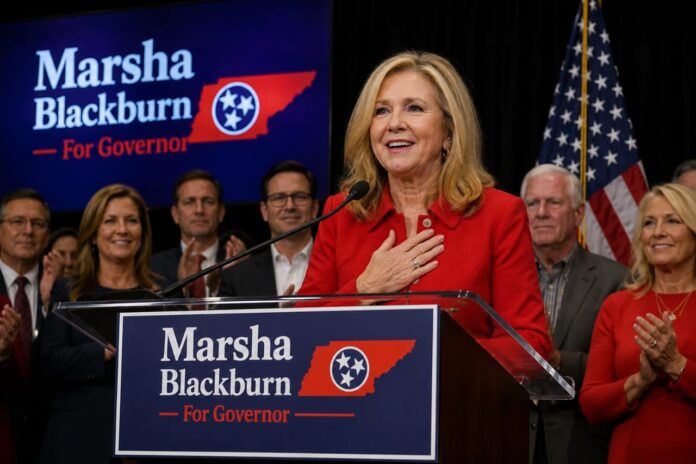
- Sen. Marsha Blackburn secured the Republican nomination for Tennessee governor, defeating Rep. John Rose in the primary race
- The 74-year-old senator is positioned as a heavy favorite in the general election against Democratic nominee Jerri Green in the solidly Republican state
- Blackburn’s conservative credentials on abortion, transgender rights, and China policy have strengthened her appeal to GOP primary voters
- If elected, she would become Tennessee’s first female governor
What Happened
The Republican primary for Tennessee’s gubernatorial race concluded with a decisive victory for the incumbent U.S. senator. Blackburn defeated Rose in a contest that saw significant spending and competing claims of alignment with national conservative leadership. The primary unfolded against the backdrop of Tennessee’s strong Republican dominance, with multiple candidates vying to succeed term-limited Gov. Bill Lee.
The race drew substantial financial resources, with Rose deploying nearly $13 million in self-funding to advance his candidacy. Blackburn, meanwhile, benefited from the Tennessee Freedom Fund, a pro-Blackburn outside group that invested heavily in television advertising and messaging. The final vote tallies reflected a clear preference among GOP primary voters for the sitting senator’s experience and established conservative record.
- Blackburn defeated Rose with approximately 43.8% to Rose’s 32.6% with two-thirds of ballots counted
- Rose invested approximately $13 million in self-funding, including $4.5 million in final weeks
- Democratic nominee Jerri Green, a Memphis City Council member, secured her party’s nomination
- Blackburn previously became the first woman to represent Tennessee in the Senate in 2018
Why It Matters
Blackburn’s primary victory positions a staunch conservative for what observers view as a highly favorable general election matchup in Tennessee. Her established legislative record and deep roots in GOP politics distinguish her candidacy as she prepares to compete for the state’s highest office. The senator’s consistent positioning on core conservative issues—particularly regarding social policy and economic matters—has resonated with Republican primary voters seeking continuity and conservative leadership.
The implications extend beyond Tennessee’s borders. Her emergence as the Republican nominee in this gubernatorial cycle reflects broader patterns within the GOP, where candidates with established conservative credentials and legislative experience command strong support. The general election landscape heavily favors Republican candidates in Tennessee, where Democrats have not won a statewide race since 2006. If Blackburn prevails in November, she would shatter the historical glass ceiling for women in Tennessee politics while advancing conservative governance in a major red state.
- Tennessee’s Republican lean creates a favorable environment for Blackburn in the November general election
- Democrats have not won statewide office in Tennessee since 2006, suggesting structural GOP advantages
- Blackburn’s Senate experience and conservative voting record provide contrast with Democratic opponent Green
- Victory would make Blackburn Tennessee’s first female governor while maintaining conservative control of the executive branch
Political and Public Context
The Tennessee gubernatorial primary represents part of a broader national phenomenon in which multiple senators have pursued gubernatorial races during this election cycle. This trend reflects both the appeal of executive office and strategic calculations among legislative incumbents seeking new challenges. The competitive dynamics within the Republican primary, despite the eventual clear outcome, illustrated the depth of conservative talent within Tennessee’s GOP establishment.
Notably, the primary unfolded in an environment where national figures remained notably selective in their endorsements. While both primary candidates positioned themselves as aligned with conservative national leadership, the restraint shown by prominent figures contrasted with previous cycles featuring more robust interventions. Blackburn’s reputation as one of the Senate’s most conservative members, particularly on issues ranging from social policy to international trade concerns, has built her a substantial foundation of support among core Republican voters.
Other senators pursuing gubernatorial races during this cycle include Republican Tommy Tuberville, who won Alabama’s GOP primary, while Democratic senators Michael Bennet and Amy Klobuchar have pursued varying degrees of success in their respective states’ races.
- Blackburn has served in federal office continuously since 2003, first in the House and then the Senate since 2018
- Blackburn is recognized as one of the Senate’s most conservative members on abortion, transgender rights, and China policy
- Multiple sitting senators from both parties are competing for gubernatorial nominations in the current election cycle
- Tennessee’s political environment has shifted decisively Republican over recent decades, with no statewide Democratic victories since 2006
2nd term Tennessee GOP Senator Marsha Blackburn wins Republican nomination for governor in Tennessee per AP over Rep John Rose and state Rep. Monty Fritts. Blackburn will face Democratic primary winner Memphis City Councilmember Jerri Green in the fall election to succeed… pic.twitter.com/EJY7fHx3Ba
— Craig Caplan (@CraigCaplan) August 7, 2026
What Happens Next
The focus now shifts to the general election campaign, where Blackburn faces Democratic nominee Green. Given Tennessee’s Republican voting patterns and structural advantages, the senator enters the fall contest as a substantial favorite. Her campaign will likely emphasize her legislative accomplishments, conservative credentials, and vision for Tennessee’s future governance. The general election presents an opportunity for her to broaden her coalition beyond the primary electorate while consolidating support among core Republican voters.
Strategic decisions regarding campaign messaging, resource allocation, and coalition-building will prove crucial in the months ahead. Blackburn’s team will need to address potential vulnerabilities while highlighting her record of accomplishment and commitment to conservative principles. The campaign dynamics may also attract national attention and resources, particularly if the race becomes viewed as competitive or emblematic of broader Republican strength in red states.
- General election campaign begins immediately, with November voting providing the decisive contest
- Blackburn’s campaign must consolidate primary supporters while potentially expanding appeal in general election
- Fundraising, advertising, and field operations will intensify throughout the fall campaign season
- Results in Tennessee could influence perceptions regarding Republican momentum heading into subsequent elections