Story Highlights
- President Trump has made multiple attempts to reach out to North Korean leader Kim Jong Un since his inauguration.
- Despite a history of personal rapport, Kim has not reciprocated Trump’s outreach efforts.
- The lack of communication underscores ongoing tensions between the U.S. and North Korea.
- Kim’s recent statements indicate a firm stance on North Korea’s nuclear capabilities.
What Happened
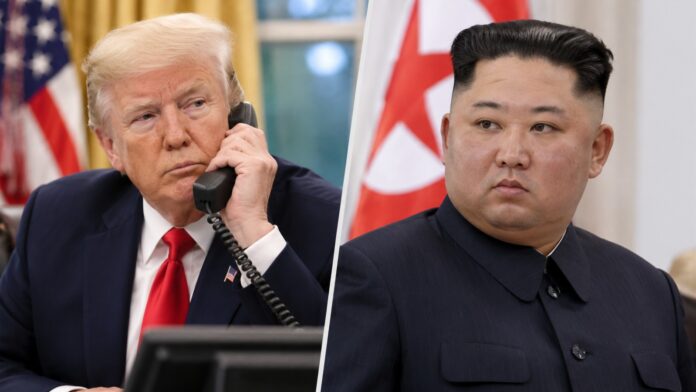
President Trump has found himself in a perplexing situation regarding his relationship with North Korean leader Kim Jong Un. According to a recent report from the Wall Street Journal, the president’s attempts to communicate with Kim have gone unanswered, raising questions about the future of U.S.-North Korea relations. Since returning to the White House in January 2025, Trump has made several efforts to reach out to Pyongyang, but these attempts have been met with silence from the North Korean regime. The president’s initial outreach came shortly after his inauguration, utilizing established phone lines and communication channels, but he was reportedly left hanging without a response. The situation escalated when White House officials attempted to deliver a letter to Kim, which proved to be a challenging task. They staked out North Korea’s United Nations office in New York City, waiting for an opportunity to hand over the correspondence. Ultimately, they managed to pass the letter to a North Korean diplomat, who later tossed the unopened letter in front of a U.S. representative during a U.N. meeting, a clear indication of Kim’s disregard for the president’s overtures.
- President Trump reached out to Kim Jong Un shortly after his inauguration on January 20, 2025.
- White House officials attempted to deliver a letter to Kim at the North Korean U.N. office.
- The letter was ultimately tossed aside by a North Korean diplomat during a U.N. meeting.
- Trump made an open call to Kim while traveling to Asia in October 2025.
Why It Matters
The implications of this lack of communication are significant, not only for U.S.-North Korea relations but also for global security. President Trump’s outreach to Kim was initially seen as a bold move, aimed at reducing tensions and potentially denuclearizing the Korean Peninsula. However, Kim’s refusal to engage in dialogue suggests a hardening of his position. The North Korean leader has publicly stated that he expects the U.S. to recognize North Korea as a nuclear power, framing the situation as a choice between ‘peaceful coexistence or eternal confrontation.’ This rhetoric indicates that Kim is not only unwilling to negotiate but is also prepared to escalate tensions if his demands are not met. The consequences of this standoff could be dire, affecting not just the U.S. and North Korea but also regional allies such as South Korea and Japan.
- Kim’s refusal to engage could lead to increased military tensions in the region.
- U.S. allies in Asia may feel compelled to bolster their own defenses in response.
- The lack of dialogue undermines previous diplomatic efforts made during Trump’s first term.
- Global perceptions of U.S. foreign policy may be affected, impacting future negotiations with other nations.
Political and Public Context
To fully understand the current situation, it is essential to consider the historical context of U.S.-North Korea relations. The relationship has been fraught with tension for decades, characterized by North Korea’s pursuit of nuclear weapons and the U.S.’s efforts to contain that threat. President Trump’s initial outreach to Kim in 2018 marked a significant shift in U.S. policy, as he became the first sitting U.S. president to meet with a North Korean leader. This unprecedented engagement led to a series of summits that raised hopes for a peaceful resolution to the nuclear issue. However, the subsequent breakdown of talks and Kim’s recent statements suggest that the progress made during those meetings may have been superficial. The current lack of communication is reminiscent of previous periods of heightened tensions, where both sides engaged in a dangerous game of brinkmanship.
- Trump’s first summit with Kim took place in June 2018 in Singapore.
- Subsequent meetings in Hanoi and the DMZ failed to produce a lasting agreement.
- North Korea’s nuclear program has continued to advance despite diplomatic efforts.
- Regional allies, including South Korea and Japan, remain on high alert due to North Korea’s actions.
#Trump gets burned by dictator friend – Kim Jong Un returned Trump’s letter unopened and ignored his calls, report says#uspoli #news #worldnews https://t.co/kTBfNCu11z
— GlobeNewsWire (@BCNewsWire) November 23, 2026
What Happens Next
Looking ahead, the future of U.S.-North Korea relations remains uncertain. President Trump has expressed a willingness to engage with Kim, but the lack of response from the North Korean leader raises questions about the viability of future negotiations. The president’s administration may need to reassess its approach, considering alternative strategies to address the nuclear threat posed by North Korea. Additionally, the situation could prompt a reevaluation of U.S. alliances in the region, as allies may seek to take a more proactive role in addressing the challenges posed by Pyongyang. As the world watches, several key questions remain: Will Kim eventually respond to Trump’s overtures? What steps will the U.S. take to ensure regional stability? And how will this situation impact the broader geopolitical landscape?
- Will President Trump continue to pursue dialogue with Kim despite the lack of response?
- What alternative strategies might the U.S. consider to address North Korea’s nuclear ambitions?
- How will regional allies respond to the ongoing tensions?
- What implications will this situation have for future U.S. foreign policy?