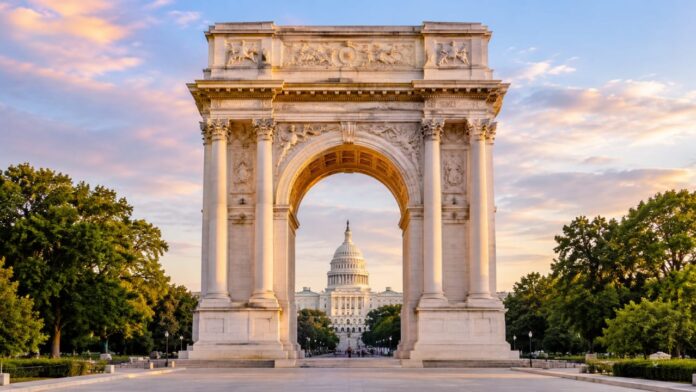
Story Highlights
- District of Columbia and Virginia officials have mounted coordinated opposition to President Trump’s planned triumphal arch monument in the nation’s capital
- The architectural project has become a focal point for ongoing political tensions between the White House and local jurisdictions
- The dispute underscores the president’s significant influence in shaping the region’s development agenda despite resistance from Democratic-led localities
- Multiple stakeholders have indicated they will pursue legal and administrative channels to challenge the project’s advancement
What Happened
President Trump has advanced plans for a triumphal arch to be constructed in Washington, D.C., a monument intended to commemorate his administration’s achievements and legacy. The proposed structure has prompted swift and unified opposition from both District officials and Virginia leadership, who have raised concerns about the project’s feasibility, cost implications, and impact on the region’s existing architectural landscape.
The architectural undertaking represents one of the most ambitious commemorative projects proposed for the capital in recent decades. Local authorities have begun mobilizing their resources to block or significantly modify the initiative through various governmental and legal mechanisms. The controversy has drawn attention from preservation advocates, urban planners, and civic groups across the metropolitan area who maintain divergent perspectives on the appropriateness and scope of such a memorial structure.
- President Trump’s administration proposed construction of a triumphal arch monument in Washington, D.C.
- District of Columbia and Virginia officials have coordinated opposition efforts against the project
- Local authorities are pursuing administrative and legal channels to challenge or delay implementation
- The monument site is visible from prominent locations including the Washington Monument
Why It Matters
This dispute carries substantial implications for how the nation’s capital develops and which commemorative visions receive support and resources. The conflict reflects deeper tensions between the federal government’s architectural ambitions and local authorities’ regulatory authority over land use and urban development. The outcome will establish important precedents regarding the balance of power between the executive branch and municipal governments when monumental construction projects face local opposition.
The White House’s push forward with the triumphal arch demonstrates the president’s continued influence over the region’s developmental trajectory, even as Democratic-controlled local governments resist federal initiatives. The debate also raises questions about public funding allocation, preservation of existing monuments and viewscapes, and the appropriate mechanisms for authorizing large-scale commemorative construction. How local jurisdictions navigate this challenge will influence their capacity to shape their own urban environments moving forward.
- Local jurisdictions face constraints in their ability to control large-scale federal construction projects within their boundaries
- The dispute will influence precedents governing monument authorization in the nation’s capital
- Preservation advocates and urban planners across the region are affected by decisions regarding the project’s advancement
- The controversy demonstrates ongoing political tensions between the federal government and Democratic-led local authorities
Political and Public Context
Washington, D.C. and surrounding Virginia jurisdictions have remained centers of Democratic political strength, creating natural friction points with a Republican administration pursuing ambitious federal projects in the region. The triumphal arch proposal emerges within a broader pattern of assertiveness from the White House regarding its architectural and commemorative priorities. Previous administrations have similarly pursued monumental projects that encountered local resistance, though the scale and prominence of this particular proposal distinguishes it within recent history.
The architectural community and preservation organizations have long debated the appropriate balance between commemorative expression and aesthetic integration within the capital’s carefully designed landscape. Local officials in D.C. and Virginia have consistently maintained that their regulatory frameworks should govern major construction projects affecting their jurisdictions. The current dispute represents a high-stakes test of those principles, with national implications for how future administrations approach similar undertakings. Political observers note that the president’s determination to advance the project regardless of local objections reflects his administration’s broader approach to federal authority and executive prerogative.
- Washington, D.C. and Virginia constitute Democratic political strongholds with histories of resisting Republican federal initiatives
- Previous administrations have pursued monumental construction projects that encountered local opposition
- Preservation and architectural communities have raised technical and aesthetic concerns about the project
- The dispute reflects competing visions of federal versus local authority over development decisions
DC, Virginia sue to block Trump’s triumphal archhttps://t.co/Ux9gbVDpcm
— The Hill (@thehill) November 1, 2026
What Happens Next
District and Virginia officials are expected to pursue multiple avenues to challenge or impede the project’s progression. Legal challenges based on regulatory authority and environmental review requirements appear likely, as do administrative delays and procedural obstacles. The White House will presumably continue advocating for the project’s advancement, potentially leveraging federal land and funding mechanisms to overcome local resistance.
Congressional action remains a potential variable, with House and Senate members from the region potentially introducing legislation to restrict or condition approval of the monument. The president’s administration may pursue alternative sites or modified designs intended to address local concerns while preserving the core commemorative vision. Public engagement and community input processes will likely expand as the dispute continues, potentially influencing the project’s final form and timeline for implementation. The resolution of this conflict will establish important precedents for how future monumental projects proceed in the nation’s capital.
- D.C. and Virginia authorities will pursue legal challenges and administrative procedures to block or delay the project
- The White House is expected to continue advancing the proposal while potentially exploring design modifications or alternative approaches
- Congressional action regarding the monument’s authorization and funding remains possible
- Community engagement processes and public review mechanisms will shape the project’s trajectory and timeline