Story Highlights
- China, Russia, and Iran are expanding conflicts across multiple geographic regions and competition domains rather than confronting the U.S. directly
- Beijing restricted rare earth element exports following American tariffs, while Tehran expanded military operations to Gulf states after U.S.-Israeli strikes
- European defense officials gathered to address grey-zone attacks, with discoveries of explosive devices underscoring an emerging pattern of indirect challenges
- America’s alliance network, while multiplying U.S. strength, creates vulnerabilities that adversaries exploit by targeting weaker allies and critical infrastructure
What Happened
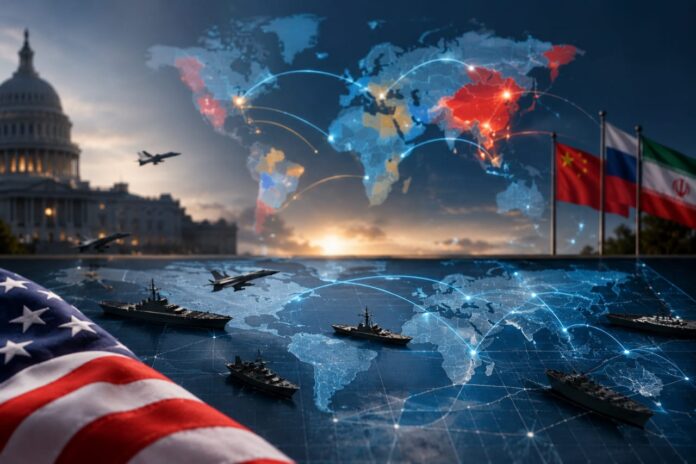
The international security landscape is undergoing a significant shift as America’s major adversaries employ what defense analysts term horizontal escalation—the expansion of conflicts across new geographic regions and competition domains rather than direct confrontation with the United States. This strategic approach has manifested across multiple flashpoints and policy areas, demonstrating a coordinated yet sometimes informal effort to challenge American influence globally.
The pattern became evident following several high-profile policy actions and military operations. When the U.S. imposed tariffs on China in April 2025, Beijing responded by restricting exports of rare earth elements and magnets, creating supply chain disruptions that threatened allied nations worldwide. The campaign has continued unabated. Similarly, following U.S. and Israeli military strikes against Iran in February, Tehran expanded its military operations to the Persian Gulf states, effectively broadening the theater of conflict. In Europe, the situation has grown sufficiently concerning that EU defense ministers convened in Brussels last month to address the rising threat of grey-zone attacks. Even traditionally neutral Switzerland has begun raising concerns about Russian activities. The August discovery of an explosive-laden drone at Germany’s Leipzig Airport exemplifies the larger strategic pattern emerging across the globe.
- China restricted rare earth exports in response to U.S. tariffs imposed in April 2025
- Iran expanded military operations to Gulf states following U.S.-Israeli strikes in February
- EU defense ministers convened in Brussels to address grey-zone attack threats
- Explosive-laden drone discovered at Leipzig Airport in August 2025
Why It Matters
Horizontal escalation presents a fundamental challenge to conventional American foreign policy frameworks. The United States traditionally organizes its strategic approach vertically, compartmentalizing policies into distinct domains such as NATO alliance management, international trade agreements, and regional security concerns like Taiwan. America’s adversaries, conversely, are operating horizontally across these artificial boundaries, creating pressure points and leveraging advantages across multiple theaters simultaneously. This mismatch between American strategic organization and adversarial tactical flexibility creates asymmetric vulnerabilities that policymakers must address.
The strategy also reveals a crucial weakness in the American alliance system. While U.S. alliances traditionally multiply American strength and extend American reach across the globe, this same network of allies provides adversaries with numerous targets. Nations unable or unwilling to directly confront American military power can instead threaten weaker allied nations, sabotage their critical infrastructure, or manipulate their economies. This distributes American defensive resources across a broader spectrum, effectively stretching U.S. capacity to respond across multiple simultaneous crises. Each crisis in different regions consumes American military assets, defensive systems, and strategic attention that cannot be deployed elsewhere.
- American policy compartmentalization creates vulnerabilities that adversaries exploit through cross-domain operations
- Allied nations become target vectors for adversaries seeking indirect pressure on the United States
- Simultaneous crises in multiple regions strain American military resources and defensive capabilities
- Supply chain disruptions and infrastructure attacks create economic pressure on allied economies
Political and Public Context
China, Russia, and Iran pursue fundamentally different objectives and possess vastly different capabilities, yet they share a common strategic goal: overturning the existing U.S.-built international order. This shared objective has motivated increasing levels of cooperation and coordination among these three nations, sometimes formal and deliberate, and sometimes simply complementary without explicit coordination.
Chinese leadership has repeatedly invoked the concept of major global changes occurring at unprecedented scale. In 2023, Chinese officials stood alongside Russian counterparts and discussed advancing shared interests together. Iran has supplied Russia with critical drone technology during periods when Russian capabilities were most constrained by the conflict in Ukraine. Russia, in turn, has provided Iran with advanced military assistance and has reportedly assisted with the development of supersonic cruise missile systems. China has simultaneously worked to blunt American pressure on both Russia and Iran by supplying Moscow with essential dual-use industrial items and maintaining purchases of sanctioned Iranian oil. These relationships demonstrate that even without formal coordination, each nation’s actions strategically complement the others by consuming American resources and military capabilities that cannot be deployed elsewhere.
- Chinese, Russian, and Iranian leaders share the objective of undermining the U.S.-led international order
- Russia received critical drone technology from Iran during periods of military constraint
- China supplies Russia with dual-use industrial components and purchases sanctioned Iranian oil
- Russia provides Iran with advanced military assistance, including supersonic missile development support
What Happens Next
American policymakers face the urgent task of reevaluating defensive and strategic frameworks to address horizontal escalation tactics. Current policy structures that treat different regions and competition domains separately will require fundamental restructuring to address threats that operate across these artificial boundaries. Defense planners must develop integrated responses that coordinate across traditional policy silos, treating regional security, trade policy, and alliance management as interconnected rather than separate challenges.
The discovery of sophisticated grey-zone attack capabilities, such as the explosive-laden drone in Germany, suggests that adversarial operations will likely continue expanding in scope and sophistication. Intelligence agencies and allied defense establishments will need to enhance coordination to identify and counter emerging threats before they escalate. Additionally, the vulnerability of allied supply chains to economic manipulation and infrastructure to physical attack demands comprehensive resilience strategies that strengthen allied nations’ ability to withstand pressure campaigns independent of American intervention.
- Policymakers must restructure compartmentalized defense frameworks into integrated, cross-domain strategies
- Intelligence coordination among allied nations requires enhancement to counter emerging grey-zone threats
- Allied supply chain resilience programs must be developed to resist economic manipulation and coercion
- Clarification of red lines and escalatory thresholds across multiple domains remains an open policy question