Story Highlights
- The Department of Justice launched an antitrust investigation into whether television networks violated federal law by suspending White House press pool coverage
- The suspension followed the administration’s decision to bar CNN, MS Now, and Politico from White House access in September
- Five major broadcasters—ABC, CBS, CNN, Fox, and NBC—received inquiries from the Justice Department regarding potential Sherman Act violations
- A federal judge temporarily restored press credentials for the barred outlets pending further legal proceedings
What Happened
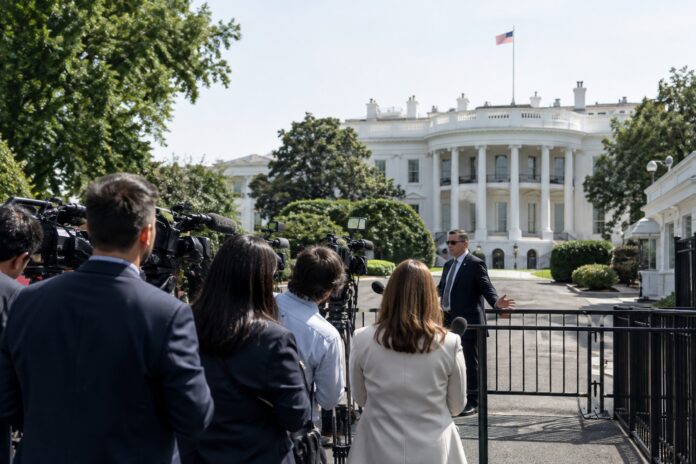
The Department of Justice initiated an investigation into potential antitrust violations by major television networks following a brief suspension of White House press pool operations. The situation developed after the administration exercised its authority to revoke White House credentials for three news organizations deemed insufficiently supportive of presidential coverage. In response to this credential revocation, five broadcasters that constitute the television press pool halted their coordinated coverage activities.
The investigation centers on whether this collective action by competing news organizations constituted an illegal group boycott under federal antitrust law. Justice Department officials indicated that such coordinated actions among commercial competitors warrant examination under the Sherman Act, a foundational statute governing competitive business practices in America. The agency’s Antitrust Division sent formal inquiries to the five major networks seeking information about their decision-making process and coordination.
- White House credentials revoked for CNN, MS Now, and Politico on September 19
- Five television networks suspended press pool coverage operations in response
- Federal judge issued temporary reprieve maintaining press access through the following Tuesday
- Justice Department sent inquiries to ABC, CBS, CNN, Fox, and NBC on Saturday
Why It Matters
This investigation represents a significant development in the ongoing tension between executive authority and press access rights. The White House press pool system has functioned for decades as the mechanism through which news organizations share the substantial costs of presidential coverage while maintaining broad access for the American public. By investigating the networks’ collective response to credential revocation, the administration effectively created a legal liability for news organizations that coordinated to protect their press access rights.
The legal questions at stake carry profound implications for press freedom and government accountability. If coordinated action by news organizations to defend their White House access constitutes antitrust violations, it substantially constrains the practical ability of the media to collectively resist restrictions on coverage. The investigation also illuminates the distinction between a government entity’s right to make access decisions and the potential consequences when news organizations respond collectively to those decisions. This case tests whether competitive news outlets can legally coordinate defensive measures when facing coordinated restrictions on their ability to serve the public’s right to know.
- Press access restrictions could limit public accountability and government transparency
- Major networks face potential legal liability for coordinating press pool responses
- The investigation affects all five major broadcasters’ relationship with the White House
- The outcome may establish precedent for future media access disputes
Political and Public Context
The administration’s approach to press credentials reflects broader efforts to reshape the media landscape and control the narrative surrounding presidential activities. Throughout his tenure, the president has consistently criticized news coverage viewed as unfavorable, and his administration has taken concrete steps to restrict outlet access. The credential revocation in September represented an extraordinary escalation of these ongoing tensions, with the White House explicitly characterizing press access as a privilege rather than a fundamental right.
This incident occurs within a larger debate about the proper balance between executive authority and press freedom. The administration’s position emphasizes that the president and his advisors retain discretion over who enters the White House and which outlets receive access. Conversely, critics argue that comprehensive press access serves the constitutional function of ensuring public accountability. The Justice Department’s investigation adds a new dimension by potentially converting what has been primarily a political dispute into a legal matter with antitrust implications. Prior administrations have occasionally restricted specific reporters or outlets, but the systematic credential revocation combined with antitrust investigation represents a more comprehensive approach.
- Previous administrations restricted individual reporter access but rarely revoked organizational credentials
- The White House press pool has operated continuously as the primary mechanism for presidential coverage
- Press freedom advocates have expressed concern about using antitrust law to penalize media coordination
- The administration has previously criticized unfavorable news coverage as insufficient or biased
What Happens Next
The immediate timeline centers on the federal court’s scheduled decision regarding whether the temporary press access reprieve would be extended beyond the initial deadline. The three barred news organizations are actively pursuing legal remedies through the courts, arguing that their credential revocation violated constitutional press freedom protections. Meanwhile, the Justice Department’s antitrust investigation will likely continue examining communications and decision-making processes among the five major networks during the press pool suspension period.
The broader implications of this investigation extend to how news organizations will respond to future access restrictions. Networks must now consider whether coordinated responses to credential revocations could trigger antitrust scrutiny, potentially creating a chilling effect on collective action. The Justice Department’s investigation outcome will establish important precedent regarding the legal risks associated with media coordination in response to government access restrictions. Legal experts will likely watch whether the administration pursues formal charges or uses the investigation primarily as a pressure mechanism on news organizations.
- Federal court scheduled to rule on extension of temporary press access reprieve
- Barred news organizations continuing legal proceedings challenging credential revocation
- Justice Department Antitrust Division examining network communications and coordination records
- Potential precedent-setting outcome may affect how media organizations respond to future access restrictions