Story Highlights
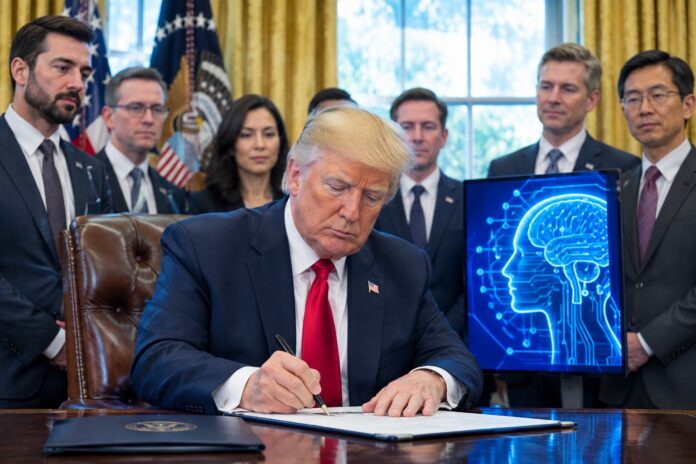
- President Trump established the Super Intelligence Force, a new federal taskforce dedicated to artificial intelligence policy and oversight, led by Director of National Intelligence Jay Clayton
- The taskforce will coordinate government engagement with consumers, public interest groups, religious organizations, critical infrastructure providers, and technology companies
- The administration renamed artificial intelligence as Super Intelligence across all federal communications, reflecting the president’s view that the original terminology sounded inauthentic
- High-ranking officials including Federal Trade Commission Chair Andrew Ferguson and Defense Department leadership will serve on the taskforce
What Happened
President Trump announced the creation of the Super Intelligence Force on Sunday as a comprehensive approach to artificial intelligence governance. The taskforce represents a significant federal commitment to ensuring American technological dominance while establishing structured oversight mechanisms. The move comes after the president signed an executive order on September 29 to officially rename artificial intelligence as Super Intelligence throughout all government operations, reflecting his belief that the original terminology conveyed a misleading impression of the technology’s authenticity.
Director of National Intelligence Jay Clayton will lead the new taskforce, which will function as a coordinating body between federal agencies and external stakeholders. The taskforce’s mandate extends across a broad spectrum of engagement, from consumer protection to infrastructure security, establishing a whole-of-government approach to an increasingly critical policy area.
- Jay Clayton selected as Director of the Super Intelligence Force
- Federal Trade Commission Chair Andrew Ferguson and Defense Department Undersecretary Emil Michael appointed to the taskforce
- Executive order signed on September 29 mandating use of SI and Super Intelligence terminology in all official federal communications
- Taskforce authorized to coordinate with consumers, public interest groups, religious organizations, critical infrastructure providers, and technology companies
Why It Matters
The establishment of the Super Intelligence Force represents a pivotal moment in American technology policy, demonstrating the administration’s determination to balance innovation with responsible governance. Rather than imposing restrictive regulatory frameworks, this approach leverages private sector expertise while maintaining federal oversight. The taskforce model allows the government to remain responsive to rapid technological developments without creating bureaucratic obstacles that could disadvantage American companies competing globally.
The renaming initiative carries substantive implications for how federal agencies approach and communicate about this transformative technology. The inclusion of diverse stakeholder groups demonstrates recognition that effective AI governance requires input from religious organizations, civil society, and infrastructure operators alongside technology companies. This comprehensive approach acknowledges that Super Intelligence impacts virtually every sector of American society and economy.
- Federal government gains unified strategy across agencies on artificial intelligence policy
- American technology companies benefit from streamlined regulatory engagement and direct access to policymakers
- Religious organizations and civil society groups gain formal mechanisms for participating in AI governance decisions
- Critical infrastructure operators receive government coordination for integrating emerging technologies while maintaining security
Political and Public Context
The Super Intelligence Force announcement occurs within a dynamic landscape of technology industry advocacy and international competition. Industry leaders have increasingly engaged with government on AI regulation, with executives from major technology firms signing what they characterized as a morally binding agreement on responsible development. The creation of this taskforce responds to industry appeals for government coordination while avoiding more restrictive regulatory approaches that have emerged in some international jurisdictions.
Globally, various nations have pursued different regulatory models for artificial intelligence, ranging from the European Union’s comprehensive framework to lighter-touch approaches emphasizing industry self-governance. The American approach embodied in the Super Intelligence Force attempts to position the United States as capable of maintaining technological leadership while establishing responsible guardrails through public-private cooperation.
- Technology industry executives from OpenAI and Anthropic have publicly advocated for coordinated government oversight structures
- International competition in AI development creates pressure for American policy that maintains innovation capacity
- Previous administration approaches to technology regulation had been criticized as insufficiently coordinated across agencies
- Public concern about AI safety and responsible development has grown, necessitating government engagement with civil society
"No more AI. SI, it's better."
Elon Musk is renaming SpaceXAI to SpaceXSI after President Trump signed an executive order directing the federal government to use "Super Intelligence" instead of "artificial intelligence."
The move also highlights Musk's ties to the Trump… pic.twitter.com/l7Y5lTmKT4
— FOX Business (@FoxBusiness) October 5, 2026
What Happens Next
The Super Intelligence Force will begin operational coordination across federal agencies immediately, establishing working relationships with stakeholder organizations and technology companies. The taskforce will develop frameworks for federal government adoption of emerging technologies while establishing communication protocols with private sector partners. Implementation of the renamed terminology across federal systems will proceed through government communications channels.
Future activity will likely include development of federal guidelines for responsible AI deployment, coordination with critical infrastructure operators on integration strategies, and ongoing engagement with religious and civil society organizations on ethical dimensions of technological development. The administration’s approach suggests continued emphasis on enabling innovation while maintaining safety through coordination rather than prohibition.
- Taskforce to establish formal coordination protocols with major technology companies and infrastructure operators
- Federal agencies to transition terminology to Super Intelligence designations across all official channels
- Development of federal guidelines for responsible AI deployment and integration across government operations
- Ongoing engagement mechanisms with stakeholder groups to inform policy development