Story Highlights
- Lawmakers express dissatisfaction with Pentagon policy chief Elbridge Colby’s briefing.
- Colby faced criticism for a lack of prepared statements and clear answers.
- Some senators praised Colby for his detailed responses despite frustrations.
- The ongoing conflict in Iran continues to be a contentious issue for Congress.
What Happened
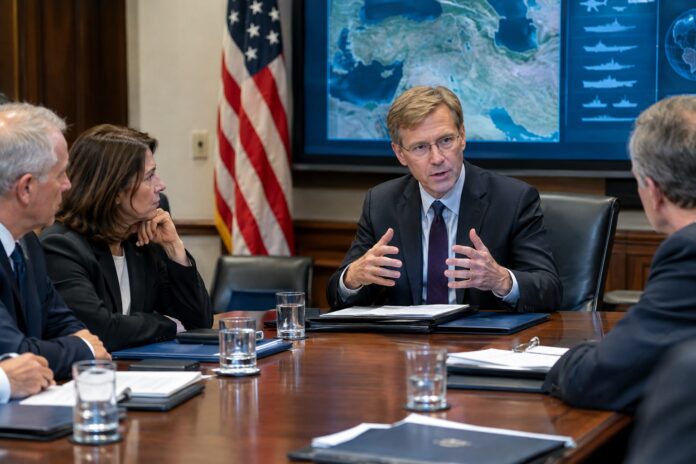
On Thursday, a closed-door briefing with Pentagon policy chief Elbridge Colby left many senators feeling frustrated and confused. The session, which was intended to provide an update on the Trump administration’s National Defense Strategy and the ongoing conflict in Iran, quickly devolved into a series of unanswered questions. Lawmakers from both sides of the aisle expressed their disappointment, highlighting a perceived lack of clarity and preparedness from Colby.
Senator Kevin Cramer, a Republican from North Dakota, described the briefing as ‘very peculiar’ and ‘weird,’ noting that Colby opened the floor for questions without first providing an opening statement. This approach, Cramer argued, was disrespectful and indicative of a broader issue within the administration’s communication strategy. Senator Joni Ernst, also a Republican, echoed these sentiments, stating that she chose not to ask questions due to the lack of clear responses from Colby.
- Colby opened the briefing without an opening statement.
- Senator Kevin Cramer criticized the lack of preparedness.
- Senator Joni Ernst expressed disappointment and refrained from asking questions.
- Iran was the primary focus of the briefing, despite the agenda including broader defense strategies.
Why It Matters
The frustrations expressed by lawmakers during the briefing underscore a growing concern regarding the Trump administration’s handling of the Iran conflict, known as Operation Epic Fury. This military engagement has now extended into its seventh month, with no clear resolution in sight. The lack of transparency and communication from the Pentagon raises significant questions about the administration’s strategy and objectives in the region.
President Trump, who initially predicted a swift victory in the conflict, has recently acknowledged that the war may continue through the upcoming November midterm elections. This acknowledgment has led to increased scrutiny from both Democratic and Republican lawmakers, who are concerned about the implications of a prolonged conflict on domestic issues, particularly rising energy prices. The ongoing situation has also prompted discussions about the potential for further military engagement and its impact on U.S. foreign policy.
- The ongoing conflict in Iran has significant implications for U.S. energy prices.
- Lawmakers are increasingly frustrated with the lack of clear communication from the Pentagon.
- President Trump’s acknowledgment of a prolonged conflict raises concerns about its impact on the midterm elections.
- Colby’s briefing reflects broader issues within the administration’s communication strategy.
Political and Public Context
The backdrop of this briefing is critical to understanding the frustrations expressed by lawmakers. The Trump administration’s National Defense Strategy has faced scrutiny since its inception, with many questioning its effectiveness in addressing current global threats. The ongoing conflict in Iran has become a focal point for criticism, particularly as it relates to the administration’s broader foreign policy objectives.
Moreover, the political landscape surrounding the Iran conflict is fraught with tension. As the midterm elections approach, lawmakers are acutely aware of the potential ramifications of a prolonged military engagement. The Democratic majority in the Senate has been vocal in demanding answers regarding the costs and implications of the war, further complicating the administration’s position. The potential for political fallout from the conflict is significant, as rising energy prices and public dissatisfaction could influence voter sentiment.
- The Trump administration’s National Defense Strategy has faced ongoing scrutiny.
- The Iran conflict has become a focal point for criticism of the administration’s foreign policy.
- Political tensions surrounding the midterm elections are influencing lawmakers’ responses to the briefing.
- Democratic lawmakers are actively seeking answers regarding the costs of the Iran war.
Pentagon No. 3 frustrates senators in closed-door briefing on Iran war, Trump defense strategyhttps://t.co/w75eCkRJPq
— The Hill (@thehill) September 18, 2026
What Happens Next
Looking ahead, the fallout from this briefing may lead to increased pressure on the Pentagon and the White House to provide clearer communication and a more coherent strategy regarding the Iran conflict. Lawmakers are likely to continue demanding answers, particularly as the midterm elections draw closer. The president’s upcoming meetings with leaders from six Persian Gulf nations may also play a crucial role in shaping the administration’s approach to Iran moving forward.
As the situation evolves, it remains to be seen how the administration will respond to the growing frustrations among lawmakers. The potential for further escalation in the conflict, coupled with the political ramifications of a prolonged war, will undoubtedly keep this issue at the forefront of congressional discussions. The administration’s ability to navigate these challenges will be critical in maintaining bipartisan support and addressing the concerns of both lawmakers and the public.
- Lawmakers will likely continue to press for clearer communication from the Pentagon.
- The president’s meetings with Gulf leaders may influence future strategies regarding Iran.
- Increased scrutiny of the administration’s handling of the Iran conflict is expected.
- The political landscape surrounding the midterm elections will continue to shape lawmakers’ responses.