Story Highlights
- JD Vance’s comments on the Antichrist resonate with many within the Christian community.
- His friend Rod Dreher emphasizes that such beliefs are common among Republican voters.
- Vance maintains a focus on his responsibilities as vice-president despite discussing these beliefs.
- The remarks reflect a broader sentiment about the state of the world and its challenges.
What Happened
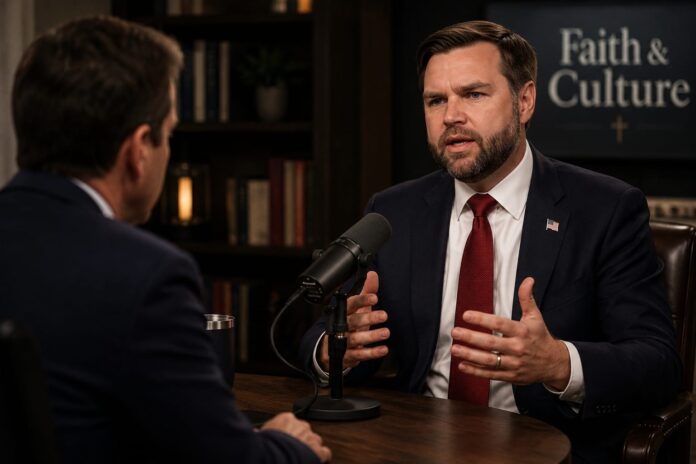
Recent remarks made by US Vice-President JD Vance regarding the Antichrist and the concept of ‘end times’ have sparked discussions across various platforms, particularly among Christian communities. During a recent podcast appearance, Vance expressed that he would ‘not be shocked if the Antichrist was walking among us,’ a statement that has resonated with many who share similar beliefs. His comments were made in response to a question posed by Bryce Crawford, a Christian podcaster, during a discussion that delved into Vance’s religious views and the implications of current global events. Vance’s friend, Rod Dreher, a conservative writer, defended the vice-president’s remarks, asserting that such views are not only common but also reflect a significant portion of the Republican voter base. Dreher stated, ‘Most Americans who are inclined to vote Republican already believe this stuff,’ indicating that Vance’s comments are in line with the sentiments of many within the party.
- JD Vance made his comments during a podcast with Bryce Crawford.
- Rod Dreher, a conservative writer, defended Vance’s remarks.
- Vance converted to Catholicism in 2019.
- He is set to deliver the first White House press briefing since the departure of Press Secretary Karoline Leavitt.
Why It Matters
The significance of Vance’s remarks lies in their reflection of a broader belief system prevalent among many Christians, particularly those who identify with conservative values. The concept of the Antichrist and the ‘end times’ is deeply rooted in Christian theology, often associated with the belief that the world is approaching a climactic conclusion. Vance’s acknowledgment of these beliefs may resonate with voters who feel a sense of urgency regarding the moral and spiritual state of the world. His comments also highlight a growing concern among many Americans about the rapid changes in society, including advancements in technology and ongoing geopolitical conflicts. These factors contribute to a sense of unease, prompting individuals to seek explanations through their faith. Vance’s focus on his duties as vice-president, despite discussing these beliefs, suggests a balance between personal faith and public responsibility.
- Vance’s remarks may strengthen his connection with conservative Christian voters.
- The comments could influence public perception of the Republican Party’s stance on faith-related issues.
- Vance’s focus on leadership amidst these beliefs may appeal to voters seeking stability.
- The discussion reflects a broader trend of faith influencing political discourse in the US.
Political and Public Context
Understanding the context of Vance’s remarks requires a look at the historical relationship between Christianity and American politics. The idea of the Antichrist has been a topic of discussion among various Christian denominations for centuries, often linked to apocalyptic literature in the Bible. This belief has been particularly prominent in evangelical circles, where interpretations of scripture often emphasize the imminent return of Christ and the rise of the Antichrist. Vance’s conversion to Catholicism in 2019 adds another layer to this discussion, as it reflects a personal journey that aligns with traditional Christian values. His comments echo sentiments expressed by previous political figures, including former President Ronald Reagan, who also spoke about similar themes during his time in office. This historical precedent suggests that Vance’s remarks are not out of place within the Republican narrative, but rather a continuation of a long-standing dialogue about faith and governance.
- Vance’s conversion to Catholicism aligns with his conservative values.
- Previous political figures, like Ronald Reagan, have made similar remarks about faith.
- The relationship between Christianity and politics has evolved over decades.
- Many churches continue to teach about the ‘end times’ and the Antichrist.
Vance's Antichrist comments are a 'common belief', his friend tells BBC https://t.co/bTtBAeMr7F
— BBC News (World) (@BBCWorld) September 3, 2026
What Happens Next
Looking ahead, Vance’s remarks may have implications for his political career and the broader Republican agenda. As he prepares to deliver the first White House press briefing since the departure of Press Secretary Karoline Leavitt, the vice-president’s comments could shape the narrative surrounding faith and politics in the upcoming election cycle. It remains to be seen how these discussions will influence voter sentiment and whether they will galvanize support among conservative Christians. Additionally, Vance’s ability to balance his personal beliefs with his responsibilities as vice-president will be closely monitored by both supporters and critics. The ongoing dialogue about faith in politics is likely to continue, with Vance positioned as a key figure in this conversation.
- Vance will deliver a White House press briefing, potentially addressing these topics further.
- His remarks may influence the Republican Party’s strategy in upcoming elections.
- Vance’s ability to navigate faith and politics will be scrutinized by the media.
- Public discourse on faith-related issues is expected to grow in prominence.