Story Highlights
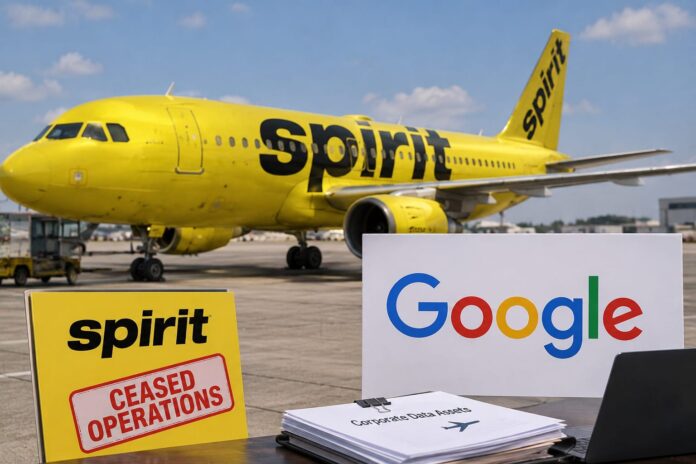
- Google secured a $10 million bid in a bankruptcy auction to acquire Spirit Airlines’ corporate data, outbidding AI data company Mercor’s $7.5 million offer
- The data cache contains 100 million emails, 500 million Microsoft Teams messages, and approximately 30 million lines of code from the now-defunct carrier
- The acquisition represents a significant shift in AI training methodology, moving beyond publicly available coding data toward private corporate information to automate white-collar tasks
- Industry experts indicate this deal signals a broader strategy by AI companies to develop agents capable of generalizing across multiple sectors of the economy
What Happened
Google emerged victorious in a bankruptcy auction this month by committing $10 million toward acquiring the corporate data assets of Spirit Airlines, the low-cost carrier that ceased operations in May. The winning bid exceeded a competing proposal from Mercor, an artificial intelligence data company that had offered $7.5 million for the same dataset. The acquisition grants Google access to an extensive repository of internal communications and code that provides a comprehensive snapshot of how the airline’s workforce conducted business operations across multiple departments and functions.
The dataset represents one of the largest collections of real-world corporate communications made available for AI training purposes. Industry analysts characterize this transaction as a watershed moment in the evolution of artificial intelligence development, particularly in the context of reinforcement learning methodologies. Rather than relying exclusively on publicly available information found across the internet, major technology companies are now pursuing private corporate archives to enhance their AI systems’ capabilities in performing tasks beyond software engineering.
- Google’s $10 million winning bid exceeded Mercor’s $7.5 million counteroffer in the bankruptcy auction
- Dataset includes 100 million emails, 500 million Teams messages, and 30 million lines of code from Spirit Airlines operations
- Spirit Airlines ceased flying operations in May before entering bankruptcy proceedings
- Transaction signals industry shift from public coding data toward private corporate archives for AI model training
Why It Matters
This acquisition carries substantial implications for how artificial intelligence systems will be trained and deployed across the economy in coming years. Historically, the most significant advances in AI model performance have emerged from training on coding tasks, primarily because code operates under clear success-or-failure parameters that provide immediate feedback signals to AI systems. The availability of vast quantities of publicly accessible code on the internet has allowed companies to develop sophisticated coding agents without requiring proprietary information. However, extending AI capabilities to handle other categories of white-collar work presents a fundamentally different challenge, as such tasks often lack the binary success metrics that code possesses.
The labor market implications of this trend warrant careful consideration. If AI systems successfully learn to automate administrative functions, customer service tasks, project coordination, and other office-based work through analysis of real corporate communications, the economic consequences could be substantial. The data from Spirit Airlines, despite the company’s failure, likely encodes valuable information about how workers collaborate, make decisions, communicate across hierarchical levels, and navigate industry-specific protocols. Even data reflecting poor business decisions carries analytical value, as it demonstrates patterns that AI systems should recognize and potentially avoid in future applications.
- Access to authentic corporate communication patterns enables AI systems to learn generalized workplace automation skills beyond coding
- Potential ripple effects across labor markets if white-collar automation proves successful through this training methodology
- Real-world data provides more accurate training than synthetically generated corporate communications that companies typically create
- The acquisition demonstrates how private corporate data has become a critical asset in competitive AI development efforts
Political and Public Context
The Spirit Airlines data acquisition occurs within a broader technological landscape where companies are investing unprecedented resources in reinforcement learning environments. These specialized training systems function as simulations of commonly used software applications where AI agents can take independent sequences of actions and receive rewards based on whether those actions produce desired outcomes. The methodology has generated rapid improvements in AI model performance across multiple domains, though success has been most pronounced in coding applications where success criteria remain unambiguous.
Industry figures suggest the financial commitment to these training approaches has reached extraordinary levels. Anthropic, a leading AI research organization, has indicated potential spending exceeding $1 billion annually on reinforcement learning environments designed to simulate real workplace software and processes. This investment trend underscores how competitive pressures within the AI industry are driving companies to seek authentic corporate data that previously remained confined to private business operations. The Spirit Airlines transaction represents one of the first major examples of a mainstream technology company acquiring actual corporate archives through formal bankruptcy proceedings, legitimizing this approach as a standard acquisition strategy rather than an anomaly.
- Reinforcement learning methodologies have demonstrated rapid improvement over the past 18 months compared to traditional AI training approaches
- Anthropic and other frontier AI labs are committing over $1 billion annually to reinforcement learning environment development
- Prior data acquisition efforts typically relied on human workers generating synthetic corporate communications rather than authentic archives
- The transaction establishes precedent for using bankruptcy proceedings as acquisition channels for corporate intellectual assets
“It never crossed my mind that they would be so bold as to sell our private data for AI,” says one former Spirit Airlines flight attendant. https://t.co/T5gABtTmz2
— WIRED (@WIRED) August 25, 2026
What Happens Next
The technology industry will likely witness increased competition for corporate data archives as companies recognize the strategic value these assets possess for AI development. Bankruptcy auctions involving businesses of various sizes may increasingly attract interest from AI firms seeking authentic communications and operational records. Google’s acquisition will serve as a proof-of-concept that could prompt other technology companies and AI-focused organizations to pursue similar transactions, potentially creating a new market for corporate data recovery and licensing.
The broader implications for corporate data governance remain uncertain as the practice becomes more commonplace. Legal questions about employee privacy, intellectual property rights, and the appropriate uses of corporate communications may emerge as these transactions accelerate. Additionally, the successful integration of Spirit Airlines data into Google’s AI training pipeline will provide crucial information about whether authentic corporate communications genuinely improve AI systems’ ability to perform diverse white-collar tasks. If the experiment proves successful, it could establish a template for how companies acquire and utilize private business data in pursuit of more capable artificial intelligence systems.
- Increased likelihood that other AI companies will pursue corporate data acquisitions through bankruptcy proceedings and direct negotiations
- Potential legal and regulatory scrutiny regarding employee privacy rights and data protection in corporate communications archives
- Integration of Spirit Airlines data into Google’s AI training pipelines will demonstrate effectiveness of authentic corporate communications for model development
- Successful implementation could drive demand for corporate data licensing agreements from still-operating companies seeking new revenue streams