Story Highlights
- Leading mathematicians gathered recently to discuss concerns about artificial intelligence’s potential impact on their profession, with many expressing worry about job security and career prospects
- Artificial intelligence systems have produced impressive mathematical results, including disproving the unit distance conjecture and generating novel cryptanalysis findings that match PhD-level research capabilities
- AI breakthroughs remain limited to finding counterexamples and applying existing techniques to known problems rather than developing new mathematical theories
- Experts suggest that the unique creative abilities required for theoretical mathematics development provide some protection for human mathematicians in the near term
What Happened
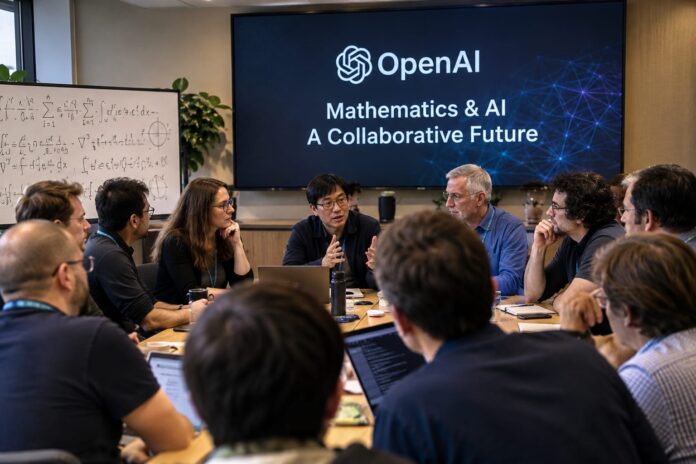
Approximately 40 prominent mathematicians convened at OpenAI offices in August to examine how artificial intelligence might reshape their field and profession. The private meeting reflected widespread anxiety among the mathematical community regarding potential threats to employment, career development, and the nature of mathematical work itself. Recent publications by mathematicians indicated that discussions were characterized by pessimism about future prospects.
Despite these concerns, artificial intelligence systems have demonstrated remarkable capabilities in solving mathematical problems. OpenAI’s frontier AI model disproved the unit distance conjecture in mid-May, resolving an 80-year-old problem in discrete geometry. Anthropic published two AI-derived results in academic cryptanalysis in July, and OpenAI released ten new mathematical results from its latest model. Additionally, Claude made an attempt to prove the Riemann hypothesis, a problem that has challenged mathematicians for more than 150 years.
- Approximately 40 leading mathematicians met at OpenAI offices in August
- OpenAI’s AI model disproved the unit distance conjecture, an 80-year-old geometry problem
- Anthropic published AI-derived cryptanalysis results and Claude attempted to prove the Riemann hypothesis
- OpenAI released ten new mathematical results from its latest AI system
Why It Matters
The intersection of artificial intelligence and mathematics represents a significant moment for academic disciplines and professional careers. The accomplishments demonstrate that AI systems can now operate at levels comparable to experienced PhD researchers in certain mathematical domains. However, analysis of these achievements reveals important limitations that may preserve traditional roles for human mathematicians. The AI results fall into two categories: counterexamples to mathematical statements and novel applications of known techniques to existing problems that human experts had not pursued or recognized.
The distinction proves crucial for understanding the scope of AI’s mathematical capabilities. Finding a counterexample to the Jacobian conjecture required computational search and pattern recognition from machine learning but did not demand creation of entirely new theoretical frameworks. The unit distance conjecture breakthrough demonstrates how AI can connect ideas from different mathematical domains, such as bringing algebraic number theory to bear on a discrete geometry problem. Human experts might eventually discover such connections independently, but they face limitations based on specialized training and research focus that AI systems do not experience. These discoveries, while impressive, represent relatively accessible mathematical challenges that do not require developing extensive new theoretical structures.
- AI systems can produce PhD-level results in specific mathematical problems, creating concern among professional mathematicians about career prospects
- Mathematical breakthroughs achieved by AI remain limited to solving existing problems rather than developing new theories, preserving a critical domain for human expertise
- AI’s ability to connect disparate mathematical domains and find counterexamples through computational search demonstrates pattern recognition capabilities that complement but do not replace theoretical innovation
- Mathematicians maintaining expertise in theory development and innovative framework creation retain competitive advantages that current AI systems cannot replicate
Political and Public Context
The concerns raised by mathematicians reflect broader societal anxieties about artificial intelligence’s impact across professional fields. Academic mathematicians occupy a position of particular cultural significance, representing the pinnacle of intellectual achievement and theoretical innovation. When leading researchers express worry about automation and job displacement, these concerns resonate throughout educational institutions and research communities. The meeting at OpenAI’s offices symbolizes the direct engagement between AI developers and potentially affected professionals, a dynamic that is reshaping multiple industries simultaneously.
The mathematical community’s response to AI advancement differs from some other professional sectors, as evidence suggests that certain uniquely human mathematical capabilities remain beyond current AI capabilities. Unlike chess, where computers surpassed humans decades ago, or Go, which recent AI systems have mastered at grandmaster level, mathematics involves elements of creative framework-building and theoretical development that distinguish it from problem-solving tasks. The distinction proves important for understanding how different knowledge domains respond to automation. Fields where tasks involve defined rule systems and measurable performance metrics face different displacement pressures than disciplines requiring original theoretical contribution and conceptual innovation.
- Academic mathematicians represent a cultural symbol of intellectual achievement, making their concerns about AI impact particularly significant to broader public discourse about automation
- Mathematical research differs from game-playing domains like chess and Go by requiring original theoretical development rather than optimal application of existing rules
- The August meeting demonstrates direct engagement between major AI research organizations and affected professional communities seeking to understand future implications
- Response to AI advancement in mathematics reflects patterns emerging across multiple knowledge-intensive professions facing automation pressures
🔴 OpenAI, Anthropic AI models solve decades-old math problems; human-level theory-building still elusive
OpenAI's frontier model disproved the unit distance conjecture in May—an 80-year-old discrete geometry problem. Anthropic published two AI-derived cryptanalysis results in… pic.twitter.com/VnXaRPRhzI
— NewsTongue (@NewsTongueX) August 25, 2026
What Happens Next
The trajectory of AI development in mathematics will likely depend on whether systems can advance beyond solving existing problems toward generating genuinely new theoretical frameworks. Current capabilities demonstrate impressive computational pattern recognition and problem-solving abilities, but the absence of original theory development represents a meaningful boundary. If this boundary holds, mathematicians may maintain secure roles as creators of new mathematical frameworks and theoretical structures that guide future research directions. However, the pace of AI capability expansion remains uncertain, and developments over the coming years will provide clarity regarding whether this distinction between problem-solving and theory-building can sustain professional mathematical careers long-term.
The mathematical community will likely continue monitoring AI progress carefully while maintaining their professional focus on questions that require genuine theoretical innovation. Graduate programs and research institutions may need to adjust emphasis toward areas where human creativity and theoretical insight provide the greatest value relative to AI capabilities. The relationship between mathematicians and AI systems may evolve from competition toward collaboration, with humans focusing on creative framework development and AI systems handling computational search and problem-solving at scale. Understanding exactly how this division of labor develops will depend on empirical evidence regarding AI’s trajectory toward independent theory generation.
- The critical test for mathematician employment security involves whether AI systems can develop entirely new mathematical theories rather than solving existing problems
- Mathematical research communities will likely shift emphasis toward domains requiring genuine theoretical innovation and creative framework-building
- Collaboration between human mathematicians and AI systems may become the dominant model, with humans directing theory and AI managing computational tasks
- The coming years will provide evidence regarding whether current AI limitations in theory development prove enduring or represent only a temporary phase