Story Highlights
- The Department of Justice deployed six federal monitors to polling locations in Charleston, South Carolina during the Senate GOP runoff election
- The monitoring effort aimed to ensure transparency, ballot security, and compliance with federal election laws including the Voting Rights Act of 1965
- The DOJ has expanded its election monitoring presence significantly, with over 80 monitors deployed across more than 200 polling locations in seven states during the primary season
- Assistant Attorney General Harmeet Dhillon indicated the department plans to deploy approximately 1,000 monitors for the upcoming midterm elections
What Happened
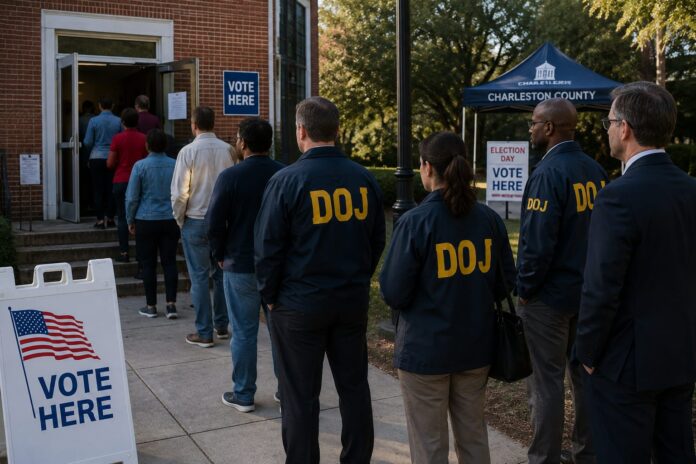
The Department of Justice announced the deployment of federal monitors to polling sites in Charleston, South Carolina on election day for the Senate GOP runoff. The monitoring contingent consisted of four attorneys from the DOJ’s Civil Rights Division, one assistant U.S. attorney from South Carolina, and one staffer from the office of the U.S. attorney for South Carolina. These monitors were positioned at polling locations throughout Charleston, the largest city in South Carolina, to oversee election procedures and ensure adherence to federal election law.
The monitoring initiative was conducted under the authority of the Voting Rights Act of 1965, which permits federal observers to monitor polling place procedures. According to the DOJ’s official announcement, the monitors were tasked with ensuring transparency, ballot security, and compliance with federal law throughout the voting process. South Carolina required voters to present valid photo identification at polling places, with voting hours extending from 7 a.m. to 7 p.m. Eastern Daylight Time.
- Six federal monitors deployed: four Civil Rights Division attorneys, one assistant U.S. attorney, and one U.S. attorney’s office staffer
- Monitoring authority derived from the Voting Rights Act of 1965
- Polling hours: 7 a.m. to 7 p.m. EDT with valid photo ID requirement
- Election determined the Republican nominee to face Democrat Annie Andrews in the general election
Why It Matters
Federal election monitoring represents a significant mechanism for ensuring election integrity and public confidence in democratic processes. By positioning neutral observers at polling locations, the DOJ aims to document compliance with federal election statutes and address potential irregularities in real time. This monitoring effort serves multiple purposes: it creates an independent verification of voting procedures, deters potential violations of federal election law, and provides a factual record of election day operations that can be referenced if disputes arise.
The presence of federal monitors also communicates to voters that election integrity is a priority for federal law enforcement agencies. For election officials at the local and state level, the monitoring process encourages adherence to established procedures and federal requirements. The DOJ’s enforcement authority extends beyond the Voting Rights Act to include the Americans with Disabilities Act and the Civil Rights Act, ensuring that monitoring encompasses accessibility and non-discrimination protections for all voters.
- Federal monitors create independent verification of voting procedures and poll operations
- Monitoring deters potential violations and provides documented record of election day activities
- Monitoring encompasses multiple federal statutes including accessibility and non-discrimination requirements
- Process reinforces public confidence in election transparency and integrity
Political and Public Context
The DOJ’s election monitoring program has expanded substantially in recent election cycles. During the 2022 primary season, the department deployed monitors to nine states. The current primary season saw an escalation, with the DOJ positioning more than 80 monitors across over 200 polling locations in seven states including Arizona, Florida, Michigan, Minnesota, Virginia, and Wyoming. Additional monitors were scheduled for Massachusetts and New Hampshire, with those states’ primaries set for September 1 and 8 respectively.
Assistant Attorney General Harmeet Dhillon, who heads the Civil Rights Division, characterized the Charleston monitoring effort as the next phase in the DOJ’s broader election transparency initiative. The department’s public statements emphasized cooperation with state and local election officials, noting appreciation for the collaboration of South Carolina state authorities, Charleston County officials, and the local U.S. attorney’s office. According to recent reporting, the DOJ indicated plans to deploy approximately 1,000 monitors for the upcoming midterm elections, representing a significant increase in federal election oversight capacity.
- DOJ deployed monitors to nine states during 2022 primary season
- Current primary season involved over 80 monitors across seven states plus scheduled deployments for two additional states
- Assistant Attorney General Harmeet Dhillon emphasized ongoing election transparency efforts
- Department plans to deploy approximately 1,000 monitors for midterm elections
DOJ to monitor Charleston polling sites for South Carolina primary runoffhttps://t.co/HQhulaBt4M
— The Hill (@thehill) August 25, 2026
What Happens Next
The DOJ’s election monitoring initiative is expected to continue throughout the election calendar. With primaries ongoing in multiple states and general election season approaching, federal monitors will likely be deployed to additional polling locations across the country. The department’s stated goal of positioning approximately 1,000 monitors for the midterm elections suggests a sustained commitment to federal election oversight during high-stakes electoral contests.
State and local election officials will continue coordinating with federal monitors to ensure smooth polling operations and compliance documentation. The data collected by federal monitors may inform DOJ enforcement decisions and provide evidence for potential civil rights investigations if violations are identified. Additionally, the monitoring presence serves as an ongoing mechanism for public assurance regarding election integrity measures, with federal observers available to address procedural questions and document adherence to established voting protocols.
- Federal monitors expected to continue deployment across remaining primary elections
- Approximately 1,000 monitors planned for midterm election polling locations
- Continued coordination between federal observers and state/local election officials
- Monitoring data may inform DOJ enforcement actions and civil rights investigations