Story Highlights
- The White House ordered the Pentagon to reduce joint military exercises with South Korea, citing concerns about diplomatic relations with North Korea
- The administration characterized the drills as costly and counterproductive to efforts aimed at fostering regional stability through dialogue
- The decision reflects a strategic pivot toward engagement with Pyongyang rather than military posturing that could escalate tensions
- Critics from the opposition party argued the move undermines longstanding alliances, though supporters view it as pragmatic diplomacy
What Happened
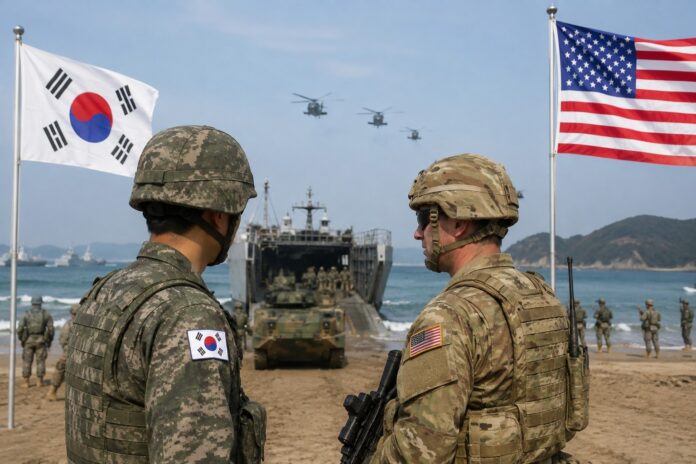
President Trump announced through social media that he had directed the Pentagon to scale back joint military exercises with South Korea that had commenced earlier in the week. The administration’s decision came after the drills had already begun, making complete cancellation impractical. Instead, the White House ordered a reduction of the planned operations, which were originally scheduled to span 11 days and involve approximately 18,000 South Korean soldiers.
The president’s rationale centered on his assessment of the current diplomatic environment in Northeast Asia. He emphasized his positive working relationship with North Korean leadership and noted that Pyongyang’s recent posture appeared less aggressive than in previous periods. Additionally, the administration expressed frustration with Seoul’s reluctance to assist in broader Middle Eastern policy objectives, particularly regarding Iran’s nuclear program.
- Joint exercises began Monday as scheduled but were subsequently reduced at presidential direction
- Original drill duration was 11 days involving 18,000 South Korean troops
- North Korea had characterized the training as a rehearsal for war before the reduction announcement
- The Pentagon received orders to implement scaling back rather than complete cancellation
Why It Matters
This decision represents a significant shift in how the executive branch approaches military readiness and alliance management in one of the world’s most sensitive geopolitical zones. The Korean Peninsula remains technically at war, with the armistice signed in 1953 never replaced by a formal peace treaty. Military exercises have traditionally served as critical mechanisms for ensuring that American and South Korean forces maintain interoperability, coordination protocols, and operational readiness in the event of unexpected aggression from the north.
The administration’s emphasis on diplomatic engagement over military exercises signals confidence in the current trajectory of negotiations and a belief that reducing provocative military displays could create better conditions for sustained dialogue. This approach prioritizes relationship-building with key actors and suggests that the benefits of demonstrating good faith through military restraint outweigh the risks of reduced combat readiness. Such strategic thinking reflects a broader philosophy that sustainable peace requires moving beyond cycles of military posturing and toward substantive negotiations between principals.
- Military coordination between U.S. and South Korean forces may be affected by reduced exercise frequency and scope
- The decision signals Washington’s willingness to prioritize diplomatic overtures to Pyongyang as a path toward denuclearization
- Regional allies assess American commitment to alliance obligations based on military exercise participation and visibility
- Reduced exercises may impact personnel training cycles and readiness assessment protocols
Political and Public Context
The approach taken by the current administration builds upon a foundation established during the previous term, when similar reductions in military exercises occurred during the initial phases of direct engagement with North Korean leadership. Historical precedent showed that such military restraint was paired with intensive diplomatic negotiations aimed at achieving denuclearization commitments. The strategy rested on the theory that removing symbols and mechanisms of military confrontation could create psychological and political space for breakthrough discussions.
Opposition figures have criticized the decision as fundamentally undermining America’s commitment to its South Korean ally and questioned whether restraint in military exercises would produce reciprocal restraint from Pyongyang. Some analysts raised concerns that previous diplomatic initiatives had failed to achieve lasting denuclearization, making current military reductions seem premature. However, proponents of the administration’s approach contend that traditional military exercises had not produced denuclearization either, and that a fundamentally different diplomatic strategy merits serious consideration. Historical patterns show that North Korea has occasionally used military exercise periods as opportunities for its own weapons testing, suggesting that the timing and scale of exercises warrant strategic reassessment.
- Previous diplomatic engagement occurred during 2018 when exercises were suspended for denuclearization talks
- Joint military exercises between the two countries have taken place for over 70 years
- North Korea has historically used exercise periods as pretexts for its own weapons development activities
- Regional stability assessments consider both military readiness factors and diplomatic engagement levels
Trump says the U.S. will scale back military drills with South Korea after staying out of the Iran war, citing his “very good relationship” with North Korea’s leader in deciding to downsize the exercises. https://t.co/QgI2BTsDFK pic.twitter.com/DP4NIilC9u
— Drew Grimaldi (@Grimillionaire) August 17, 2026
What Happens Next
The administration has not yet specified detailed parameters for how the military exercise reductions will be implemented or what specific operational elements will be scaled back. South Korea’s defense establishment indicated that the drills would proceed as originally planned at the time of the announcement, though Pentagon guidance is expected to clarify the extent and nature of reductions in coming weeks. The practical implementation of the scaling-back directive will require coordination between American and South Korean military commands to determine which training components take priority and which can be deferred or eliminated.
The success or failure of this diplomatic-military strategy will likely become evident through observable actions from Pyongyang in the coming months. If North Korean leadership reciprocates with restraint in weapons testing and inflammatory rhetoric, the administration’s gamble on military exercise reduction as a confidence-building measure will gain credibility. Conversely, if North Korea continues or escalates its weapons development activities despite reduced exercises, critics will cite such developments as evidence that military restraint produced no diplomatic benefits. The White House’s willingness to adjust course based on actual North Korean behavior will be crucial to determining whether this approach represents a viable alternative to traditional deterrence-focused military exercises.
- Pentagon implementation details regarding exercise scaling remain to be specified and coordinated
- North Korean response patterns over coming months will serve as key indicator of diplomatic progress
- Future exercise schedules and force training cycles will require reassessment by military planners
- Congressional oversight committees are likely to request briefings on strategic rationale and operational implications