Story Highlights
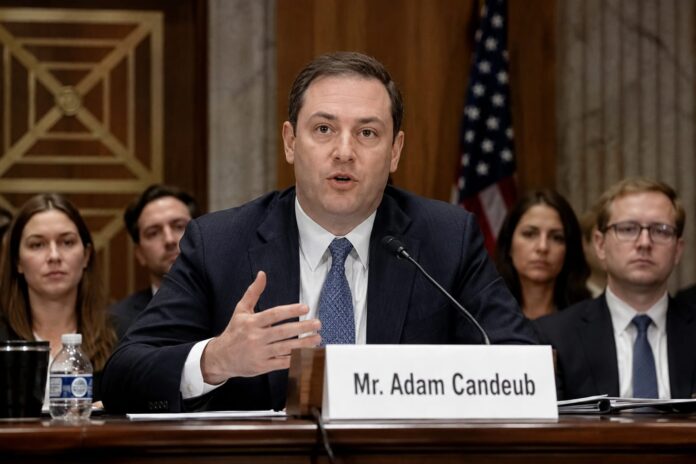
- Adam Candeub, a telecommunications law scholar and former FCC general counsel, testified before the Senate for confirmation as head of the Justice Department’s Antitrust Division
- If confirmed, Candeub would oversee landmark antitrust cases against Google’s search dominance and Apple’s App Store control, potentially reshaping enforcement strategy
- The nominee has emerged as a prominent conservative critic of Big Tech, arguing that dominant platforms have accumulated excessive power over competition and public discourse
- Candeub previously worked on efforts to narrow Section 230 protections for online platforms and contributed to Project 2025’s antitrust policy framework
What Happened
Adam Candeub appeared before the Senate on Wednesday for a confirmation hearing that could fundamentally reshape how aggressively the federal government pursues antitrust enforcement against the nation’s largest technology companies. The longtime telecommunications law expert and former Federal Communications Commission general counsel is being considered for appointment as head of the Justice Department’s Antitrust Division, a position that would place him in direct control over some of the most significant antitrust litigation in recent decades.
The position carries enormous influence over the trajectory of the government’s ongoing legal battles against technology giants. Control of these cases would determine whether the administration continues aggressive enforcement efforts or shifts its approach toward the industry’s dominant players. Candeub’s background as a vocal critic of Big Tech’s market power suggests a continuation of robust antitrust action against companies that have come under increasing regulatory scrutiny.
- Candeub testified before the Senate on Wednesday regarding his nomination
- The role oversees Justice Department cases against Google and Apple involving search dominance and App Store control
- As FCC general counsel, he gained extensive experience in technology regulation and competition issues
- His confirmation would directly impact ongoing major antitrust litigation
Why It Matters
The confirmation of this antitrust chief represents a pivotal moment for technology regulation in America. Big Tech companies have faced mounting criticism from across the political spectrum regarding their market power, content moderation practices, and influence over information flow. The appointment of someone with Candeub’s stated philosophy could accelerate enforcement actions and potentially reshape the legal landscape for the entire industry. His record suggests a willingness to challenge the assumption that has long governed technology regulation: that market dominance without obvious consumer harm requires limited intervention.
Candeub has demonstrated particular concern about how dominant online platforms wield power over speech and political participation. His previous work on narrowing Section 230 protections indicates a perspective that existing legal frameworks inadequately address the broader societal impact of technology companies. For conservatives who have long expressed frustration with perceived bias and outsized influence from Big Tech, this appointment signals a more aggressive posture toward holding these companies accountable. The implications extend beyond traditional antitrust concerns to encompass fundamental questions about the role of technology platforms in democratic discourse and fair competition.
- Google’s search dominance and Apple’s App Store control represent cases worth billions in potential remedies
- Antitrust outcomes could affect how technology platforms operate globally, influencing innovation and market structure
- Conservative voters and politicians view Big Tech regulation as essential to addressing perceived political bias
- Smaller technology companies and developers could benefit from enforcement that opens competitive markets
Political and Public Context
Big Tech regulation has become increasingly bipartisan in scope, though often for different reasons. While progressive lawmakers express concerns about monopolistic practices and consumer protection, conservatives have focused heavily on perceived censorship and political bias by dominant platforms. The Fox News polling data indicating that voters see Big Tech as a greater threat than traditional government surveillance reflects the salience of this issue across the political spectrum. This convergence of concern from different ideological directions has created unusual political opportunity for meaningful enforcement action.
Candeub’s contribution to Project 2025, the comprehensive conservative policy framework developed by the Heritage Foundation for potential administration use, demonstrates alignment with broader administration priorities regarding technology regulation. His previous work during the first Trump administration on narrowing Section 230 protections shows continuity between administrations regarding the need for greater accountability for online platforms. The emphasis on how technology platforms influence competition and information flow reflects concerns that have become central to conservative political messaging and policy priorities. His expertise in telecommunications law provides a technical foundation for sophisticated antitrust arguments that go beyond simple market share analysis.
- Bipartisan concern about Big Tech market power provides political cover for aggressive enforcement
- Previous administration efforts to narrow Section 230 protections established precedent for regulatory expansion
- Conservative policy frameworks prioritize both competition concerns and free speech implications
- Polling demonstrates public support for more aggressive Big Tech regulation
Trump’s antitrust pick, Adam Candeub, could reshape Big Tech cases against Google and Apple if confirmed. A nod would put a seasoned telecom scholar at the helm of high-stakes DOJ antitrust actions and 230 reform debates. https://t.co/8GSLy9hgMx pic.twitter.com/xQw5IqEWz8
— Drew Grimaldi (@Grimillionaire) August 5, 2026
What Happens Next
The Senate confirmation process will likely involve detailed questioning about Candeub’s enforcement priorities and his views on the scope of antitrust law as applied to technology platforms. Confirmation appears probable given Republican control of the Senate and the bipartisan concern about Big Tech. Once confirmed, the new antitrust chief would have immediate authority to shape litigation strategy, determine resource allocation across cases, and potentially pursue additional enforcement actions against technology companies that earlier administrations may have deprioritized.
The landmark cases against Google and Apple will move forward under new leadership with a clearly articulated philosophy about the dangers of unchecked platform power. These cases could take years to resolve through the courts, but the aggressive prosecution strategy indicated by Candeub’s background suggests the administration intends to press hard for meaningful structural remedies or behavioral restrictions. Additional enforcement actions targeting other technology companies may follow, particularly those involving concerns about speech moderation and competitive fairness. The broader technology industry will be watching carefully to understand how this administration interprets the scope and application of antitrust law in the digital economy.
- Senate confirmation vote will likely occur within weeks, with strong Republican support anticipated
- Google and Apple cases will proceed under leadership committed to aggressive enforcement
- Additional antitrust investigations into other Big Tech companies may be initiated or expanded
- Technology industry will adjust compliance and business practices in anticipation of stricter enforcement