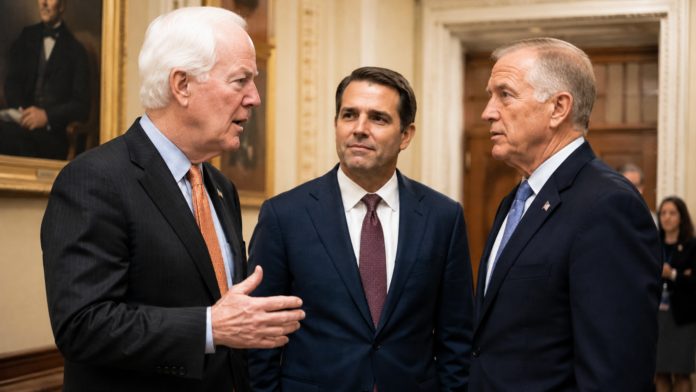
Senators John Cornyn and Thom Tillis announced Monday they will support Todd Blanche’s nomination for U.S. attorney general after the Justice Department agreed to formally terminate a controversial $1.8 billion “anti-weaponization” fund tied to President Trump’s settlement with the IRS. The deal ends a weeks-long standoff that had stalled Blanche’s confirmation and clears the way for a Senate Judiciary Committee vote Tuesday. The episode highlights ongoing friction between the White House and Republican senators over a settlement critics have called an unprecedented act of presidential self-dealing.
Story Highlights
- Cornyn and Tillis said the DOJ issued a binding written order permanently ending the $1.8 billion fund
- Blanche’s confirmation had been stalled for weeks amid the standoff, with a Judiciary Committee vote now set for Tuesday
- The tax audit immunity granted to Trump and his family under the original settlement remains fully intact
What Happened
John Cornyn of Texas and Thom Tillis of North Carolina, the two Republican holdouts on the Senate Judiciary Committee, announced Monday that they had reached an agreement with the Department of Justice that satisfied their concerns about acting Attorney General Todd Blanche’s nomination. The senators said in a joint statement that they were pleased the Department of Justice had issued a formal order terminating the anti-weaponization fund, adding that the written settlement reached with Trump and his lawyers had not been modified.
The standoff traces back to a settlement the Trump administration struck with the IRS in May, following Trump’s withdrawal of a $10 billion lawsuit against the tax agency over a leak of his tax returns during his first term. That settlement included a $1.766 billion fund intended to compensate people described as victims of government “weaponization,” which lawmakers in both parties quickly condemned as a taxpayer-funded slush fund benefiting the president’s political allies.
Cornyn and Tillis had refused to advance Blanche’s nomination out of committee without written assurances that the fund was permanently dead and that the audit immunity granted to Trump was narrowly limited. In their joint statement, the senators said the Department had acknowledged in a binding written order that the audit settlement is limited to the plaintiffs and does not extend beyond the defendants in the lawsuit, the IRS and the Treasury. Blanche posted a memo late Sunday night rescinding the fund, though it left the government “barred and forever precluded” from any investigation or prosecution into Trump, his adult children, and their businesses.
The deal followed days of public pressure from Trump, who had threatened to push for legislation compensating his allies if the two senators did not fall in line, and reportedly floated withdrawing Blanche’s nomination and resubmitting it after Cornyn and Tillis leave office at the start of 2027. Senate Judiciary Committee Chairman Chuck Grassley scheduled a vote on Blanche’s nomination for Tuesday morning.
Why It Matters
The resolution of the Cornyn-Tillis standoff removes a significant obstacle to installing a permanent attorney general at a Justice Department that has operated under an acting chief since April. But the underlying dispute, over whether a sitting president can effectively grant himself and his family immunity from IRS scrutiny, remains largely unresolved. Critics argue that the core benefit to Trump, freedom from audits on previously filed returns, survives entirely intact even as the more politically toxic compensation fund has been scrapped.
For Senate Republicans, the episode illustrates the limits of internal dissent within the party. Cornyn and Tillis, both retiring and therefore insulated from primary threats, were among the few GOP senators willing to publicly challenge the president on this issue. Their eventual agreement to a deal that leaves the audit immunity untouched suggests that even determined intra-party resistance can be narrowed down to more symbolic concessions.
For the Justice Department, Blanche’s expected confirmation removes lingering uncertainty about permanent leadership at a moment when the department faces scrutiny over its handling of politically sensitive cases involving the president himself. Blanche, Trump’s former personal defense attorney, will take over the post with his independence already a subject of considerable debate on Capitol Hill.
Economic and Global Context
While this story is primarily a domestic governance and legal matter, it carries meaningful fiscal implications. The now-terminated fund would have directed nearly $1.8 billion in taxpayer money toward individuals claiming to be victims of government “weaponization,” a category lawmakers worried could include participants in the January 6, 2021, Capitol riot. Scrapping the fund removes that specific budgetary exposure from federal spending, though the broader audit immunity component of the settlement means the government forgoes any potential tax revenue that might otherwise be recovered from Trump, his family, or the Trump Organization on previously filed returns.
The episode also feeds into a broader national conversation about IRS independence and the rule of law as applied to the presidency. Two former IRS commissioners have described the original arrangement as unprecedented, noting that ordinary taxpayers do not have the ability to negotiate blanket immunity from audits through settlement agreements with an agency that reports, ultimately, to the president himself.
Internationally, the dispute has limited direct bearing, though it adds to a growing list of governance controversies that shape global perceptions of U.S. institutional checks and balances at a time when allies and rivals alike are closely watching the durability of American legal norms under the current administration.
Implications
With Cornyn and Tillis now on board, Blanche’s nomination appears likely to clear the Judiciary Committee Tuesday and could reach a full Senate floor vote before lawmakers depart for the August recess. Senate Majority Leader John Thune has expressed confidence that Republicans can confirm Blanche this week or shortly after, given unified GOP support and unanimous Democratic opposition.
For Democrats, the outcome offers a new line of political attack heading into the midterms, framing the episode as evidence that Republican oversight of the president remains largely symbolic. Expect continued efforts, such as the failed Senate Finance Committee amendment led by Ranking Member Ron Wyden, to legislatively unwind the audit immunity even after Blanche’s confirmation.
For Trump, the resolution allows the administration to move past a distracting confirmation fight, though the surviving audit immunity provision ensures the underlying legal and political controversy will likely resurface in future oversight hearings, litigation, and campaign messaging.
Source
Cornyn reaches deal on ‘anti-weaponization fund’ to allow Blanche nomination to advance