Story Highlights
- JPMorgan Chase is restructuring its artificial intelligence leadership team amid broader shifts in corporate strategy and technology priorities.
- Teresa Heitsenrether, who has served as a central figure in the bank’s AI efforts, is expected to retire, triggering a significant realignment at the top.
- The changes reflect a broader transformation in how one of the world’s largest financial institutions is approaching cutting-edge technology.
- New key players are being identified to guide JPMorgan’s AI direction into the next phase of its development.
What Happened
JPMorgan Chase, the largest bank in the United States by assets, is undergoing a notable reset of its artificial intelligence leadership structure. Teresa Heitsenrether, who has held a prominent role overseeing the bank’s AI initiatives, is set to retire, prompting the institution to evaluate and reorganize who will lead its technology ambitions going forward. The transition marks one of the most significant shifts in the bank’s AI division since it began aggressively investing in the technology sector.
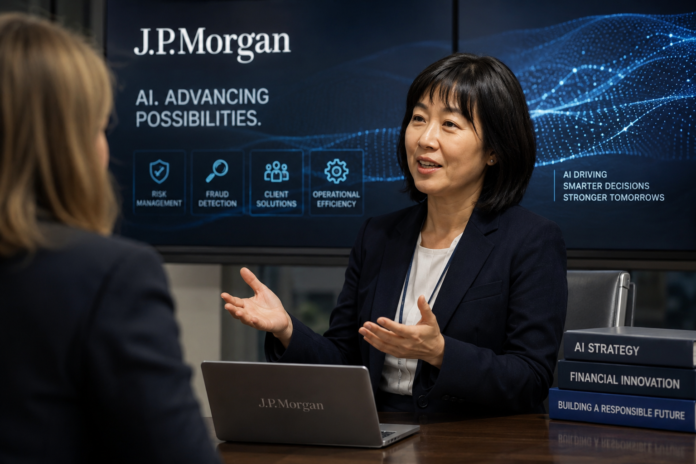
The bank has been at the forefront of integrating AI into its operations, from risk management and fraud detection to client services and internal productivity tools. As these programs have matured, the demands on leadership have evolved considerably, requiring a new generation of executives with both technical depth and strategic vision to carry the work forward. The departure of a key figure like Heitsenrether has opened the door to a broader conversation about who the next generation of AI leaders at JPMorgan will be.
- Teresa Heitsenrether, a key AI executive at JPMorgan, is preparing to retire from her leadership role.
- The bank is actively identifying and positioning new leaders to steer its artificial intelligence strategy.
- JPMorgan has been a major institutional investor in AI tools, dashboards, and engineering productivity metrics.
- The restructuring is occurring as the broader financial industry accelerates its adoption of AI technologies.
Why It Matters
JPMorgan’s AI leadership transition carries significant weight not just for the bank itself but for the broader financial services industry. As one of the most closely watched institutions on Wall Street, the moves JPMorgan makes in technology tend to set the tone for competitors and smaller regional banks alike. When a firm of this scale decides to reset its AI leadership, it signals that the era of early experimentation is giving way to a more operationally mature and strategically rigorous phase of AI deployment.
For employees, investors, and clients, this transition raises important questions about continuity and direction. A leadership change in a domain as fast-moving as artificial intelligence can either accelerate progress or introduce a period of uncertainty. The manner in which JPMorgan handles this transition will be scrutinized carefully by peers across the industry.
- Major financial institutions across the country are likely to monitor how JPMorgan navigates this transition as a benchmark for their own strategies.
- JPMorgan’s engineering workforce could experience shifts in how AI performance is tracked and incentivized under new leadership.
- Investors in JPMorgan will be watching for signals that the bank’s AI momentum is sustained, not disrupted.
- Clients who rely on AI-enhanced services from JPMorgan may eventually see changes in how those services are developed and delivered.
Political and Public Context
The broader context surrounding JPMorgan’s AI leadership changes reflects a cultural and institutional transformation happening across corporate America. Wall Street firms have increasingly embraced a work-intensive culture, and the integration of AI tools is both accelerating productivity expectations and reshaping job roles at every level of the organization. JPMorgan’s own internal dashboards, which track and rank engineers based on their AI usage, are emblematic of how deeply these tools have been embedded into the firm’s operational philosophy.
At the same time, the financial industry is navigating increased public scrutiny over how AI is deployed, who benefits from it, and whether it displaces workers or empowers them. These are not abstract policy debates for a bank the size of JPMorgan; they are day-to-day management realities that the incoming AI leadership team will need to address head-on. The cultural message sent by JPMorgan’s new headquarters, widely interpreted as reinforcing a demanding, work-centered environment, adds another layer of context to these personnel decisions.
- JPMorgan has built internal dashboards to measure and rank how actively its engineers use AI tools, signaling a data-driven management culture.
- The bank’s recently opened headquarters has been widely discussed as a symbol of its demanding, immersive work culture.
- Rival firm Citigroup is simultaneously undergoing its own technology leadership changes, reflecting an industry-wide moment of transition.
- Younger banking professionals are reportedly adapting to higher expectations around AI fluency and productivity metrics.
What Happens Next
With a leadership transition of this magnitude underway, all eyes will be on JPMorgan to see how quickly it can install new AI leadership and articulate a clear strategic vision for the years ahead. The bank has significant infrastructure already in place, including its AI dashboards, its internal productivity tools, and its ongoing investment in machine learning capabilities, but sustained momentum will require steady, experienced hands at the helm.
Industry analysts and observers will be paying close attention to any formal announcements regarding who steps into the key roles being vacated. The decisions made in the coming weeks and months will shape the bank’s competitive positioning in a field where the pace of change is relentless and the stakes are extraordinarily high.
- Formal announcements identifying the new AI leadership team at JPMorgan are expected in the coming months.
- The bank will need to clearly communicate its AI strategy to retain top engineering and technology talent.
- Competitors will closely track JPMorgan’s next moves to assess whether gaps or opportunities emerge during the transition period.
- The scope and direction of JPMorgan’s AI investments going into 2026 will serve as a key indicator of how successfully the transition has been managed.