Story Highlights
- The Justice Department subpoenaed four journalists as part of a federal investigation into unauthorized disclosures about the new Air Force One.
- Officials say the journalists are not criminal targets and that investigators are seeking the government employees who allegedly disclosed sensitive information.
- The disputed reports claimed that the Qatari-provided aircraft lacked some defensive capabilities installed on the older presidential jets.
- The news organization plans to challenge the subpoenas, creating a legal confrontation over national security and source protection.
What Happened
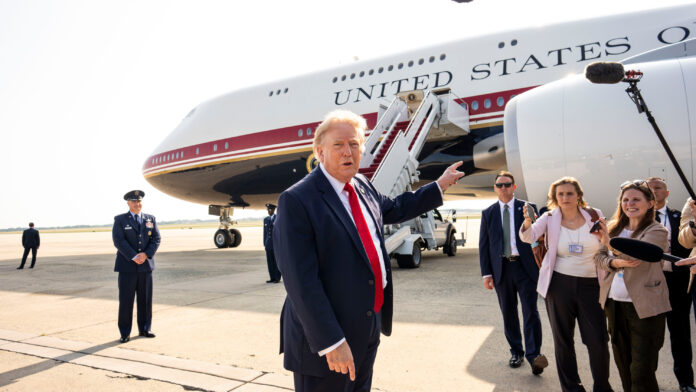
The Trump administration issued federal grand jury subpoenas to four journalists who reported alleged security deficiencies involving the president’s newly converted Air Force One.
Julian Barnes, Eric Lipton, Tyler Pager, and Eric Schmitt were directed to appear before a federal grand jury in Manhattan. Federal agents reportedly delivered some of the subpoenas directly to the journalists’ homes.
The orders followed reports based on anonymous sources claiming that the aircraft provided by Qatar did not yet possess all the defensive systems available on the older presidential planes.
- The reporting discussed sensitive presidential-security arrangements.
- It identified alleged differences between the new and older aircraft.
- The Federal Bureau of Investigation had reportedly asked that some details not be published.
- The news organization published the information despite the government’s warning.
Justice Department officials emphasized that the journalists themselves are not the targets of the criminal investigation.
The administration says investigators are attempting to identify officials who may have disclosed classified or otherwise protected national-security information without authorization.
That distinction is central to the government’s position. Trump officials argue that the investigation is about enforcing laws governing sensitive information—not criminalizing unfavorable reporting.
The White House has also rejected claims that the new aircraft is unsafe, describing it as a modern plane equipped with high-level security protocols.
Why It Matters
Presidential aircraft contain some of the most closely guarded defensive, communications, and continuity-of-government systems in the United States.
Information revealing what the aircraft can—or cannot—defend against could potentially assist foreign intelligence agencies, terrorist organizations, or hostile governments attempting to assess presidential vulnerabilities.
Trump’s supporters therefore argue that investigating the source of such disclosures is a legitimate national-security responsibility.
- The president faces documented threats from foreign adversaries.
- Aircraft-security information could expose operational weaknesses.
- Government employees generally cannot disclose classified information without authorization.
- Reporters are not automatically immune from grand jury requests for relevant evidence.
The administration’s case is strengthened by its assertion that prosecutors are pursuing the leakers rather than attempting to prosecute the journalists for publishing the reports.
Press organizations nevertheless argue that forcing reporters to testify could expose confidential sources and discourage government employees from reporting legitimate wrongdoing.
The dispute therefore presents two important constitutional interests: protecting a free press and protecting the president and the country from unauthorized disclosures of sensitive security information.
Political and Public Context
Trump has repeatedly criticized unauthorized disclosures from within the federal government, arguing that leaks can distort policy debates, damage negotiations, and place American personnel at risk.
His administration has adopted a more aggressive approach to identifying officials who provide protected information to journalists without authorization.
The Air Force One investigation comes at an especially sensitive time because Trump has faced reported threats from Iran and other hostile actors.
- The aircraft is designed to function as a secure airborne command center.
- Its defensive capabilities are closely connected to presidential survival and national continuity.
- Trump has said he receives serious threats on a continuing basis.
- The administration argues that publicizing alleged vulnerabilities can increase those risks.
Critics say subpoenas directed at reporters can intimidate journalists and weaken protections for confidential sources.
However, the First Amendment does not create an absolute privilege allowing journalists to disregard every grand jury subpoena. Courts frequently balance press interests against the government’s need to investigate serious crimes.
The government will likely argue that it first attempted to identify the source through other investigative methods and that testimony is now necessary to determine who disclosed the information.
The journalists’ lawyers are expected to challenge that claim and ask a court to block or narrow the subpoenas.
What Happens Next
The news organization has announced that it will contest the subpoenas in court.
Its attorneys may argue that prosecutors failed to exhaust alternative investigative avenues or that compelling testimony would violate Justice Department safeguards governing investigations involving the media.
The government will likely respond that the disclosure involved exceptionally sensitive presidential-security information and that investigators have a compelling need to identify its source.
- A judge could enforce, narrow, delay, or invalidate the subpoenas.
- The journalists could be questioned about their communications and sources.
- Prosecutors may continue examining government records and employee communications.
- The legal fight could influence future national-security leak investigations.
The investigation may also become part of congressional consideration of Jay Clayton, the U.S. attorney overseeing the Manhattan grand jury and Trump’s nominee for director of national intelligence.
Lawmakers are expected to question whether the subpoenas were properly authorized and whether the Justice Department followed its internal rules concerning reporters.
For Trump, the central issue remains accountability inside the federal government. His administration argues that officials entrusted with national secrets cannot independently decide to disclose sensitive presidential-security information without facing investigation.
The courts must now determine whether the government’s national-security justification is strong enough to compel testimony from the reporters.