Story Highlights
- President Donald Trump canceled a planned signing of a bipartisan housing bill, demanding action on the SAVE America Act first.
- The housing bill passed Congress with overwhelming bipartisan support and was designed to address affordability and supply.
- The move puts Republican leaders in a difficult position between Trump’s election-security push and voters’ cost-of-living concerns.
What Happened
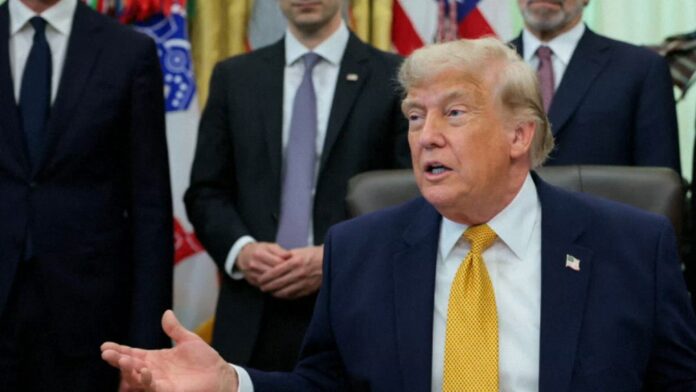
President Donald Trump abruptly canceled a planned signing ceremony for a bipartisan housing bill, saying he would not move forward until Congress passes the SAVE America Act.
The event had been scheduled for Capitol Hill, where lawmakers from both parties were prepared to celebrate one of the rare bipartisan legislative wins of the year.
Instead, Trump announced on Truth Social that the signing would be delayed until lawmakers advanced his election-security priority.
- The housing bill had passed both chambers by large bipartisan margins.
- Trump called the SAVE America Act a national emergency.
- Republican leaders expressed frustration but largely deferred to the president.
The housing legislation was intended to expand affordable housing supply, speed up certain reviews, support homebuilding and address the role of large investors in single-family housing.
Reuters reported the bill passed 85-5 in the Senate and 358-32 in the House.
Despite that support, Trump refused to commit to signing it unless the Senate moves on the SAVE America Act.
That bill would require photo ID for federal voting, proof of U.S. citizenship for voter registration and broader federal access to state voter registration data.
The SAVE America Act passed the House earlier this year but has stalled in the Senate.
Why It Matters
The delay matters because housing affordability is one of the clearest economic pain points for voters heading into the midterms.
High rents, elevated home prices and mortgage-rate pressure have kept many Americans locked out of homeownership.
The bipartisan housing bill gave Republicans and Democrats a chance to show they could act on a kitchen-table issue.
- Trump is prioritizing election security over a bipartisan affordability bill.
- Republicans hoped to campaign on housing relief and cost-of-living action.
- Democrats are already framing the delay as Trump holding housing relief hostage.
For Trump, the strategy is about leverage.
He believes the SAVE America Act is essential and wants Senate Republicans to force action before moving on other priorities.
For his supporters, that makes sense: election integrity is a foundational issue, and Trump is using the power of the presidency to push Congress.
But the political risk is clear.
Voters struggling with rent or mortgage costs may not welcome a delay in housing legislation, especially if they view the two issues as unrelated.
That is why the fight creates a difficult midterm message for Republicans.
Political and Public Context
Trump has spent months pressuring Congress to pass the SAVE America Act.
The bill is popular with many conservatives who want stricter national rules around voter identification and citizenship verification.
But it faces major Senate obstacles, including Democratic opposition and concerns from some Republicans about federalizing election rules that states currently administer.
- The SAVE America Act passed the House but remains stalled in the Senate.
- Sen. Thom Tillis has warned the bill still lacks the 60 votes needed to pass.
- House conservatives are pressing Senate Republicans to move faster.
Reuters reported Trump pressured Senate Republicans on the voter ID bill after canceling the housing signing, while some GOP senators questioned the political wisdom of blocking a bipartisan affordability measure.
Axios reported Speaker Mike Johnson said Trump still intended to sign the housing bill within the 10-day window, even after canceling the public ceremony.
That leaves the outcome uncertain.
Trump may still sign the bill, allow it to become law without his signature, veto it, or use the remaining time to extract a stronger commitment on SAVE.
What Happens Next
The next step is the constitutional signing window.
If Trump neither signs nor vetoes the housing bill within 10 days while Congress remains in session, it can become law without his signature.
That gives the White House time to pressure Senate Republicans while avoiding an immediate veto fight over a popular housing package.
- Watch whether Trump signs the housing bill before the deadline.
- Monitor whether Senate Republicans attach SAVE provisions to another bill.
- Follow whether Speaker Johnson tries to move election-security language through reconciliation.
- Track whether Democrats use the delay in housing-focused midterm messaging.
For Trump, the best outcome is forcing movement on SAVE while eventually allowing the housing bill to become law.
That would let him claim action on both election security and affordability.
For Republicans in Congress, the risk is that the fight turns into another example of legislative disruption at a time when voters want economic relief.
For Democrats, the message is simple: Trump delayed a housing bill over an unrelated elections fight.
For the White House, the bet is that election integrity matters enough to justify the pressure campaign.
The coming days will show whether that bet produces a Senate breakthrough or simply turns a bipartisan housing win into another intraparty fight.
Sources
- Reuters: Trump Cancels Signing of Bipartisan U.S. Housing Bill
- Reuters: Trump Pressures Senate Republicans to Pass Voter ID Bill
- Axios: Trump Cancels Housing Bill Signing Until SAVE Act Is Passed
- Scripps News: Trump Calls Bipartisan Housing Bill a Yawn
- Roll Call: Chambers Clash Over Voter ID Bill Inaction