Story Highlights
- President Trump used his Fourth of July address to promote the stalled SAVE America Act.
- The National Mall event was delayed by severe storms after a day of extreme heat in Washington.
- Trump also touted U.S. military gains against Iran while defending his broader foreign policy approach.
What Happened
President Donald Trump marked America’s 250th Independence Day celebration with a late-night address on the National Mall, blending patriotic tribute with a renewed push for his election-security agenda and a defense of his Iran policy.
The “Salute to America 250 Celebration” was delayed for nearly two hours after severe thunderstorms forced crowds to evacuate parts of the National Mall. Earlier in the day, Washington faced record-breaking heat, adding to the difficult conditions for spectators who waited through the delay.
Trump chose to proceed with the speech rather than postpone the event, telling aides that the Fourth of July moment could not be recreated later. He appeared alongside First Lady Melania Trump, senior administration officials, congressional leaders, veterans, and Medal of Honor recipients.
- The event marked the 250th anniversary of American independence.
- Storms pushed the speech late into the night.
- Trump used the platform to highlight voting rules, military strength, and national pride.
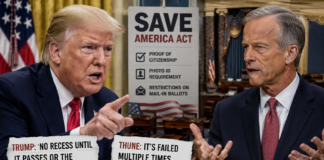
During the address, Trump honored the Founding Fathers, praised American service members, and displayed historic symbols tied to the nation’s past. He also turned directly to current political priorities, calling again for passage of the SAVE America Act.
Trump said voters should be required to show voter ID and provide proof of citizenship, arguing that the measure is needed to protect election integrity ahead of the 2026 midterms. The bill remains stalled in the Senate, where Republicans do not appear to have the 60 votes needed to overcome a Democratic filibuster.
The president also highlighted the conflict with Iran, claiming major U.S. military success and presenting the administration’s actions as a demonstration of American strength.
Why It Matters
The speech matters because Trump used one of the country’s most symbolic civic events to press two major themes of his second term: election security at home and military strength abroad.
For Trump and his supporters, the SAVE America Act is a central part of restoring confidence in U.S. elections. The bill would require documentary proof of citizenship for federal voter registration and strengthen identification requirements for voting.
Democrats and voting rights groups oppose the measure, arguing that it could make registration harder for eligible voters who do not have immediate access to passports, birth certificates, or updated identification documents.
- Supporters say the bill would reduce doubt about voter eligibility.
- Opponents say it could create barriers for lawful voters.
- The Senate filibuster remains the biggest obstacle to passage.
Trump’s comments on Iran also carry political weight. By describing the military campaign as a success, he is framing his foreign policy as firm, decisive, and backed by results — even as indirect talks with Tehran continue and the region remains tense.
The address also showed how Trump is likely to campaign ahead of the midterms: combining patriotic messaging, election-integrity demands, and claims of strength on the world stage.
Political and Public Context
Trump’s Fourth of July message reflected his broader governing style: using major public moments to connect national identity with his policy priorities.
The SAVE America Act has become a key issue for the president, especially as he pressures Senate Republicans to find a way around Democratic opposition. House conservatives have backed the effort, while Senate leaders have been more cautious about changing rules or forcing a vote that may fail.
The speech also comes as Trump continues to argue that his Iran strategy produced both military and diplomatic leverage. That message is important for the administration as it tries to maintain public support while negotiations remain unresolved.
For critics, the event raised concerns about turning a national anniversary into a partisan platform. For supporters, Trump’s remarks reinforced the idea that patriotism, secure elections, and military strength are connected parts of the same agenda.
What Happens Next
The SAVE America Act is expected to remain a major pressure point in Congress as the 2026 midterms approach. Trump is likely to keep pushing Senate Republicans to act, either through a standalone vote or by attaching the bill to another legislative package.
The Iran issue will also remain central to the administration’s foreign policy message. If talks continue and regional tensions ease, Trump could use the outcome to argue that his pressure campaign worked. If violence resumes, the administration may face renewed scrutiny over the conflict’s cost and direction.
- Trump is expected to keep pressing for voter ID and proof-of-citizenship rules.
- Senate Republicans must decide whether to force a vote or seek a narrower compromise.
- The administration will continue promoting its Iran policy as a show of American strength.
The Fourth of July speech gave Trump a national stage to frame both fights on his terms. Whether Congress and voters respond the same way will become clearer as the midterm campaign intensifies.