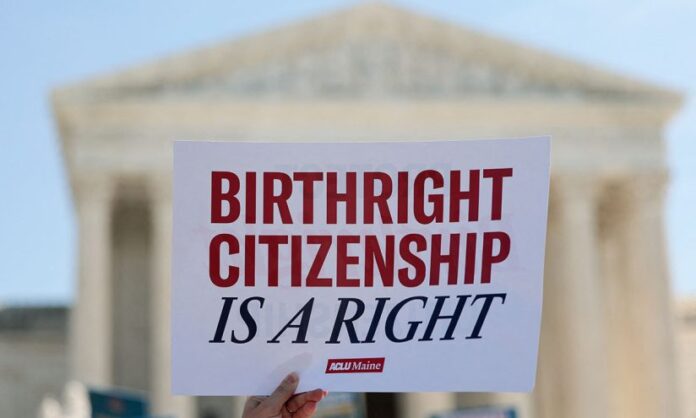
Story Highlights
- The Supreme Court rejected President Donald Trump’s executive order seeking to restrict birthright citizenship.
- The ruling preserves automatic citizenship for nearly all children born on U.S. soil, regardless of parental immigration status.
- The decision gives Trump a major immigration defeat but also creates a new campaign fight over the 14th Amendment.
What Happened
The Supreme Court ruled against President Donald Trump’s attempt to restrict birthright citizenship, blocking one of the most aggressive immigration moves of his second term.
The case centered on Trump’s executive order directing federal agencies to deny citizenship documents to some children born in the United States if their parents were undocumented or in the country on temporary visas.
The Court rejected that approach, reaffirming that the 14th Amendment protects citizenship for nearly all people born on U.S. soil.
- The ruling blocks Trump’s day-one executive order from taking effect.
- The Court reaffirmed the long-standing interpretation of the 14th Amendment’s Citizenship Clause.
- The decision preserves the precedent of United States v. Wong Kim Ark, the 1898 case that confirmed birthright citizenship for children of immigrants.
Reuters reported the decision was a major defeat for Trump’s immigration agenda and affects the legal status of hundreds of thousands of babies born each year.
Chief Justice John Roberts wrote the majority opinion, joined by the Court’s liberal justices and some conservatives.
The ruling means Trump cannot use an executive order alone to rewrite the constitutional rule on citizenship.
Why It Matters
The decision matters because birthright citizenship is one of the most important guarantees in American constitutional law.
The 14th Amendment says that all persons born or naturalized in the United States, and subject to its jurisdiction, are citizens of the United States.
Trump argued that children born to undocumented immigrants or temporary visa holders should not automatically qualify.
The Court disagreed.
- The ruling limits presidential power over citizenship.
- It protects a constitutional interpretation that has stood for more than 125 years.
- It prevents federal agencies from creating a new citizenship-screening system at birth.
For Trump, the ruling is a legal loss but not necessarily the end of the political fight.
He can still argue that birthright citizenship has been abused and that Congress or the states should pursue a constitutional amendment.
For immigration advocates, the ruling is a major relief because it prevents the creation of a large class of American-born children without citizenship.
For the Court, the decision shows that even a conservative majority was not willing to let a president change the Citizenship Clause through executive action.
Political and Public Context
Trump made birthright citizenship a major part of his immigration agenda, arguing that the current system encourages illegal immigration and birth tourism.
His supporters view the Court’s decision as another example of judges limiting a president who is trying to enforce immigration laws more aggressively.
But critics say the ruling was straightforward because the Constitution, not the president, defines citizenship.
- Republicans may use the ruling to call for constitutional or legislative changes.
- Democrats will frame it as a defense of the 14th Amendment and basic constitutional limits.
- The issue is likely to remain central to the midterm immigration debate.
The Guardian reported the ruling struck down Trump’s order and reaffirmed that the Citizenship Clause protects people born in the United States regardless of their parents’ immigration status.
The Council on Foreign Relations noted that nearly 30 countries, including Canada and Mexico, also practice birthright citizenship, making the issue part of a broader debate over citizenship rules in the Western Hemisphere.
That gives both parties a clear message.
Trump can argue the ruling shows why voters need lawmakers willing to change immigration law.
Democrats can argue the ruling proves Trump overreached and tried to bypass the Constitution.
What Happens Next
The immediate result is that Trump’s executive order remains blocked.
Federal agencies must continue recognizing citizenship for children born in the United States under the existing constitutional framework.
The administration may still look for narrower immigration tools, but it cannot deny citizenship at birth through this order.
- Watch whether Trump calls for a constitutional amendment on birthright citizenship.
- Monitor whether Republicans introduce new citizenship legislation in Congress.
- Follow how immigration groups respond to families affected by uncertainty during the litigation.
- Track whether the ruling becomes a major midterm campaign issue.
For Trump, the political path is likely to shift from court action to campaign messaging.
He can tell supporters that the Supreme Court blocked him and that broader immigration reform requires new legislative power.
For Democrats and immigrant-rights groups, the ruling is a major constitutional victory.
For the Supreme Court, the case becomes one of the defining decisions of the term because it preserved a central meaning of the 14th Amendment against an aggressive executive-branch challenge.
The fight over birthright citizenship is not over politically, but legally, Trump’s executive order has been stopped.
Sources
- Reuters: Supreme Court Rejects Trump Bid to Restrict Birthright Citizenship
- Reuters: Supreme Court Spurns Trump on Birthright Citizenship
- The Guardian: What to Know About the Supreme Court Birthright Citizenship Ruling
- Council on Foreign Relations: What Is Birthright Citizenship?
- CNN: Supreme Court Turns Toward Explosive Final Month With Trump Priorities at Stake