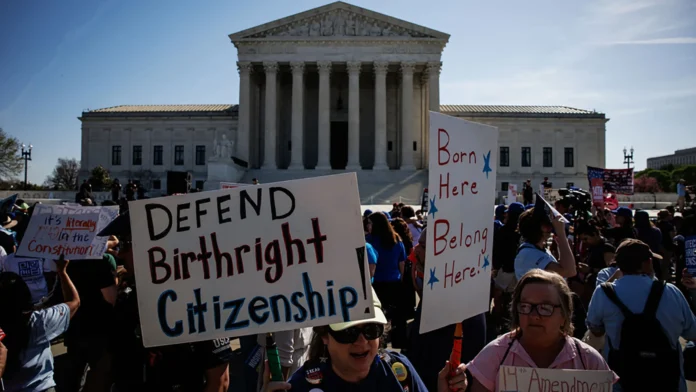
Story Highlights
- The Supreme Court struck down President Trump’s executive order seeking to end birthright citizenship.
- The 6-3 ruling affirmed that the 14th Amendment protects citizenship for nearly all children born on U.S. soil.
- Trump and his allies are now expected to shift the fight toward Congress and a possible constitutional amendment.
What Happened
The Supreme Court ruled that President Donald Trump’s executive order attempting to end birthright citizenship violates the Constitution, delivering a major decision on one of the administration’s most closely watched immigration policies.
Trump signed the order on January 20, 2025, his first day back in office. The order sought to deny automatic citizenship to children born in the United States if their parents were undocumented immigrants or in the country on temporary visas.
Federal courts blocked the order before it could take effect, and the case eventually reached the Supreme Court for a final ruling on the constitutional question.
- The order challenged more than a century of birthright citizenship precedent.
- Lower courts had already blocked the policy from taking effect.
- The Supreme Court ruled 6-3 against the administration.
Chief Justice John Roberts wrote for the majority, tracing birthright citizenship through English common law, the 14th Amendment, and the Supreme Court’s 1898 decision in United States v. Wong Kim Ark.
The Court held that the 14th Amendment’s Citizenship Clause guarantees citizenship to nearly all people born in the United States, with narrow exceptions such as children of foreign diplomats and occupying armies.
Justice Brett Kavanaugh wrote separately, concluding that Trump’s order violated federal immigration law rather than directly relying on the constitutional question. Justices Clarence Thomas, Samuel Alito, and Neil Gorsuch dissented.
Why It Matters
The ruling matters because it preserves the current understanding of birthright citizenship while also setting the stage for a larger political fight over immigration and constitutional change.
For Trump supporters, the decision is a setback in court but not necessarily the end of the issue. The president has argued for years that birthright citizenship has been stretched too far and that Congress or the states should revisit whether children of undocumented immigrants should automatically receive citizenship.
The ruling makes clear, however, that a president cannot make that change through executive order alone. If Trump’s allies want a lasting change, the path now likely runs through a constitutional amendment.
- The Court said birthright citizenship cannot be ended by executive order.
- Trump’s allies are expected to push for legislative or constitutional action.
- The issue will likely remain central to the immigration debate before the midterms.
Supporters of Trump’s position argue that the current system encourages illegal immigration and birth tourism. They say the ruling should intensify pressure on Congress to address what they see as a loophole in U.S. immigration policy.
Civil rights groups and immigrant advocates welcomed the ruling, saying it protects a core constitutional guarantee and prevents millions of children from being left in legal uncertainty.
Political and Public Context
Trump’s birthright citizenship order was one of the clearest examples of his second-term effort to test the limits of executive power on immigration.
The president has repeatedly argued that the United States needs stronger tools to control illegal immigration, reduce incentives for unlawful entry, and protect American citizenship. The Supreme Court ruling blocks one method, but it also gives Trump a new political message: the courts have spoken, so voters and lawmakers must decide whether the Constitution should be changed.
That argument is already gaining traction among some Republicans. Sen. Rand Paul acknowledged that lasting change would require the amendment process, while Sen. Eric Schmitt introduced a constitutional amendment that would limit birthright citizenship to children of U.S. citizens and permanent residents.
For Trump’s base, the ruling may strengthen the belief that major immigration reforms require not only executive action, but also a broader congressional and state-level campaign.
For critics, the decision is a major legal defeat for the administration and a reminder that constitutional rights cannot be rewritten by presidential order.
What Happens Next
The immediate effect is that birthright citizenship remains unchanged. Children born on U.S. soil continue to receive citizenship regardless of their parents’ immigration status, except for the narrow exceptions already recognized under law.
The political fight, however, is likely to continue. Trump may urge Congress to pass legislation, while some Republican lawmakers may focus on a constitutional amendment.
- Children born in the United States remain citizens at birth under current law.
- Republican lawmakers may push a constitutional amendment to narrow birthright citizenship.
- Immigration will remain a major campaign issue heading into the midterms.
A constitutional amendment would be extremely difficult, requiring two-thirds approval in both chambers of Congress and ratification by 38 states. Still, the ruling gives Trump and his allies a clear issue to rally around.
For the administration, the decision is a legal loss but also a political opening. The president can now argue that if Americans want birthright citizenship changed, they must elect lawmakers willing to take the fight beyond the courts.