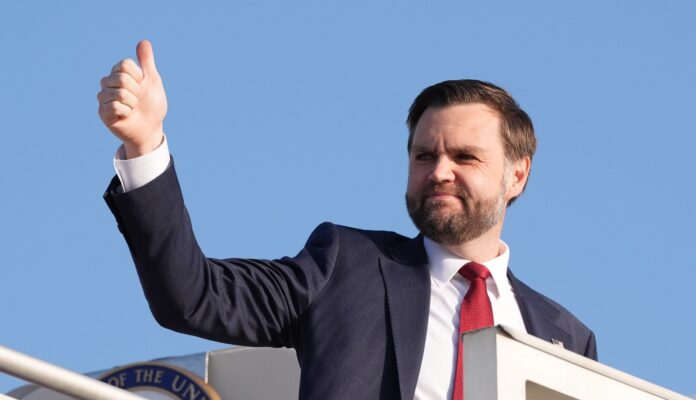
President Donald Trump had yet to announce a decision on a potential peace agreement with Iran as of Sunday morning, one day after pledging a “final determination” following a White House Situation Room briefing. Vice President JD Vance told reporters the two sides were “very close” to a memorandum of understanding on reopening the Strait of Hormuz, while Iranian officials publicly contradicted U.S. accounts of progress. The standoff is one of the most consequential foreign policy decisions of Trump’s second term, with energy markets, midterm politics, and American strategic credibility all riding on the outcome.
Story Highlights
- Trump pledged a “final determination” on a possible Iran deal following a Friday Situation Room meeting, but no announcement had materialized by Sunday morning
- VP Vance described the U.S. and Iran as “very close” to an initial deal that would extend the ceasefire for two months and reopen the Strait of Hormuz
- Iran’s chief negotiator publicly declared that concessions were secured “through missiles, not talks,” signaling deep distrust of any negotiated framework
What Happened
President Donald Trump announced Friday he would be making a “final determination” on a possible peace deal following a meeting in the White House Situation Room. As of Sunday morning, no decision had materialized. Trump posted on Truth Social that any acceptable deal must include the Strait of Hormuz being fully reopened and require Iran to cooperate with U.S. demands on Washington’s terms.
Vice President JD Vance told reporters the U.S. and Iran were “not there yet” on an initial deal expected to reopen the Strait of Hormuz, extend the ceasefire, and deepen negotiations on contentious issues including Iran’s nuclear program, but he said the two sides were “very close.” U.S. sources confirmed a tentative framework existed but that it remained pending Trump’s approval.
Iranian state media, citing a source close to the country’s negotiating team, said no agreement had been “finalized nor confirmed,” and dismissed any suggestion otherwise from Western sources as “incorrect.” Iran’s chief negotiator Mohammed Bagher Ghalibaf posted on X that his country had obtained concessions “not through talks, but through missiles,” declaring that Tehran holds “absolutely no trust in guarantees or words — only actions matter.”
Ebrahim Rezaei, spokesperson for Iran’s National Security and Foreign Policy Commission, claimed that “Iranian management” of the Strait of Hormuz had already been internationally established, with countries paying fees to Iran’s Islamic Revolutionary Guard Corps for the right to transit the waterway. Trump rejected that framing outright and issued a pointed warning to U.S. ally Oman, suggesting consequences if it cooperated with Iran’s maritime authority structure.
Defense Secretary Pete Hegseth publicly discussed the state of negotiations and confirmed that military options remained fully available if diplomacy failed to produce a satisfactory outcome, reinforcing that the United States was prepared to resume active operations.
Why It Matters
The Strait of Hormuz channels roughly 20 percent of the world’s oil supply through a narrow corridor between Iran and Oman. Any sustained disruption carries immediate consequences for global energy prices, maritime insurance, and the economic stability of import-dependent nations across Asia and Europe. Iran’s attempt to assert formal operational control over the waterway represents a direct challenge to the rules-based international order governing freedom of navigation.
For Trump, a deal concluded on U.S. terms would be a defining foreign policy achievement of his second term. His administration launched joint military strikes with Israel against Iran in February 2026, a decision that divided his political coalition and triggered a high-profile public rupture with former ally Tucker Carlson, who condemned the campaign as a betrayal of the America First movement. Ending the conflict on favorable terms would allow Trump to reframe the war as a calculated and successful exercise of American power.
The November 2026 midterm elections inject urgent political pressure. Republicans are defending narrow majorities in both chambers of Congress, and public appetite for prolonged military engagement in Iran has visibly eroded. A deal seen as favorable to American interests strengthens Republican candidates heading into the fall; a prolonged conflict or inconclusive outcome delivers Democrats a powerful campaign issue.
The situation also raises a structural constitutional question: whether a president can sustain what amounts to a war-scale foreign policy commitment without formal congressional authorization, and how long domestic political tolerance holds under those conditions.
Economic and Global Context
Oil prices fell and U.S. stock markets climbed after opening Friday, adding to records a day earlier on optimism over a tentative deal to extend the Iran ceasefire. The Dow Jones Industrial Average was up 0.5 percent to 50,902 points in early trading, while the S&P 500 rose 0.4 percent to 7,594.10, and the Nasdaq Composite rose 0.5 percent to 27,062.47.
Washington announced sanctions against Iran’s newly established Persian Gulf Strait Authority, the mechanism Tehran created to manage vessel transit and charge fees through the Hormuz passage. The sanctions signal a firm U.S. refusal to accept any arrangement that transfers operational control of the waterway to Iran, regardless of how the arrangement is framed diplomatically.
The conflict has imposed measurable costs on global commerce since February 2026. Disruption to Hormuz transit has elevated maritime insurance premiums and prompted some commercial carriers to reroute vessels around the Cape of Good Hope, adding days of transit time and significantly increasing freight costs. Those elevated costs have filtered through to consumer prices in transportation, manufacturing, and retail sectors.
Implications
If Trump accepts the proposed memorandum of understanding, the immediate effects would include a two-month ceasefire extension and a framework for reopening the Strait to international shipping. Energy markets would respond positively, freight costs would begin to normalize, and both sides would enter a structured diplomatic process for the significantly more difficult negotiations on Iran’s nuclear capacity.
If Trump rejects the current terms or Iran refuses to finalize, the probability of resumed military operations increases substantially. Ghalibaf’s statement that the winner is “the side that is better prepared for war the day after” reflects how lightly Tehran holds the current ceasefire and how quickly conditions could deteriorate.
For American businesses and consumers, the outcome will register almost immediately in energy and commodity prices. For voters, Trump’s handling of Iran functions as a real-time test of foreign policy credibility at a pivotal moment before the midterms.
Trump’s “final determination” pledge has created a defined expectation window. Both domestic stakeholders and international allies are watching closely to see whether Washington’s stated objectives can be converted into a durable and enforceable outcome in the days ahead.
Source
Vance says U.S. and Iran close but ‘not there yet’ on initial deal to reopen Strait of Hormuz