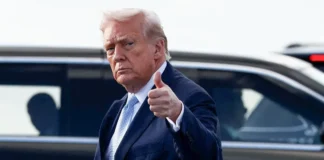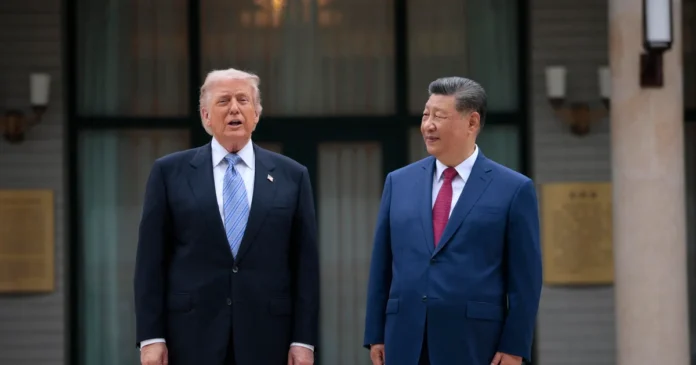
President Donald Trump has returned to Washington after a two-day summit in Beijing with Chinese President Xi Jinping, a high-stakes meeting that produced warm rhetoric and at least one notable commercial agreement but failed to deliver concrete resolutions on Taiwan, the Iran war, or the blockade of the Strait of Hormuz. While Trump declared the trip a tremendous success, analysts and foreign policy observers noted that the most pressing geopolitical disputes between the world’s two largest economies remained unresolved. The summit underscores both the importance and the difficulty of U.S.-China diplomacy at a moment of extraordinary global tension.
Story Highlights
- China agreed to order 200 Boeing jets as part of what Trump called “fantastic trade deals”
- No major agreements were reached on Taiwan or the Iran war before Trump departed Beijing
- Trump said Taiwan was the “most important” issue for Xi during the talks, and said the Chinese leader “does not want to see a fight for independence”
What Happened
President Donald Trump traveled to Beijing for a two-day summit with Chinese President Xi Jinping on May 14–15, the most consequential face-to-face meeting between the two leaders since Trump returned to the Oval Office in January 2025. The trip came against the backdrop of a prolonged tariff standoff, an ongoing U.S. military conflict with Iran, and escalating tensions over Taiwan’s status.
Both sides traded praise and touted progress in stabilizing what they agreed is the world’s most important bilateral relationship. Trump held multiple sessions with Xi at the Zhongnanhai compound in central Beijing, concluding with a bilateral tea that the president described in glowing terms. “This has been an incredible visit,” Trump told reporters. “I think a lot of good has come of it, and we’ve made some fantastic trade deals. Great for both countries.”
The most tangible commercial result of the summit was China’s agreement to purchase 200 Boeing jets, a significant order for the American aerospace giant that had faced headwinds in the Chinese market during the trade war. Beyond that agreement, however, the specifics of what Trump called the “great trade deals” were not publicly disclosed before Air Force One departed Beijing.
Xi warned Trump on the first day of the summit that mishandling China’s claims on Taiwan could cause “clashes and even conflicts,” placing the disputed island at the center of Beijing’s view of the talks. The two leaders also discussed the ongoing U.S.-Iran war and China’s potential role in reopening the Strait of Hormuz, a critical global shipping lane that has been blocked since the conflict began in February 2026.
Trump also said he brought up the issue of political prisoners held in China, including imprisoned Hong Kong media tycoon Jimmy Lai, who was convicted in December 2025 on national security charges and sentenced to 20 years in prison. Trump said he had also raised the detention of Christian pastors with Xi, though no commitments were announced.
Why It Matters
The Trump-Xi summit matters enormously because the relationship between the United States and China is the defining geopolitical axis of the 21st century. Every major challenge facing the world — from trade imbalances and technology competition to nuclear proliferation and regional military conflicts — is shaped in some part by how Washington and Beijing manage their relationship. A summit of this nature, whatever its outcome, sets the tone for months of diplomatic and economic interaction.
For American businesses and workers, the results of U.S.-China diplomacy have direct consequences. The prolonged tariff standoff has raised the cost of consumer goods, strained supply chains, and introduced uncertainty into investment decisions across multiple sectors. The Boeing jet order, if it proceeds, represents one concrete win for American manufacturing and the thousands of workers whose livelihoods depend on commercial aerospace.
The failure to reach tangible agreements on Iran and Taiwan, however, leaves two of the most dangerous flashpoints in the world unresolved. The Iran war has pushed global oil prices higher, hitting American consumers at the pump, while the unresolved status of Taiwan continues to create anxiety among U.S. allies in the Asia-Pacific. A summit that ends with vague claims of progress but no deliverables risks leaving adversaries and allies alike uncertain about American intentions.
Finally, the optics of the visit itself carry weight. Critics of the administration have pointed out that Trump traveled to Beijing — lending the summit a prestige that typically goes to the host nation — without extracting firm commitments in return. Supporters argue the personal relationship between the two leaders creates the conditions for future breakthroughs.
Economic and Global Context
Trump’s trade policy has dominated his economic agenda, with his administration imposing sweeping tariffs that sparked a global trade war. In February 2026, the U.S. Supreme Court ruled 6-3 that the International Emergency Economic Powers Act does not authorize the president to impose tariffs, striking down those levies in a landmark separation-of-powers decision. Trump subsequently invoked alternative trade statutes to maintain tariff pressure on China and other trading partners.
The Boeing order is economically significant but relatively modest in the context of the broader trade imbalance. The U.S. goods trade deficit with China has remained stubbornly large, and a single commercial agreement — even a substantial one — does not fundamentally alter the structural dynamics that have fueled years of trade tension between the two nations.
The Iran war’s impact on global energy markets has added a further layer of economic urgency to U.S.-China diplomacy. China, as one of the world’s largest importers of oil, has its own incentive to see the Strait of Hormuz reopened. American consumers are facing a $37 billion hit from the spike in gasoline and diesel prices since the Iran war started, amounting to more than $284 per household, according to research from Brown University.
Global markets and allied governments will now closely parse the summit’s readout. Investors have been watching for signals of a sustained de-escalation in the trade war, which could ease inflationary pressures in the United States and stabilize supply chains that span both economies. Any indication of a framework for reducing tariffs, even a partial one, would likely be welcomed by equity and bond markets.
Implications
The most immediate implication of the summit’s limited outcomes is that the United States and China remain on a cautious, transactional footing rather than a cooperative one. Both governments have acknowledged the importance of the relationship, but the core disputes — over Taiwan’s sovereignty, China’s support for Iran, and trade imbalances — are no closer to resolution.
For Taiwan, the summit has generated serious concern. Trump acknowledged that the U.S. had pledged under the 1982 “six assurances” policy not to consult with China about arms sales to Taiwan, but seemingly dismissed that promise as outdated. Taiwan’s government responded by reaffirming the importance of American security commitments, while analysts warned that Beijing may interpret Trump’s ambiguity as an opportunity.
For American allies in the Asia-Pacific — particularly Japan and South Korea — the summit’s uncertain outcome reinforces anxiety about U.S. reliability as a security partner. Those governments have invested heavily in the assumption that Washington will maintain a strong posture on Taiwan’s defense. Any perceived softening of that commitment forces difficult calculations about their own defense spending and diplomatic alignments.
For the Trump administration itself, the summit’s mixed results present a political challenge. A president who has consistently framed himself as the master dealmaker will need to demonstrate concrete economic wins from the China relationship in the months ahead, particularly as the 2026 midterm elections approach and cost-of-living concerns dominate the domestic political conversation.