Story Highlights
- President Trump was secretly relocated from Air Force One to a secure aircraft to counter a credible Iranian assassination threat while in Turkey
- The White House employed a decoy flight strategy with journalists aboard the original aircraft as part of comprehensive security protocols
- The president’s quick decision-making and security team coordination exemplified decisive leadership under direct threat conditions
- The incident underscores the ongoing challenges posed by hostile foreign actors targeting the sitting president
What Happened
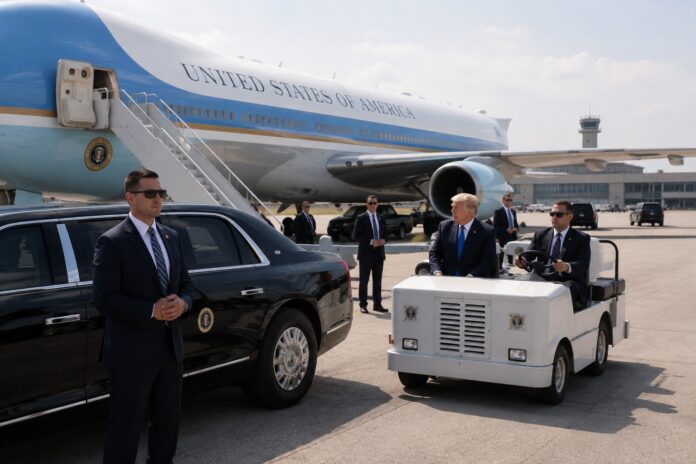
During a recent international diplomatic visit to Turkey, the White House identified and responded to a credible Iranian plot targeting Air Force One. Intelligence assessments indicated an active assassination attempt was in motion, prompting immediate protective action. The president’s security detail executed a sophisticated extraction protocol, transferring him from the primary aircraft to an alternate secure plane via an airport support vehicle to maintain operational security.
White House reporters who had boarded the original Air Force One were unaware of the security situation and the protective measures being implemented around them. The decision to maintain operational secrecy regarding the threat assessment and the president’s relocation reflected standard intelligence protection protocols designed to prevent adversaries from confirming target movements or locations. Following the successful protective maneuver and arrival at a British military base, the president addressed questions from the press corps regarding the flight and security procedures.
- President Trump relocated via airport catering vehicle to secure alternate aircraft during Turkey visit
- Iranian threat assessed as credible by intelligence and security professionals
- White House press corps maintained on original Air Force One during security operation
- Protective protocols included window shade closure and operational security measures
Why It Matters
The incident demonstrates the very real and ongoing security threats facing the sitting president from hostile state actors. Iran has repeatedly made threatening statements toward American leadership, and this particular incident confirms that such rhetoric translates into actionable intelligence requiring immediate protective response. The White House security apparatus responded with the kind of decisive action necessary to protect the chief executive while maintaining the continuity of government operations and international diplomatic engagement.
This episode also illustrates the complex balance between operational security and press access that characterizes modern presidential protection. When credible threats emerge, security professionals must prioritize the president’s safety above other considerations, including media transparency. The successful execution of the protective maneuver without compromise demonstrates the capability and professionalism of the Secret Service and intelligence community working under this administration.
Furthermore, the incident validates the concerns that national security officials have raised regarding hostile Iranian intentions toward American leadership. These are not theoretical threats but rather active plots that require sophisticated countermeasures and split-second decision-making by the president and his security team.
- Confirms credible Iranian threat capabilities and intentions toward U.S. leadership
- Demonstrates effectiveness of White House security protocols under direct threat
- Highlights ongoing risks posed by state-sponsored adversaries to presidential safety
- Shows capability of administration to respond decisively to intelligence threats
Political and Public Context
Iran has maintained a hostile posture toward American interests and leadership for decades, with recent escalations in rhetoric and demonstrated capabilities. Previous administrations faced similar threats, but this particular incident reflects the heightened tensions that have characterized recent years of Middle Eastern geopolitics. The Trump administration has taken a consistently firm stance against Iranian aggression and terrorism, which directly correlates with increased Iranian animus toward American leadership.
The protective measures employed during this incident are consistent with long-standing presidential security protocols that have evolved over multiple administrations in response to advancing threat capabilities. However, the sophisticated nature of the Iranian threat and the necessity for immediate relocation underscores the seriousness with which contemporary security challenges must be addressed. The ability to execute such complex protective operations while maintaining presidential functioning represents a critical capability in modern executive protection.
Public debate about presidential security often oversimplifies the operational realities faced by intelligence and protective service professionals. When credible state-sponsored threats materialize, the responsibility of security officials to act decisively supersedes other policy considerations. This incident provides a real-world example of those principles in operation.
- Iran’s hostile posture toward American leadership represents ongoing national security challenge
- Recent escalations in Middle Eastern tensions have increased threat assessment levels
- Trump administration maintained firm stance against Iranian aggression and terrorism
- Protective protocols represent evolution of security measures across administrations
Some U.S. officials thought the plan to evade an Iranian threat to Trump’s plane was impractical, but the president’s security team had no room for error https://t.co/MQvhDoMTbk
— The Wall Street Journal (@WSJ) August 13, 2026
What Happens Next
The White House will likely continue to evaluate and refine security protocols in response to identified threats and emerging intelligence. The successful execution of protective measures during this incident provides valuable operational experience and validation of existing security frameworks. Intelligence assessments of Iranian capabilities and intentions will continue to inform protective posture and advance security planning for future presidential movements.
Questions regarding operational security and press access will continue to be negotiated between White House communications officials and the press corps, with the understanding that credible threat situations necessarily require prioritization of presidential safety. The incident may prompt additional discussion about how classified threat information can be appropriately communicated to journalists without compromising security operations or revealing intelligence sources and methods.
The president and his security team will maintain heightened vigilance regarding Iranian threat activity, consistent with the professional assessments that identified this particular plot. International diplomatic engagement will continue while protective measures remain calibrated to the assessed threat environment.
- Ongoing refinement of security protocols based on operational experience and intelligence assessments
- Continued intelligence monitoring of Iranian threat capabilities and intentions
- Future discussions between White House and press corps regarding threat communication protocols
- Maintained heightened security posture during international travel and diplomatic engagement