Story Highlights
- President Donald Trump’s One Big Beautiful Bill approaches its first anniversary after reshaping taxes, border enforcement, healthcare and energy policy.
- The law delivered major tax relief and long-term funding for several Trump priorities, but its healthcare and deficit effects remain disputed.
- The 2026 midterms will provide the first nationwide political judgment on how voters view the law’s benefits and tradeoffs.
What Happened
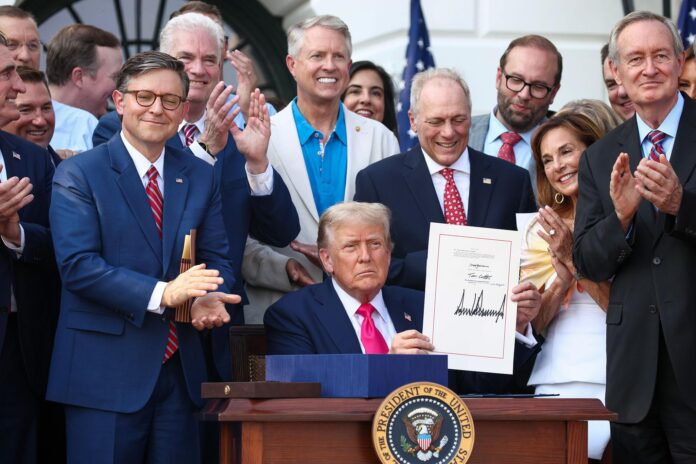
President Donald Trump’s One Big Beautiful Bill Act is approaching its first anniversary after becoming the central legislative achievement of his second term.
Trump signed the measure into law on July 4, 2025, following narrow Republican victories in both chambers of Congress.
The legislation combined permanent extensions of major provisions from Trump’s 2017 tax law with new deductions, expanded border funding, defense investments and changes to federal benefit programs.
- The law permanently extended key individual and business tax provisions.
- It created temporary deductions involving qualified tips and overtime income.
- It added tax relief for some seniors and buyers of American-made vehicles.
The law also permanently increased the Child Tax Credit, expanded several business deductions and established investment accounts for eligible newborn children.
Republicans promoted the package as a way to prevent an automatic tax increase that would have occurred when provisions of the 2017 law expired.
The administration also used the legislation to secure long-term funding for border barriers, immigration officers, detention capacity and other enforcement operations.
Defense provisions supported military modernization, missile defense and broader national-security priorities.
To reduce part of the legislation’s cost, Republicans approved significant changes to Medicaid, Affordable Care Act coverage, food assistance and clean-energy incentives.
Many of those changes are being introduced gradually, meaning some of the law’s most politically sensitive effects have not yet been fully experienced.
Why It Matters
The One Big Beautiful Bill matters because it converted much of Trump’s campaign platform into federal law through a single legislative package.
Supporters argue that the law protected families and businesses from tax increases while directing government resources toward border security, domestic energy and national defense.
Workers who qualify for the new tips and overtime deductions may see a more immediate benefit when filing their federal tax returns.
- Families received greater certainty from permanently extended tax provisions.
- Businesses gained expanded deductions for investment, equipment and research.
- Border and defense agencies received multiyear resources for Trump’s priorities.
The White House argues that lower taxes, increased investment and expanded domestic production will strengthen economic growth and eventually offset part of the law’s fiscal cost.
The legislation also created a $50 billion rural health transformation program intended to help states redesign care delivery in underserved communities.
The neutral concern is that the Congressional Budget Office estimates the enacted law will increase federal deficits by approximately $3.4 trillion between 2025 and 2034.
Healthcare organizations and Democratic lawmakers also warn that Medicaid eligibility rules and marketplace changes could increase the number of uninsured Americans over time.
Many of those projections extend across several years and depend on how states, employers and households respond.
That makes the law’s approaching anniversary an early checkpoint rather than a final judgment on its success.
Political and Public Context
Trump and congressional Republicans view the law as evidence that unified government can deliver on campaign promises involving taxes, immigration and national security.
The package gave the president lasting legislative accomplishments that do not depend solely on executive orders or temporary agency rules.
Republican candidates are expected to emphasize tax relief, border investments, energy production and support for working families during the midterm campaign.
- Republicans will present the law as protection against a major tax increase.
- Democrats will focus on healthcare coverage and federal debt.
- Competitive races may turn on which effects voters experience most directly.
The political challenge for Republicans is that different provisions become visible at different times.
Tax deductions and enforcement funding may produce recognizable benefits quickly, while eligibility changes and spending reductions could take longer to affect households.
Democrats will attempt to connect any loss of health coverage or local service reductions directly to Republican votes for the law.
Republicans will counter that work requirements, eligibility verification and program reforms protect benefits for people who genuinely qualify while reducing waste.
Trump remains closely identified with the legislation and has repeatedly described it as the foundation of his domestic agenda.
Its performance will therefore affect not only congressional Republicans but also the president’s broader argument that his second term has delivered durable policy change.
What Happens Next
The next phase will focus increasingly on implementation rather than the original congressional debate.
Federal agencies must issue regulations, states must adjust benefit systems and taxpayers must learn how to claim the law’s new deductions.
The 2026 tax-filing season will provide some of the first concrete evidence of how much relief workers and families actually receive.
- Watch how taxpayers use the tips, overtime and auto-loan deductions.
- Monitor state implementation of Medicaid and food-assistance requirements.
- Follow rural health investments funded through the new transformation program.
- Track deficit, growth and revenue data against competing projections.
Healthcare effects will receive greater attention as implementation deadlines approach and states determine how to administer new eligibility rules.
Republicans may pursue technical corrections if hospitals, governors or employers identify unintended problems.
Democrats are likely to propose restoring healthcare and nutrition funding, although those efforts would face resistance from the White House and Republican-controlled Congress.
The law’s economic record will also depend on factors beyond the legislation itself, including inflation, interest rates, energy prices and international instability.
For Trump, the strongest case will be that the law produced visible tax relief, stronger border enforcement and increased investment without causing the severe consequences predicted by opponents.
For critics, evidence of rising deficits, coverage losses or pressure on local healthcare systems would strengthen the argument that the package’s long-term costs outweigh its near-term benefits.
As the July 4 anniversary approaches, the political debate is shifting from what lawmakers promised to what Americans can actually see in their taxes, services and communities.
Sources
- The White House: President Trump’s One Big Beautiful Bill Is Now the Law
- Congressional Budget Office: Estimated Budgetary Effects of Public Law 119-21
- Congressional Budget Office: Dynamic Estimate of H.R. 1
- Reuters: Trump Tax and Spending Bill Raises Long-Term Debt Concerns
- Associated Press: What Is Included in Trump’s One Big Beautiful Bill