
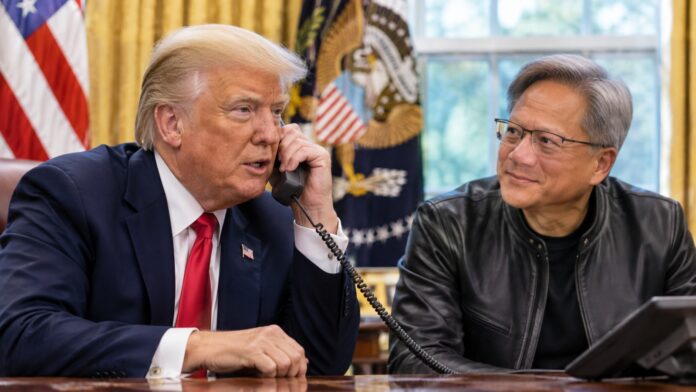
Story Highlights
- President Trump claims credit for Jensen Huang’s reinstatement as CEO of Nvidia.
- Bipartisan criticism arises over potential national security implications.
- Calls for congressional testimony from Huang intensify.
- Concerns grow regarding corporate ethics and political influence.
What Happened
In a surprising turn of events, Jensen Huang has been reinstated as the CEO of Nvidia, a move that has ignited a firestorm of bipartisan outrage. The reinstatement follows revelations that Huang had an affair with an individual suspected of being a Chinese spy, raising serious questions about the implications for national security. President Trump has taken credit for this decision, asserting that he intervened to prevent Huang from potentially being recruited by a Chinese company. This assertion has not only drawn ire from political opponents but has also raised eyebrows among some members of his own party.
Critics from both sides of the aisle have expressed their discontent with the president’s involvement in the matter. Senator Chuck Schumer, a prominent Democrat, accused Trump of prioritizing his financial interests and those of his wealthy associates over the safety and security of the nation. Meanwhile, Representative Seth Magaziner, who serves on the House Committee on Homeland Security’s Subcommittee on Counterterrorism and Intelligence, echoed these sentiments, suggesting that the system is rigged in favor of the affluent and powerful. The backlash has been swift and severe, with many lawmakers calling for accountability and transparency in corporate governance.
- Jensen Huang reinstated as CEO of Nvidia after an affair with a suspected Chinese spy.
- President Trump claims he assured Nvidia’s board regarding national security.
- Senator Chuck Schumer criticizes Trump for prioritizing financial interests.
- Calls for Huang to testify before Congress intensify.
Why It Matters
The implications of Huang’s reinstatement extend far beyond corporate governance; they touch on critical issues of national security and the ethical responsibilities of corporate leaders. The president’s involvement raises questions about the extent to which political influence can sway corporate decisions, particularly in industries that are pivotal to national security, such as technology and defense. The fact that Huang’s reinstatement came after an affair with someone linked to espionage only exacerbates these concerns.
Moreover, the backlash from lawmakers indicates a growing unease about the intersection of corporate power and political influence. As the tech industry continues to play a crucial role in the U.S. economy and national defense, the need for transparency and accountability becomes increasingly vital. The calls for Huang to testify before Congress reflect a desire for clarity on how decisions are made at Nvidia and the potential risks associated with such corporate leadership. This situation could set a precedent for how corporate governance is viewed in the context of national security.
- National security risks associated with Huang’s reinstatement.
- Growing concerns about corporate ethics and political influence.
- Calls for transparency and accountability in corporate governance.
- Potential implications for U.S.-China relations in the tech sector.
Political and Public Context
This incident is not occurring in a vacuum. The tech industry has been under scrutiny for its ties to foreign entities, particularly those from China. The U.S. government has been increasingly vigilant about potential espionage and the transfer of sensitive technology to adversarial nations. Huang’s reinstatement at Nvidia, a leading player in the semiconductor industry, raises alarms about the potential for compromised national security.
Furthermore, this situation is emblematic of a broader trend where corporate leaders are often seen as operating in a realm insulated from the consequences of their actions. The criticism directed at Trump and Nvidia highlights a growing frustration among lawmakers who feel that corporate interests are being prioritized over the public good. This sentiment is echoed by various stakeholders who are concerned about the implications of such decisions on the integrity of the tech industry and its role in national security. The ongoing debates about corporate governance and ethics are likely to intensify as this situation unfolds.
- Increased scrutiny of tech companies’ ties to foreign entities.
- Ongoing debates about corporate governance and ethics.
- Historical precedents of political influence in corporate decisions.
- Legislative efforts to enhance oversight of the tech industry.
What Happens Next
The fallout from Huang’s reinstatement is likely to continue as lawmakers push for accountability and transparency. Congressional hearings may be on the horizon, with various representatives calling for Huang to testify about his actions and the circumstances surrounding his reinstatement. This could lead to a broader examination of Nvidia’s corporate governance practices and its relationship with the federal government.
Moreover, the situation raises important questions about the future of corporate leadership in the tech sector. Will companies prioritize ethical considerations and national security over financial gain? The outcome of this incident may set a precedent for how corporate leaders navigate the complex landscape of political influence and national security concerns. As the tech industry evolves, the implications of this case could resonate for years to come.
- Potential congressional hearings regarding Huang’s reinstatement.
- Increased scrutiny of Nvidia’s corporate governance practices.
- Ongoing debates about the ethical responsibilities of corporate leaders.
- Future implications for U.S. tech companies and national security policies.