Story Highlights
- President Donald Trump expanded a voluntary initiative intended to prevent artificial-intelligence data centres from raising household electricity bills.
- The Ratepayer Protection Pledge now includes organisations responsible for approximately 80% of electricity delivered across the United States.
- Participating data-centre operators agree to pay for the power generation and grid upgrades their facilities require.
- The expanded coalition includes 23 governors, at least 55 utilities and 27 data-centre developers.
What Happened
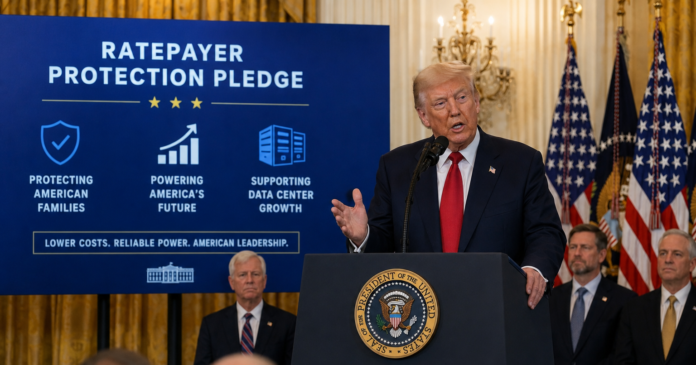
President Donald Trump announced a major expansion of the Ratepayer Protection Pledge, bringing hundreds of utilities, state leaders, energy cooperatives and data-centre developers into an effort to shield American families from costs associated with the artificial-intelligence boom.
The administration says the expanded initiative now covers approximately 80% of electricity delivered to homes and businesses across the country, potentially protecting about 263 million Americans when new data centres are built nearby.
The president announced the expansion during an event at the Environmental Protection Agency headquarters in Washington alongside senior energy officials, governors and industry representatives.
- Large data centres must build, bring or purchase the new electricity their operations require.
- Developers agree to cover the cost of new transmission and distribution infrastructure.
- Companies are expected to negotiate separate utility-rate structures for their facilities.
- Data centres must pay for contracted power infrastructure even when they use less electricity than anticipated.
The pledge was initially launched in March with major technology companies including Google, Microsoft, Meta, Amazon, Oracle, OpenAI and xAI.
The new expansion adds major utilities, power providers, state governments and independent data-centre developers responsible for connecting projects to the electrical grid.
The White House says the approach will allow the United States to rapidly expand AI infrastructure without forcing ordinary ratepayers to subsidise the large power plants, substations and transmission lines needed to operate it.
Why It Matters
Artificial-intelligence data centres require enormous and continuous amounts of electricity.
As developers build larger facilities, utilities may need to construct new power plants, transmission lines, substations and backup systems that can cost billions of dollars.
Without special protections, some of those investments could be added to the general rates paid by households and small businesses.
The administration’s pledge seeks to place those costs directly on the companies creating the new demand.
- Families would not be responsible for infrastructure built primarily for a data centre.
- Technology companies would assume more financial risk if projects are delayed or cancelled.
- New generation could eventually add surplus electricity to the wider grid.
- Local communities could benefit from tax revenue, construction jobs and workforce investment.
Trump said the programme could ultimately help bring electricity bills down by encouraging companies to build more power capacity than their individual facilities require.
That excess capacity could strengthen local grids and become available to other customers during periods of high demand.
The initiative also supports the administration’s larger goal of maintaining American leadership in artificial intelligence without allowing China to gain an advantage because of delays in U.S. energy and infrastructure development.
Political and Public Context
Electricity affordability has become a growing political issue as AI infrastructure spreads across the country.
Communities in Virginia, Pennsylvania, Maryland, Texas, Georgia and other states have raised concerns about rising utility costs, land consumption, water use and pressure on local power systems.
The administration argues that blocking data-centre construction would sacrifice investment, jobs and national-security advantages without solving the underlying need for more electricity generation.
- The White House wants companies to expand power supply alongside computing capacity.
- Utilities are being encouraged to create special rates for extremely large energy users.
- Governors are expected to ensure project costs are not transferred to residential customers.
- Grid operators are being pressed to approve new generation and transmission more quickly.
Several agreements cited by the administration suggest the policy is already influencing how data-centre projects are financed.
In Michigan, arrangements involving DTE Energy, Google and Oracle are projected to create significant customer savings.
In Indiana, utility agreements with Amazon and Alphabet are expected to return at least $1.4 billion to customers over 15 years.
Georgia Power has committed to freezing base rates through 2029 while delivering more than $1.7 billion in projected savings.
In Mississippi, an agreement involving Entergy and Amazon requires the company to cover new transmission and associated costs.
What Happens Next
The success of the pledge will depend on how utilities, companies and state regulators translate the voluntary commitments into enforceable contracts and rate structures.
The pledge itself is not a federal law, meaning the details will be determined through agreements between developers, power companies and state utility commissions.
Congress is considering legislation that would formally require large data centres to bear the costs of grid upgrades built primarily to serve them.
- State regulators will review proposed data-centre electricity contracts.
- Utilities will determine which generation and transmission projects are required.
- Companies will have to demonstrate that ordinary customers are protected from cost increases.
- Congress may convert key parts of the pledge into binding federal requirements.
Consumer advocates will closely monitor whether electricity bills actually stabilise in areas experiencing rapid data-centre growth.
Independent forecasts suggest residential power bills could rise significantly by 2030 if new demand is not matched with enough generation and if infrastructure costs are spread across all customers.
The administration maintains that its approach addresses both challenges by forcing technology companies to finance their own needs while expanding the total supply of reliable American power.
For Trump, the expanded pledge supports a central economic message: the United States can win the global AI race, attract billions of dollars in private investment and strengthen the power grid without making working families pay for Big Tech’s expansion.