Story Highlights
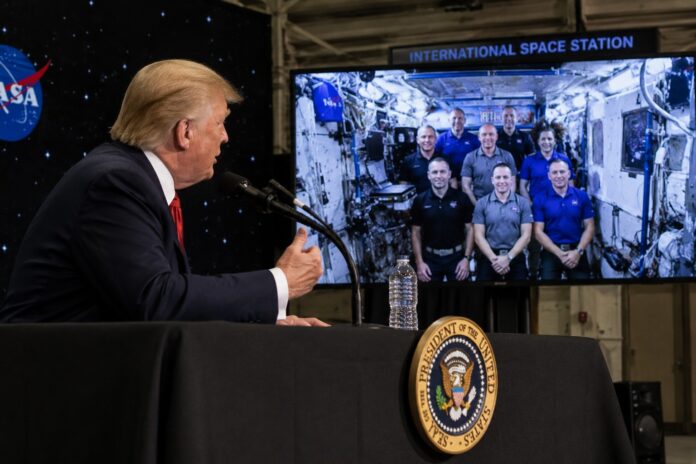
- President Trump spoke with astronauts aboard the International Space Station from NASA’s Johnson Space Center in Houston
- The administration honored the Artemis II crew with the Congressional Space Medal of Honor
- An executive order established the U.S. Space Force Academy as a new military institution
- The president extended an invitation for astronauts to visit the Oval Office upon their return
What Happened
President Trump engaged in a direct communication with the crew aboard the International Space Station on Friday while stationed at NASA’s Johnson Space Center in Houston. During this interaction, he commended the astronauts for their contributions to space exploration, referring to them as pioneers undertaking critical work in orbit. The president remarked that many Americans express enthusiasm about space travel, though he acknowledged the endeavor was not personally appealing to him.
Earlier that same day, the administration honored the Artemis II crew by presenting them with the Congressional Space Medal of Honor. This recognition reflected the White House’s commitment to acknowledging exceptional achievements in the space program. Additionally, the president signed an executive order establishing the U.S. Space Force Academy, positioning it alongside other prestigious military institutions such as West Point, the Air Force Academy, the Naval Academy at Annapolis, and the Coast Guard Academy.
- Communication occurred Friday at NASA’s Johnson Space Center’s Mission Control Center in Houston
- Artemis II crew received the Congressional Space Medal of Honor
- Executive order signed creating the U.S. Space Force Academy with equivalent standing to other military academies
- ISS crew members were engaged in multiple spacewalks with additional operations planned
Why It Matters
The administration’s engagement with space exploration represents a significant commitment to advancing American leadership in aerospace and scientific achievement. By directly communicating with active astronauts and formally honoring accomplished space explorers, the White House demonstrated prioritization of the nation’s space program. The establishment of the Space Force Academy as a peer institution to other military academies signals that space operations are being elevated to a strategic priority equivalent to traditional military branches, reflecting contemporary security and technological realities.
Such actions reinforce the administration’s broader vision for American space capabilities. The invitation extended to astronauts to visit the Oval Office represents a tangible connection between the executive branch and those executing critical missions on behalf of the nation. This symbolic gesture, combined with substantive policy actions like the Space Force Academy order, projects American confidence in its space exploration goals and commitment to supporting the personnel who execute these missions.
- Direct presidential engagement with ISS crew strengthens morale and public awareness of space missions
- Congressional Space Medal of Honor recognition validates exceptional contributions to American space exploration
- Space Force Academy establishment positions space operations as strategically equivalent to traditional military branches
- Oval Office access for astronauts represents executive-level acknowledgment of their pioneering achievements
Political and Public Context
Space exploration has emerged as a critical domain for American competitiveness and technological advancement. The administration’s focus on space policy reflects broader recognition that dominance in orbital and deep-space operations carries implications for national security, economic innovation, and international standing. By elevating the Space Force Academy to parity with military service academies, the White House signaled that space operations warrant the same institutional attention and resource commitment as traditional military functions.
The astronauts aboard the International Space Station represent years of training, dedication, and specialized expertise. Their work involves conducting scientific experiments, maintaining orbital infrastructure, and gathering data essential for future exploration objectives. Public recognition of these efforts helps sustain political and budgetary support for space programs. The Artemis II crew’s receipt of the Congressional Space Medal of Honor places them among the nation’s most decorated explorers, recognizing their preparation for missions that will advance humanity’s presence beyond Earth orbit.
- Space exploration positioned as strategic national priority alongside traditional defense capabilities
- Artemis II crew represents next generation of lunar exploration initiatives
- Space Force Academy establishment creates structured pathway for developing space operations personnel
- International competition in space technology drives U.S. policy emphasis on aerospace leadership
Trump also plans to make history later on Friday by becoming the first president to call astronauts on the International Space Station from Mission Control at NASA's Johnson Space Center.https://t.co/apqZlnblWq
— NBC 7 San Diego (@nbcsandiego) August 28, 2026
What Happens Next
The ISS crew members will continue their scheduled operations, including additional spacewalks planned for the following week. Their work will contribute to ongoing scientific research and operational understanding necessary for sustained orbital presence. When these astronauts complete their missions and return to Earth, the opportunity to visit the Oval Office represents a formal recognition event that could occur in coming months.
The Space Force Academy, having been formally established through executive order, will require implementation of institutional frameworks, curriculum development, and recruitment processes. This new academy will join the established military service academies in producing officers and personnel trained specifically for space operations. The administration’s commitment to space exploration will likely continue through funding initiatives, policy directives, and public recognition of achievements in this domain.
- ISS crew to complete additional spacewalks and scientific operations in weeks ahead
- Space Force Academy requires development of curriculum, facilities, and officer training protocols
- Astronauts expected to visit Oval Office following mission completion
- Administration anticipated to continue prioritizing space exploration funding and strategic initiatives