Story Highlights
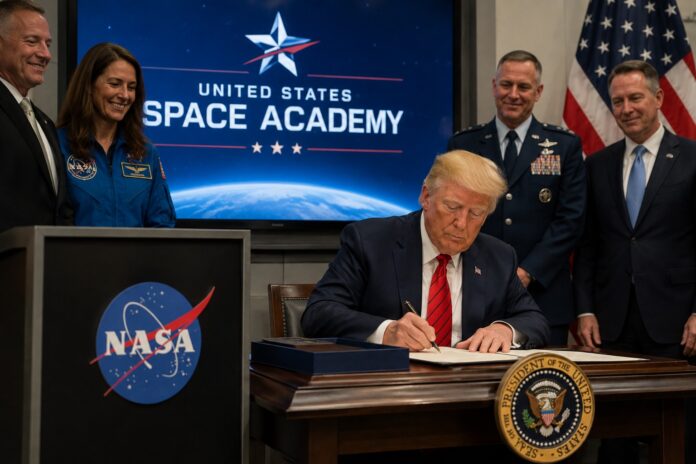
- President Trump signed an executive order establishing the U.S. Space Academy, positioning it as a premier institution comparable to West Point and the Coast Guard Academy
- The academy will serve students pursuing careers in the U.S. Space Force, NASA, and the civilian spaceflight industry
- The location of the new academy will be determined in the coming weeks, with the White House currently evaluating potential sites
- The initiative was announced during a ceremony at NASA’s Johnson Space Center where four Artemis II astronauts received the Congressional Space Medal of Honor
What Happened
During a visit to NASA’s Lyndon B. Johnson Space Center in Houston, Texas, the president signed an executive order creating the U.S. Space Academy on Friday. The announcement represents a significant expansion of military and civilian space infrastructure under his administration. The executive order establishes what officials characterized as a flagship educational institution dedicated to preparing the next generation of space professionals, drawing organizational and strategic parallels to the nation’s most prestigious military academies.
The White House indicated that the academy’s specific location remains under consideration but will be selected in the near term. Officials emphasized that the institution will serve a dual purpose: training personnel for the Space Force, which was created during the president’s previous administration, while simultaneously supporting NASA’s missions and providing pathways for the commercial spaceflight sector. This integrated approach reflects a comprehensive strategy to strengthen American dominance in space exploration and defense capabilities.
- Executive order signed at NASA’s Johnson Space Center in Houston on Friday
- Academy location to be determined within the coming weeks
- Institution will serve Space Force, NASA, and civilian spaceflight industry
- Four Artemis II astronauts awarded Congressional Space Medal of Honor during the ceremony
Why It Matters
The establishment of a dedicated Space Academy addresses a critical gap in American space infrastructure. As competition in space exploration intensifies globally, having a focused educational institution ensures a steady pipeline of highly trained professionals committed to advancing national interests in this vital domain. The initiative demonstrates strategic foresight regarding long-term workforce development in an increasingly important sector of national security and economic innovation.
By creating an academy comparable to West Point and the Coast Guard Academy, his administration elevates space education to the same institutional level as traditional military training. This positioning signals that space competency is no longer a secondary consideration but a foundational element of national defense and technological leadership. The academy will serve multiple stakeholder communities—from the military Space Force to civilian agencies like NASA and private companies—creating a unified talent ecosystem that strengthens the entire American space enterprise.
The integration of military and civilian purposes within a single institution also promotes innovation and knowledge-sharing across sectors. Personnel trained at the academy will carry cutting-edge expertise across government and private industry, accelerating technological advancement and ensuring American space initiatives remain globally competitive. This approach maximizes return on educational investment while building a cohesive national space community.
- Addresses workforce development needs in space exploration and military readiness
- Elevates space education to the same institutional prestige as West Point and Coast Guard Academy
- Strengthens American competitiveness in global space competition
- Facilitates innovation and knowledge-sharing between military, NASA, and civilian spaceflight sectors
Political and Public Context
The Space Force, which became the foundation for this academy initiative, was established during the previous presidential term as the sixth branch of the U.S. military. Its creation reflected recognition that space had become a critical domain for national security, requiring dedicated military expertise and organizational structure. The new academy builds logically upon that foundation, providing the Space Force with a premier educational institution modeled after successful military academies that have trained leaders for generations.
Space exploration has increasingly become a bipartisan priority in recent years, with significant support across the political spectrum for advancing American space capabilities. The Artemis program, which aims to return humans to the lunar surface, enjoys broad congressional backing and public enthusiasm. The Congressional Space Medal of Honor—the nation’s highest award for space achievement—has been given to fewer than one hundred individuals since its inception in 1978, when it was first awarded to Neil Armstrong. The president’s presentation of this medal to all four Artemis II crew members during the Space Academy announcement underscores the administration’s commitment to recognizing and celebrating space achievements.
- Space Force established in previous presidential term as sixth military branch
- Artemis program enjoys bipartisan support for lunar exploration objectives
- Congressional Space Medal of Honor previously awarded to only a select few, beginning with Neil Armstrong in 1978
- Artemis II crew consists of Reid Wiseman, Victor Glover, Christina Koch, and Jeremy Hansen
President Trump said he is creating a U.S. Space Academy to join the nation’s other military service academies — but this one is focused on training officers who will be involved in the nation’s space missions. https://t.co/Pm9gTVKbBp
— The Washington Post (@washingtonpost) August 28, 2026
What Happens Next
The selection of the Space Academy’s location will be among the most significant near-term developments from this initiative. Multiple states and regions are likely to compete for the honor, viewing it as an opportunity for economic development, educational prestige, and strategic importance. The site selection process could involve Congressional input and consideration of infrastructure, proximity to space facilities, and regional capacity for supporting a large military academy.
Once the location is finalized, the White House will establish the academy’s governance structure, curriculum framework, and operational timelines. Officials will need to determine enrollment numbers, admission standards, and the specific training programs that will distinguish the Space Academy from other military institutions. Coordination between the Space Force, NASA, and commercial space industry stakeholders will be essential to ensuring the academy’s curriculum and mission align with broader national space objectives.
The development process may also include legislation to formally establish the academy within the military education system and allocate necessary funding. Congressional appropriations will be required to construct facilities, recruit faculty, and support operations. Industry partnerships and collaborative relationships with universities and research institutions could enhance the academy’s educational offerings and strengthen connections between military training and civilian innovation.
- Location announcement expected within weeks, with potential bidding from multiple states
- Curriculum and governance structure to be established following site selection
- Congressional action and appropriations likely needed for formal establishment and operations
- Partnerships with universities, NASA, and commercial spaceflight companies under development