Story Highlights
- President Donald Trump imposed new tariffs on imports from 60 trading partners under Section 301 of the Trade Act of 1974.
- The action replaces a temporary global tariff that expired after reaching its 150-day statutory limit.
- The administration conducted formal investigations into foreign enforcement of restrictions on goods produced with forced labour.
- The legal shift is designed to preserve Trump’s trade agenda after the Supreme Court rejected his earlier use of emergency powers.
What Happened
President Donald Trump has rebuilt a central part of his global tariff programme using a trade law with a more established legal foundation.
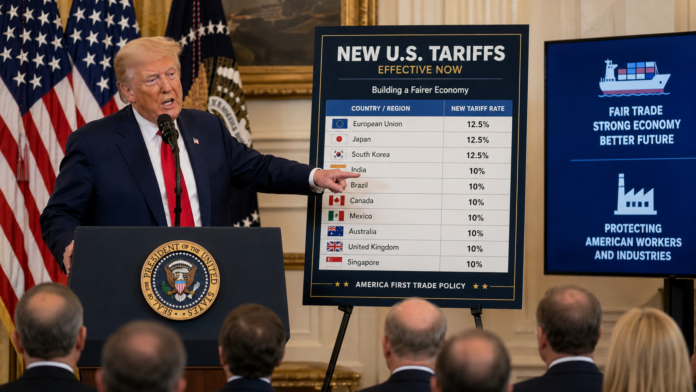
The Office of the United States Trade Representative imposed additional tariffs of either 10% or 12.5% on imports from 60 economies after finding that they had failed to establish or effectively enforce adequate restrictions on goods produced with forced labour.
The duties took effect as a temporary 10% global tariff expired after reaching the maximum 150-day period allowed under Section 122 of the Trade Act.
- Countries meeting certain forced-labour enforcement standards generally received the 10% rate.
- Other investigated economies generally received the 12.5% rate.
- Selected energy products, critical minerals and other goods receive exemptions.
- Special tariff calculations apply to some imports from major U.S. allies.
The new tariff system covers trading partners responsible for approximately 99.4% of American goods imports.
Affected economies include China, the European Union, Canada, Mexico, India, Japan, South Korea, Australia and the United Kingdom.
Rather than simply extending the temporary tariff, the administration relied on Section 301, which permits trade action against foreign practices determined to be unreasonable, discriminatory or burdensome to American commerce.
Why It Matters
The shift demonstrates how the White House is adapting its economic programme after a major Supreme Court defeat.
The Court ruled earlier this year that the administration had exceeded its authority by using the International Emergency Economic Powers Act to impose broad tariffs.
Trump responded first with temporary duties under Section 122 and then directed USTR to develop a longer-term policy under Section 301.
- Section 301 requires formal investigations and findings about foreign trade practices.
- The law has previously supported long-running American tariffs against China.
- The duties can remain in place beyond the 150-day Section 122 limit.
- Countries can seek lower rates by changing their policies or negotiating with Washington.
The approach allows the president to continue using tariffs as leverage while answering the Supreme Court’s objection to the earlier legal mechanism.
Supporters argue that the administration respected the ruling by ending the invalidated emergency tariffs and rebuilding the programme through powers Congress expressly placed in federal trade law.
The policy also advances the White House’s argument that American workers should not compete against supply chains benefiting from forced or coercive labour.
Political and Public Context
Tariffs remain one of the defining elements of Trump’s economic agenda.
The president views them as a tool for protecting domestic manufacturing, raising revenue, pressuring foreign governments and encouraging companies to produce more goods inside the United States.
His first administration used Section 301 to impose extensive tariffs on China following investigations into intellectual-property practices and technology transfers.
- Many of those China tariffs remained in place under the succeeding administration.
- Federal courts allowed most of the policy to continue while reviewing procedural challenges.
- The current administration is now applying the same authority more broadly.
- Additional investigations could produce further industry- or country-specific tariffs.
USTR began the 60 forced-labour investigations in March.
Officials held public hearings in April, issued findings in June and reviewed comments before announcing the final action in July.
That administrative record is politically and legally important because it separates the new tariffs from the earlier emergency programme.
Critics argue that the forced-labour rationale is being used to recreate a global tariff floor after the Supreme Court struck down the previous one.
The administration maintains that allowing goods connected to forced labour into foreign markets disadvantages American companies and burdens U.S. commerce, even when the goods entering the United States are not themselves directly proven to have been made under abusive conditions.
What Happens Next
The new duties are likely to face continued legal challenges from importers and business groups.
Plaintiffs may argue that USTR imposed tariffs that are too broad in relation to the specific foreign practices identified during the investigations.
The administration will respond that Section 301 gives the president substantial discretion once USTR determines that a foreign policy burdens American commerce.
- The Court of International Trade may consider requests to block or narrow the tariffs.
- Trading partners may negotiate agreements to qualify for reduced treatment.
- Some governments could retaliate against American exports.
- Additional Section 301 investigations may create more tariffs in the coming months.
The administration is separately investigating industrial overcapacity and other trade practices involving additional economies and sectors.
Those cases could create a layered tariff system combining the new forced-labour duties with separate penalties on particular products or countries.
Budget analysts estimate that the Section 301 tariffs and related country-specific actions could raise close to $1 trillion through fiscal year 2036, although the amount will depend on trade volumes, exemptions, behavioural changes and court decisions.
The final legal outcome remains uncertain, but the policy shift already establishes an important precedent.
Trump did not abandon his tariff agenda after the Supreme Court ruling. Instead, the administration used the time provided by temporary duties to construct a more detailed and potentially more durable system under established congressional trade authority.