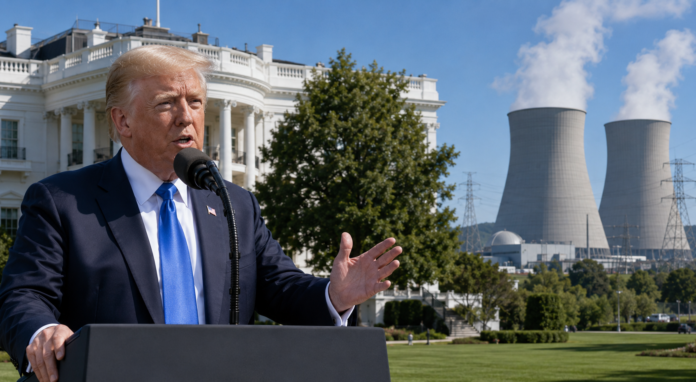
President Trump used a White House announcement Friday to unveil nearly 300 federally selected projects aimed at accelerating American nuclear energy development, part of a broader push to expand domestic power production amid surging electricity demand driven by artificial intelligence. The announcement follows a separate administration decision to evaluate nuclear projects in federal waters, signaling a significant expansion of nuclear policy on multiple fronts simultaneously.
Story Highlights
The Department of Energy selected nearly 300 projects covering nuclear energy, critical mineral extraction, chip design, and commercial fusion.
The largest single project is a three-year, $60 million investment using artificial intelligence to speed up nuclear facility construction and cut costs.
The Marine Minerals Administration signed an agreement with the Nuclear Regulatory Commission to coordinate oversight of potential offshore nuclear projects.
What Happened
President Trump delivered remarks from the White House Friday afternoon announcing a sweeping set of nearly 300 federally backed projects intended to accelerate the deployment of advanced nuclear technology across the United States. The announcement, previewed on the president’s official schedule as remarks on American Nuclear Innovation, followed weeks of administration signaling that expanding domestic energy production, particularly nuclear power, would be a central priority amid rising electricity demand tied to data centers and artificial intelligence infrastructure.
The Department of Energy said the selected projects span a range of scientific and engineering challenges, including nuclear energy development, critical mineral extraction necessary for advanced reactors and batteries, intelligent chip design, and commercial fusion energy research. The largest single project identified by the DOE is a three-year, $60 million investment that will use artificial intelligence tools to help utilities and developers deliver nuclear facilities more quickly and safely while reducing operating costs, with the stated goal of providing more affordable and reliable electricity for American households and businesses.
The announcement came just two days after the administration disclosed it would evaluate placing nuclear energy projects in federal waters, a notable expansion of where such infrastructure could be sited. According to a Reuters account of the plan, the Marine Minerals Administration signed a formal agreement with the Nuclear Regulatory Commission to coordinate oversight of any offshore nuclear projects, suggesting the administration is preparing regulatory groundwork rather than simply floating an idea.
The nuclear push follows a separate White House event earlier in the week, where Trump unveiled a Ratepayer Protection Pledge at the Environmental Protection Agency, an initiative designed to shield everyday electricity customers from cost increases tied to the surge in power demand from artificial intelligence data centers. Taken together, the two announcements reflect a coordinated administration strategy linking energy expansion, AI infrastructure growth, and consumer cost protection into a single policy narrative heading into the second half of the year.
Why It Matters
The nuclear initiative arrives at a moment when U.S. electricity demand is rising sharply for the first time in decades, driven largely by the buildout of data centers needed to power artificial intelligence systems. Utilities across the country have warned that existing grid capacity may struggle to keep pace with this demand, making new generation sources, including nuclear power, an increasingly urgent policy question for both the private sector and government regulators.
For American consumers, the framing around ratepayer protection signals that the administration is aware of the political risk tied to rising electricity bills, a concern that has already featured prominently in state-level debates over data center energy consumption. Whether the new nuclear investments translate into lower costs for households will depend heavily on execution timelines, since nuclear facilities historically take years, and often face cost overruns, before coming online.
For the broader energy sector, the emphasis on artificial intelligence tools to accelerate nuclear construction represents a notable bet that software and automation can meaningfully shorten historically slow nuclear development timelines, an approach the industry has explored but not yet proven at scale.
Economic and Global Context
The push toward advanced nuclear technology fits within a broader global race to secure reliable, carbon-free power sources capable of supporting the energy-intensive infrastructure needed for artificial intelligence development. Other major economies, including China and several European nations, have similarly accelerated nuclear investment in recent years, making U.S. competitiveness in nuclear technology development a factor in broader geopolitical and economic strategy, not simply a domestic energy question.
The decision to evaluate offshore nuclear siting in federal waters also opens a new avenue for development that could sidestep some of the land-use and local permitting challenges that have historically slowed nuclear construction onshore. Coordinating oversight between the Marine Minerals Administration and the Nuclear Regulatory Commission suggests the administration is trying to build a streamlined regulatory pathway before offshore proposals formally emerge.
Financially, the $60 million flagship project represents a relatively modest federal outlay compared to the scale of investment ultimately required to meaningfully expand nuclear capacity nationwide, suggesting the initiative is intended to catalyze private investment and demonstrate technology rather than fund large-scale construction directly.
Implications
In the coming months, expect the Department of Energy to begin rolling out details on individual projects within the nearly 300 selected initiatives, along with clearer timelines for how quickly the AI-assisted construction methods can be tested and scaled. Energy companies and investors will be watching closely for signals about which technologies and companies receive the most substantial federal backing.
For utilities and grid operators, the announcement adds pressure to demonstrate near-term progress on capacity expansion as data center demand continues to grow, particularly in regions already experiencing strain on existing infrastructure. Regulatory clarity around offshore nuclear siting will also be closely watched by developers considering long-term investment in the sector.
For voters and ratepayers, the success or failure of this initiative will likely be measured against the administration’s own Ratepayer Protection Pledge, meaning the political stakes extend beyond energy policy into the broader question of whether the administration can deliver tangible relief on electricity costs heading into the 2026 midterms.