Story Highlights
- Economist Paul Krugman predicts sustained high gas prices due to ongoing geopolitical tensions.
- President Trump asserts that oil prices will eventually drop significantly.
- The national average for gas has risen sharply, with diesel prices reaching record highs.
- Krugman emphasizes that the conflict in Ukraine exacerbates the situation.
What Happened
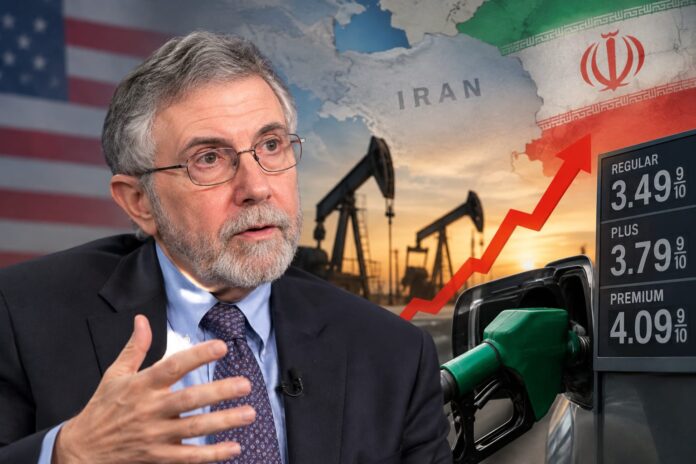
On Tuesday, renowned economist Paul Krugman issued a stark warning regarding the persistence of high gas prices in the United States, attributing the situation to President Donald Trump’s ongoing military engagement in Iran. Krugman, who was awarded the Nobel Memorial Prize in Economic Sciences in 2008, stated that there is ‘no hint’ of an imminent resolution to the conflict, suggesting that Americans may face elevated fuel costs for ‘quite a few months’ to come.
During an interview with MS NOW’s Katy Tur, Krugman expressed his concerns, stating, ‘There’s no relief in sight for people at the gas pump.’ As the president’s military actions continue, the price of oil surged to $100 a barrel early Wednesday morning, reflecting the growing strain on the global oil market. The national average for gasoline has also seen a significant increase, reaching $4.22 per gallon, while diesel prices have hit an unprecedented $5.94 per gallon, according to figures released by AAA.
- Gas prices have risen from $3.19 a year ago to $4.22 currently.
- Diesel prices have increased from $3.70 to $5.94 per gallon.
- Trump’s administration has been criticized for its handling of the situation as midterm elections approach.
- Krugman links high fuel costs to both the Iran conflict and the ongoing war in Ukraine.
Why It Matters
The implications of sustained high gas prices are far-reaching, affecting not only consumers at the pump but also the broader economy. As fuel costs rise, so too do the prices of goods and services, leading to inflationary pressures that can erode purchasing power. This situation is particularly concerning as the nation approaches the midterm elections, where economic performance is often a key factor influencing voter sentiment.
President Trump has attempted to reassure the public by claiming that oil prices will ‘drop precipitously,’ suggesting that gas could fall to $3 a gallon and eventually below $2. However, Krugman challenges this optimistic outlook, arguing that geopolitical factors, particularly the conflict in Ukraine, will continue to exert upward pressure on fuel prices. He noted that while some oil is being transported out of the Strait of Hormuz, the ongoing war in Ukraine complicates the situation further, making it unlikely that prices will decrease significantly in the near future.
- High gas prices contribute to inflation, affecting consumer spending and economic growth.
- Voter sentiment may shift negatively for the president as fuel costs remain elevated.
- Businesses may face increased operational costs, leading to higher prices for consumers.
- Geopolitical tensions continue to impact global oil supply and pricing.
Political and Public Context
The current situation regarding gas prices cannot be viewed in isolation. The interplay of various geopolitical conflicts, particularly the Iran war and the ongoing conflict in Ukraine, has created a complex landscape for global oil markets. The president’s military decisions have drawn criticism, especially as they coincide with rising fuel costs that directly impact American households.
Krugman’s analysis highlights the interconnectedness of these conflicts and their implications for the economy. He pointed out that even if a resolution were to be reached with Iran, the ramifications of the Ukraine war would still keep fuel prices elevated. This perspective underscores the challenges faced by the administration in managing both foreign policy and domestic economic stability.
- The Iran war has been a contentious issue, with many questioning its necessity and impact on fuel prices.
- The Ukraine conflict has disrupted global supply chains, further complicating the energy market.
- Previous administrations have faced similar challenges with fluctuating oil prices due to geopolitical tensions.
- Public sentiment regarding military engagements often correlates with economic conditions.
'No Relief In Sight': Paul Krugman Spells Out The Damning Impact Of Trump's Iran War #HuffingtonPost https://t.co/7DoCflrXgK
— #TuckFrump (@realTuckFrumper) September 10, 2026
What Happens Next
Looking ahead, the trajectory of gas prices remains uncertain. Analysts and economists will be closely monitoring developments in both the Iran and Ukraine conflicts, as any escalation or resolution could significantly impact oil supply and pricing. The administration’s response to these challenges will also be critical as it seeks to reassure the public and stabilize the economy ahead of the midterm elections.
As the situation evolves, several key questions remain unanswered. Will President Trump’s predictions about falling oil prices come to fruition, or will Krugman’s warnings prove more accurate? How will the administration navigate the political fallout from high gas prices as voters head to the polls? These questions will shape the economic landscape in the coming months and could have lasting implications for the president’s legacy.
- Monitoring of oil prices and geopolitical developments will be crucial in the coming months.
- The administration may need to implement measures to mitigate the impact of high fuel costs on consumers.
- Public opinion will play a significant role in shaping policy decisions as elections approach.
- Potential diplomatic efforts may be explored to address the conflicts affecting oil supply.