Story Highlights
- President Trump executed a sophisticated security operation at Ankara airport following credible Iranian threats to his safety
- The White House employed a catering truck and decoy aircraft to ensure the president’s secure departure from the NATO summit
- Intelligence officials had identified specific targeting threats from Iran following U.S. military strikes earlier in the summer
- The operation demonstrated advanced protective measures and strategic planning by the president’s security team
What Happened
During a NATO summit in Turkey in July, President Trump orchestrated a remarkable security maneuver that highlighted the sophisticated measures required to protect a sitting president in an increasingly volatile geopolitical environment. The White House implemented an innovative two-stage departure strategy after intelligence officials identified credible threats from Iran targeting the president’s movements. The operation unfolded with precision at Ankara’s airport, where multiple aircraft and coordinated misdirection tactics were employed to ensure safe passage.
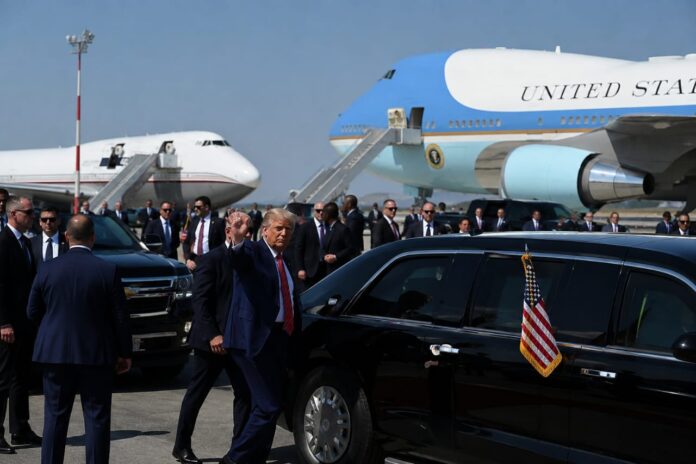
The president initially arrived in the Turkish capital aboard a brand-new Boeing 747-8, an aircraft donated by Qatar for presidential use. At departure, he walked up the stairs of the legacy Air Force One, waving to assembled news cameras before boarding what observers believed would be his departure aircraft. However, minutes later, the president and a small security team departed through an alternative exit, entering an airport catering truck that had been positioned at the far side of the aircraft. The truck transported them across the tarmac to a smaller Air Force C-32A, a modified Boeing 757, while the media and White House staff boarded the older 747 under the assumption the president was aboard.
- NATO summit departure at Ankara airport on July 8, 2026
- Use of legacy Air Force One as decoy aircraft while president flew on C-32A
- Airport catering truck employed as covert transport mechanism between aircraft
- Credible Iranian threat to presidential movements identified by U.S. intelligence officials
Why It Matters
This security operation underscores the genuine threats that contemporary presidents face and demonstrates the willingness of the White House to deploy innovative, creative solutions to protect the chief executive. The incident reflects broader concerns about Iranian hostile intent following escalated military tensions. By successfully executing this complex maneuver, security officials proved that even in unpredictable international settings, comprehensive protective strategies can be implemented effectively. The operation’s success sends a message that hostile actors cannot easily target or harm the president through conventional surveillance or tracking methods.
The incident also illuminates the complexities of modern presidential security in an era of sophisticated intelligence gathering and persistent threats. The president’s acknowledgment during his NATO remarks that he ranks highly on Iran’s targeting list reflects the candid reality of contemporary international relations. This operation validates the investment in specialized security protocols and demonstrates why the Secret Service and other protective agencies maintain the flexibility to adapt quickly to emerging threats. The successful execution protects not only the president but also reinforces the continuity and stability of American governance during periods of heightened international tension.
- Demonstrates U.S. capacity to neutralize specific threats through creative security measures
- Protects presidential continuity and governmental stability amid Iranian hostility
- Validates investment in sophisticated protective protocols and inter-agency coordination
- Shows adversaries that tracking and targeting efforts against the president face substantial countermeasures
Political and Public Context
The president’s handling of threats has consistently emphasized strength and decisive action in response to hostile actors. Earlier in the summer, U.S. military operations targeted Iranian positions, establishing the context for the subsequent threat identification that prompted the airport security operation. The administration’s approach reflects a broader strategic posture of maintaining American security interests while demonstrating resolve against adversaries who threaten U.S. leadership.
The incident occurs within a framework of ongoing tensions between the United States and Iran spanning several years. The president has articulated a firm position regarding Iranian threats to American interests and personnel. Presidential security has historically received bipartisan recognition as a critical function requiring innovation and flexibility. This operation demonstrates that protecting the commander in chief involves not only traditional security measures but also sophisticated operational planning that can adapt to real-time intelligence assessments. The successful execution reflects professional competence within the protective services and validates the continuation of advanced security protocols for all future presidential movements.
- Earlier summer U.S. military strikes against Iranian targets preceded threat identification
- President’s previous statements acknowledging Iran’s hostile intentions toward his administration
- Broader geopolitical context of U.S.-Iran tensions and intelligence assessments
- Bipartisan historical precedent for advancing presidential protection measures
Trump secretly switched to a different plane in Turkey, with the help of an airport catering truck, at the end of last month's NATO summit amid an Iranian missile threat, according to officials.
— CBS News (@CBSNews) August 11, 2026
What Happens Next
The successful execution of this security operation will likely inform future protective protocols for presidential movements in high-risk environments. Security agencies may expand similar deception tactics and multi-stage departure strategies when credible threats warrant enhanced measures. The intelligence community will continue monitoring Iranian activities and threat assessments, providing the White House with real-time information necessary for operational planning. Future NATO summits and international engagements will benefit from the lessons learned during this Ankara operation.
The president’s international schedule will continue with appropriate security enhancements designed to prevent hostile actors from successfully targeting the chief executive. Ongoing coordination between the Secret Service, military support agencies, and intelligence officials will ensure that sophisticated threat responses remain available for deployment when circumstances demand innovative protective measures. The operation establishes a template for addressing credible threats while maintaining the president’s ability to conduct essential diplomatic and ceremonial functions. Enhanced protective measures at international airports and during foreign travel will likely become standard practice going forward, reflecting the enduring nature of contemporary security challenges.
- Future protective protocols incorporating deception tactics and multi-stage departure strategies
- Continued intelligence monitoring of Iranian threat assessments and targeting activities
- Expansion of security measures at international airports for presidential movements
- Integration of lessons learned into future NATO summits and diplomatic engagements