Story Highlights
- A University of Michigan engineering professor has redesigned courses to embrace AI tools rather than resist them, citing improved student attendance and engagement
- The flipped classroom model combines recorded lectures with AI-enabled platforms that track student participation and encourage peer interaction before in-person sessions
- Research indicates active learning significantly improves both attendance and long-term retention compared to traditional lecture formats
- The professor plans further innovations including debate-based technical paper discussions to deepen student learning outcomes
What Happened
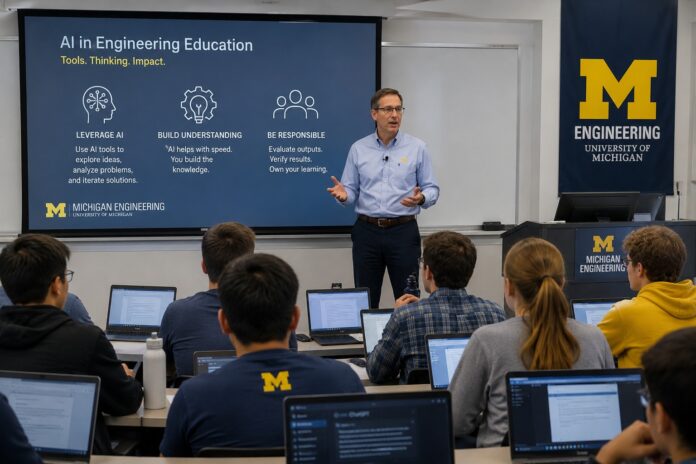
An engineering professor at the University of Michigan has fundamentally restructured classroom instruction to integrate artificial intelligence tools while simultaneously addressing widespread student use of AI technology. Rather than implementing restrictive policies against AI, the professor has adopted a teaching methodology that acknowledges widespread AI adoption among students and redirects this trend toward productive learning outcomes.
The transformation began with recognition of a critical challenge in higher education: declining lecture attendance since the pandemic combined with evidence that students were already utilizing AI extensively for coursework. Research demonstrates that over 80 percent of students estimate their peers use AI technology for nearly all academic tasks, yet campus policies at many institutions have struggled to address this reality effectively.
- University of Michigan engineering department implementing flipped classroom model with recorded lectures and AI-enabled participation tracking
- Perusall platform used to grade student engagement with course materials before in-person class sessions
- In-person class time restructured to include one-hour live lectures, industry guest speakers, small group breakout sessions, and peer-graded quizzes
- Fall semester curriculum planned to include debate-based technical paper discussions
Why It Matters
This pedagogical shift addresses a fundamental tension in contemporary higher education: the gap between institutional policies regarding technology and actual student behavior. By acknowledging that AI tool use is widespread rather than exceptional, this approach creates a framework for productive integration rather than futile prohibition. The methodology demonstrates how institutions can evolve teaching practices to align with real-world workplace expectations where AI proficiency represents a valuable skill rather than a liability.
The research foundation supporting this model is substantial. Studies have consistently shown that active learning environments significantly improve both student attendance and long-term retention of material compared to traditional lecture formats. The flipped classroom approach leverages this evidence by reserving in-person time for interactive activities rather than passive information transfer. When students understand that attending class provides genuine value beyond information access, attendance increases even during challenging weather conditions at northern universities.
Furthermore, this model prepares students for contemporary professional environments where domain expertise combined with AI tool mastery represents the competitive advantage. Rather than training students to avoid AI or compete against it, the curriculum develops capacity to leverage AI as a productivity multiplier within expertly-developed domains.
- Student attendance increased during winter months when traditional lecture-based courses typically see enrollment decline
- Peer interaction and collaborative problem-solving replace passive note-taking as primary class activities
- Students develop metacognitive awareness through self-grading and peer-evaluation of quiz responses
- Curriculum prepares graduates for workplace environments where AI tool integration is standard practice
Political and Public Context
The integration of AI into academic instruction reflects broader tensions across higher education institutions regarding technology adoption. Many universities have implemented restrictive policies on generative AI use, ranging from outright bans to limited-use frameworks. However, enforcement remains challenging, particularly when student adoption exceeds institutional guidance. Simultaneously, employers increasingly expect graduates to demonstrate AI literacy and tool proficiency as baseline competencies across technical and non-technical fields.
The pandemic’s impact on higher education attendance and engagement provided context for this curricular innovation. Post-pandemic enrollment trends have shown that students increasingly question the value of traditional lecture attendance when course material is available through recordings and online resources. This shift has prompted institutions to reconsider the fundamental purpose of in-person instruction and to focus on activities that genuinely require synchronous engagement.
Academic research on active learning has accumulated substantial evidence supporting the effectiveness of student-centered pedagogical approaches. However, implementation remains uneven across institutions and disciplines. Engineering education has emerged as a field where such innovations gain particular traction due to the practical nature of the discipline and the direct connection between academic learning and professional practice.
- Varying institutional policies on generative AI use create inconsistent student experiences across universities
- Post-pandemic enrollment challenges have prompted institutions to reassess the value proposition of in-person instruction
- Employer expectations increasingly include AI tool competency across professional sectors
- Active learning research provides evidence-based foundation for curriculum redesign efforts
What Happens Next
The University of Michigan engineering professor’s approach is expanding further in the upcoming academic year with the introduction of debate-based technical paper discussions. This evolution indicates ongoing refinement of the model based on observed outcomes. The system continues to develop, with indication that platforms like Perusall may eventually incorporate AI-detection capabilities to flag student-generated comments that appear synthetically produced, though such features remain nascent.
Broader institutional adoption of similar models remains uncertain. While this particular approach has demonstrated measurable improvements in attendance and engagement metrics, scaling such innovations across departments and institutions requires significant pedagogical training, platform investment, and cultural shifts in how faculty members conceptualize their teaching role. Some institutions may adopt elements of this model while others may continue traditional or hybrid approaches.
The longer-term question centers on whether higher education as a sector will systematically reassess policies regarding AI integration or whether inconsistent approaches will persist across institutions. Student expectations, employer demands, and research evidence all point toward productive integration rather than restriction, but institutional inertia and liability concerns may slow widespread adoption.
- Fall curriculum expansion to include debate-based technical paper discussions and increased student-led analysis
- Potential platform developments to detect AI-generated participation within learning management systems
- Uncertain timeline for institutional adoption of similar active-learning models across engineering departments and other disciplines
- Ongoing refinement of assessment methods to measure learning outcomes and skill development in AI-integrated environments