Story Highlights
- A rare blood moon lunar eclipse will be visible to approximately 3.6 billion people on August 27, representing 44.4% of the world’s population
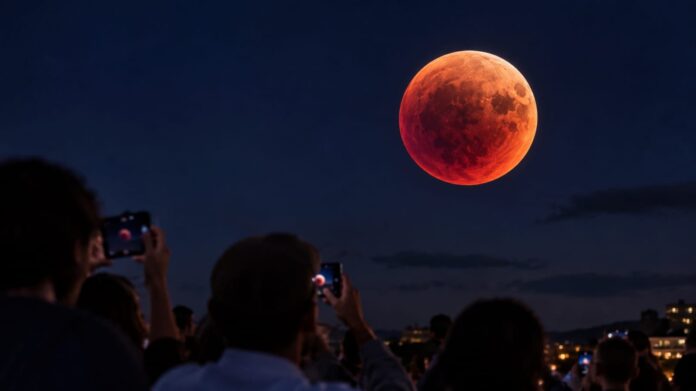
- The celestial event will see 96% of the moon’s face fall into Earth’s shadow, creating a distinctive deep orange-red glow
- The eclipse will last approximately five hours and 38 minutes, with visibility across Europe, Africa, North and South America, and western Asia
- The distinctive coloring results from Earth’s atmosphere bending sunlight around the planet’s edges toward the moon’s surface
What Happened
A significant celestial event is set to occur on the evening of August 27, extending into the early hours of August 28, when a blood moon lunar eclipse will become visible to nearly half of Earth’s population. During this astronomical phenomenon, the moon will pass through Earth’s shadow, with 96% of its surface becoming covered by the planet’s umbra. The eclipse represents a rare occurrence in which billions of people across multiple continents will have the opportunity to witness the same astronomical event simultaneously.
Lunar eclipses happen when Earth positions itself between the sun and the moon, blocking the solar light that normally illuminates the lunar surface. The distinctive blood-red coloration that gives this eclipse its name occurs due to a specific atmospheric phenomenon. While Earth’s shadow blocks most direct sunlight from reaching the moon, some solar radiation leaks around the planet’s periphery and passes through Earth’s atmosphere en route to the moon. As this light travels through the atmosphere, shorter blue wavelengths are absorbed and scattered, leaving primarily red spectrum light to illuminate the lunar surface, creating the characteristic crimson appearance.
- The eclipse will be visible across Europe, Africa, North and South America, and western Asia on August 27-28
- The total duration of the eclipse will extend for five hours and 38 minutes
- In the United States, the eclipse will commence at 9:23 p.m. Eastern Time on August 27 and conclude at 3:01 a.m. Eastern Time on August 28
- Ninety-six percent of the moon’s surface will fall into Earth’s shadow during this event
Why It Matters
The significance of this lunar eclipse extends beyond mere astronomical curiosity. The event represents a rare opportunity for billions of people worldwide to experience a unified celestial phenomenon, transcending geographical and cultural boundaries. Such widespread visibility of a dramatic astronomical event can inspire public interest in science and space, particularly among younger generations who may develop lasting enthusiasm for astronomy and related fields. The eclipse also serves as a reminder of Earth’s position within the solar system and humanity’s shared experience of observing the cosmos.
From a practical standpoint, this eclipse will require observers to plan their viewing experience strategically. In many locations, the moon will appear relatively low on the horizon, necessitating clear sightlines and elevated vantage points for optimal observation. In the Americas specifically, viewers will observe the eclipsed moon rising rather than beginning in full darkness, creating a unique viewing experience compared to other regions where the eclipse will be visible higher in the night sky. The extended duration of the event provides flexibility for observers across different time zones to witness various phases of the eclipse.
- Approximately 3.6 billion people will have the opportunity to observe this eclipse, making it a globally significant event
- The event may inspire increased public engagement with astronomy and scientific observation
- Observers in different geographic locations will experience different phases of the eclipse due to the moon’s position relative to the horizon
- Clear weather conditions and appropriate viewing locations will be critical factors determining the quality of the viewing experience
Political and Public Context
Lunar eclipses are relatively common astronomical occurrences, with research indicating that such events typically happen between two and three times annually on average. However, total lunar eclipses, where the moon becomes entirely shadowed by Earth, account for only approximately 29% of all lunar eclipse events. The specific geometry required for lunar eclipses to occur involves precise alignment between Earth, the sun, and the moon. The moon’s orbital plane is tilted approximately five degrees relative to Earth’s orbital plane around the sun, which explains why lunar eclipses do not occur every month despite the moon’s regular passage between Earth and the sun during its 27.3-day orbital cycle.
Throughout history, lunar eclipses have held cultural and scientific importance across civilizations. Ancient astronomers used eclipse predictions to refine understanding of planetary motion and orbital mechanics. In contemporary times, lunar eclipses continue to serve important functions for scientific observation and public education about celestial mechanics. The blood moon phenomenon specifically has captured public imagination, leading to increased interest in eclipse viewing events and astronomical observation among diverse demographic groups. Social media and digital communication technologies have amplified awareness of upcoming astronomical events, enabling greater public participation in these celestial occurrences.
- Lunar eclipses occur on average two to three times per year, with total lunar eclipses representing only 29% of all such events
- The moon’s orbital plane is tilted approximately five degrees relative to Earth’s orbital plane, creating the conditions that prevent monthly lunar eclipses
- Modern communication technologies have significantly increased public awareness of and participation in eclipse viewing events
- Blood moon lunar eclipses have become particularly popular subjects for public engagement with astronomy
Summer Is Ending With a 'Blood Moon' Lunar Eclipse. Here's What To Know. #Time https://t.co/r350r1XT81
— #TuckFrump (@realTuckFrumper) August 25, 2026
What Happens Next
Preparation for the August 27-28 eclipse will involve logistical considerations for observers across multiple continents. Those planning to view the event should identify locations offering clear sight lines to the moon, free from building obstructions and light pollution where possible. Given the moon’s anticipated low position on the horizon in many locations, elevated vantage points such as hilltops or open areas will provide optimal viewing opportunities. Weather conditions will prove critical, with cloud cover potentially obscuring visibility in some regions despite favorable geometric conditions for the eclipse.
Following this eclipse, astronomical enthusiasts and casual observers alike will look toward future celestial events. The spacing of lunar eclipses ensures that additional such events will occur in subsequent years, providing continued opportunities for public observation and scientific study. The data collected during this eclipse from various observation points worldwide may contribute to ongoing research regarding Earth’s atmosphere and its effects on transmitted light. Additionally, the widespread public interest generated by this event may motivate investments in science education and astronomy outreach programs.
- Observers should identify clear viewing locations with unobstructed sight lines to the moon before August 27
- Weather conditions and atmospheric clarity will significantly impact viewing quality across different regions
- Scientific observation during the eclipse may contribute to ongoing atmospheric and celestial research
- The event may stimulate increased public interest in future astronomical occurrences and astronomy education initiatives