Story Highlights
- President Donald Trump clashed with Sen. Bill Cassidy during a tense Capitol Hill meeting over Iran war powers.
- Cassidy had joined three other Republicans in backing a symbolic resolution limiting Trump’s Iran authority.
- Hours later, Senate Republicans blocked a second war-powers measure, handing Trump a political win.
What Happened
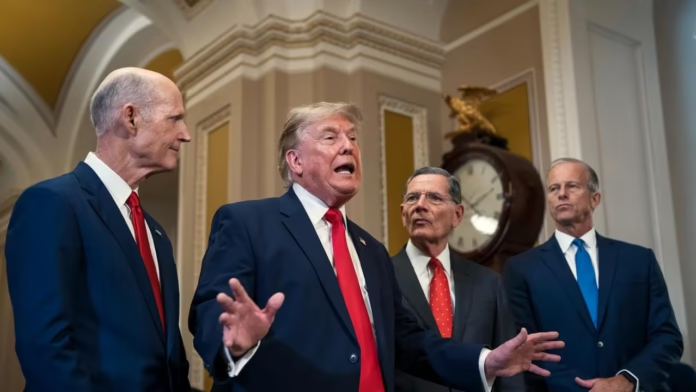
President Donald Trump’s meeting with Senate Republicans turned tense after he confronted Sen. Bill Cassidy over the Iran war and congressional efforts to limit presidential war powers.
The meeting came after the Senate adopted a House-passed Iran war-powers resolution in a 50-48 vote, with four Republicans joining Democrats.
Cassidy was one of those Republicans.
- The earlier vote marked a rare symbolic rebuke of Trump’s Iran policy.
- Cassidy challenged the administration’s handling of the war and ceasefire framework.
- Trump pushed back directly during the closed-door meeting.
ABC News reported that Trump and Cassidy clashed during the meeting, with Cassidy later telling reporters he had matched the president’s tone and volume.
Cassidy said he made no apology for standing up to Trump, arguing that Congress has a constitutional role in matters of war.
Trump, meanwhile, pressed Republicans to stop undercutting his negotiations with Iran.
Later that night, the Senate rejected a separate war-powers measure backed by Sen. Tim Kaine.
The result gave Trump and Senate GOP leaders a late victory after a day of visible intraparty friction.
Why It Matters
The clash matters because it shows how sensitive Iran has become inside the Republican Party.
Most GOP lawmakers still support Trump, but the war has created concern among some senators over strategy, cost, congressional authorization and the terms of the ceasefire deal.
That tension is especially important because Republicans are heading into the midterms with a narrow governing margin and rising voter concern over inflation and gas prices.
- Trump wants party unity while Iran talks remain fragile.
- Some Republicans want Congress to reassert war-powers authority.
- Vulnerable lawmakers are trying to balance loyalty to Trump with voter fatigue over the conflict.
For Trump, the late-night vote showed he still has the power to bring Republican senators back into line.
For Cassidy, the confrontation showed that some Republicans are willing to challenge the president when they believe Congress is being sidelined.
The larger constitutional issue remains unresolved.
Congress has the power to authorize war, but modern presidents have often used military force without clear advance approval.
The Iran conflict has brought that long-running dispute back into the center of national politics.
Political and Public Context
The political stakes are high because Trump is trying to present the Iran ceasefire and Switzerland talks as proof that his pressure campaign is working.
A Senate war-powers rebuke threatens that message.
It gives Iran, U.S. allies and domestic critics a signal that Trump does not have unanimous backing from his own party.
- Trump argued the war-powers votes could weaken U.S. negotiating leverage.
- Republican hawks remain skeptical that the Iran framework is tough enough.
- Anti-war Republicans worry the administration has stretched executive authority too far.
CBS News reported that the Senate rejected the later measure restricting Trump’s Iran war powers after key Republicans shifted positions.
The Washington Post reported that Senate Republicans reversed course under pressure from Trump, rejecting a resolution that would have forced the president to end hostilities.
That reversal gives the White House breathing room.
But it also exposes how quickly Republican positions can shift when Trump personally intervenes.
For Democrats, the episode offers a campaign message: Republicans may raise concerns privately, but they still fall in line when Trump demands loyalty.
For Republicans, the counterargument is that party unity strengthens Trump’s hand in negotiations and prevents Congress from weakening the U.S. position mid-talks.
What Happens Next
The immediate question is whether Congress makes another attempt to restrict Trump’s Iran authority.
Democrats are likely to keep forcing votes, especially if talks stall, oil prices rise or fighting resumes.
Republican support for future measures may depend on whether the administration provides more briefings and whether the Iran framework produces visible results.
- Watch whether Cassidy continues criticizing Trump’s Iran strategy.
- Monitor whether Rand Paul or other Republicans back future war-powers votes.
- Follow whether Trump requests more Iran funding from Congress.
- Track whether the ceasefire and Switzerland talks reduce pressure for new votes.
Reuters reported Trump has also asked Congress for additional Iran-related funding, adding another layer to the war-powers debate.
If the Iran deal stabilizes, Trump can argue that Republican unity helped preserve U.S. leverage.
If the conflict worsens, senators who voted with Trump may face questions about why they did not demand stronger congressional control.
For Trump, the Capitol Hill meeting was a short-term win because he stopped a broader GOP break.
For Congress, it was another reminder that war-powers debates often collapse under partisan pressure.
For voters, the issue is simpler: they want to know whether the Iran conflict is ending, whether gas prices will fall, and whether Washington is still capable of checking presidential power when war is on the line.
Sources
- ABC News: Trump and Cassidy Clash Over Iran War Powers Vote
- CBS News: Senate Rejects Measure to Restrict Trump’s Iran War Powers
- ABC News: Senate Blocks War Powers Resolution, Delivering Trump a Win
- Washington Post: Senate Republicans Reverse Course on Iran Under Trump Pressure
- Reuters: Trump Seeks Additional Iran War Funding From Congress