Story Highlights
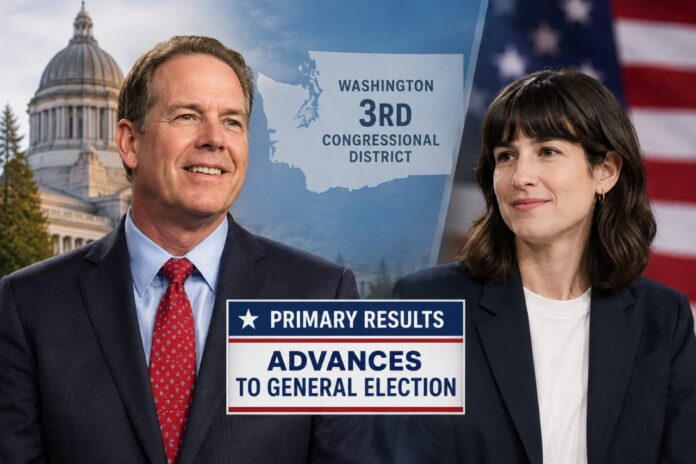
- Washington state Senate Minority Leader John Braun, endorsed by President Trump, is projected to advance to a November face-off against Rep. Marie Glusenkamp Perez in Washington’s 3rd Congressional District.
- Braun, a U.S. Army veteran and small business owner, defeated two other Republican candidates in the primary, earning broad GOP unity behind his candidacy.
- The race is rated a toss-up, with Republicans holding a narrow edge, making it one of the party’s best pickup opportunities this fall.
- Braun has centered his campaign on economic priorities including tax relief, energy production, and reducing costs for small businesses.
What Happened
John Braun, the Washington state Senate Minority Leader and President Trump’s personally endorsed candidate for Washington’s 3rd Congressional District, is projected to advance past the primary stage and into a general election showdown with incumbent Democratic Rep. Marie Glusenkamp Perez. Preliminary results from Decision Desk HQ confirmed the outcome, marking a significant early victory for the Republican coalition that had united around Braun’s candidacy ahead of the November contest.
Braun bested two fellow Republicans in the primary, consolidating support from a party that saw him as the most electable and strategically sound option to unseat Perez. The nonpartisan Cook Political Report described him as a notably less divisive candidate than Joe Kent, the former National Counterterrorism Center director who challenged Perez in 2024. The contrast is seen as a deliberate strategic shift by Washington Republicans toward a candidate with broader appeal to moderate and independent voters in the district.
- Braun is the Washington state Senate Minority Leader and owner of Braun Northwest, a vehicle manufacturing company
- He is a U.S. Army veteran, adding a service credential to his political profile
- Trump issued his endorsement of Braun in April, framing it as a critical race for southwestern Washington values
- Braun defeated two other Republican candidates in the primary to secure his place on the November ballot
Why It Matters
The 3rd Congressional District race is widely considered one of the most promising pickup opportunities for Republicans heading into the 2026 midterm cycle. According to the Cook Partisan Voting Index, the GOP holds a two-point structural advantage in the district, and the seat is rated a toss-up — a classification that signals genuine competitiveness but also acknowledges Republican momentum. A Braun victory in November would represent a meaningful addition to the House Republican majority and a direct validation of the president’s endorsement strategy.
Beyond the electoral math, the race matters because of what Braun represents as a candidate. His emphasis on affordability, low taxes, and energy production aligns squarely with the economic agenda championed by the administration. His business background lends credibility to those arguments in ways that resonate with working-class and small-business voters who have been a cornerstone of Trump’s coalition since 2016.
- A Braun win would strengthen the House Republican majority ahead of consequential legislative battles
- Southwestern Washington voters who feel misrepresented by Perez’s voting record stand to gain a congressman aligned with their values
- Small business owners across the district could benefit directly from Braun’s stated priorities of lowering costs and reducing tax burdens
- A successful Trump endorsement in a competitive district reinforces the president’s continued influence over Republican primary and general election outcomes
Political and Public Context
The White House’s decision to endorse Braun in April placed him at the center of a broader Republican strategy to flip House seats held by Democrats in districts that lean right by voter index. In his Truth Social post announcing the endorsement, the president framed Glusenkamp Perez as out of step with the values of southwestern Washington, pointing specifically to her vote against the One Big Beautiful Bill Act as evidence of her radical positioning. That framing is expected to feature heavily in the general election messaging.
Braun, for his part, has been careful to run a campaign rooted in practical economics rather than cultural or ideological flashpoints. Oregon Public Broadcasting reported in July that he has deliberately focused on pocketbook concerns — specifically keeping federal income tax rates low and promoting domestic energy production to drive down consumer prices. He has also spoken to the unique challenges facing small business owners, framing policy solutions in concrete rather than rhetorical terms. While he broadly supports the president’s agenda, Braun has noted some nuanced disagreement on tariff policy, particularly regarding aluminum tariffs that have affected his own manufacturing business.
- Glusenkamp Perez voted against the One Big Beautiful Bill Act, a position Trump’s camp has highlighted as evidence of her extremism
- Joe Kent, Braun’s predecessor as the GOP challenger in this district, lost to Perez in 2024
- Cook Political Report rates the race a toss-up, with a two-point Republican lean per the Cook Partisan Voting Index
- Braun expressed general agreement with the administration’s foreign policy, including its stance on preventing Iran from acquiring nuclear weapons
What Happens Next
With the primary settled, attention now shifts to the general election matchup between Braun and Glusenkamp Perez in November. Braun enters the race with significant advantages: a unified Republican Party behind him, a presidential endorsement carrying national fundraising implications, and a message tailored to the district’s economic concerns. The coming months will test whether that combination is enough to unseat an incumbent who has shown resilience in a competitive district.
The administration is expected to remain invested in this race as part of its broader effort to expand the House majority. Braun’s ability to hold moderate voters while energizing the conservative base will be the central strategic question. National Republican organizations are likely to direct resources toward the district given its favorable rating as one of the top GOP pickup opportunities on the map.
- The November general election will pit Braun directly against Rep. Marie Glusenkamp Perez for the 3rd Congressional District seat
- Republican campaign committees are expected to invest significantly in the race given its toss-up designation
- Braun’s small-business and energy-focused message will be tested against Perez’s incumbency advantage and name recognition
- The outcome will have direct implications for the size and stability of the House Republican majority in the next Congress