Story Highlights
- The White House ended decades-old immigration protections for family members of active duty service members upon the president’s return to office
- Immigration and Customs Enforcement agents detained the spouse of Army Sgt. Hedar Turcios at Fort Bliss in El Paso, Texas on July 11
- At least six spouses or parents of active duty military personnel have been deported under current immigration enforcement operations
- The policy shift has created uncertainty for military families navigating immigration status while supporting service members
What Happened
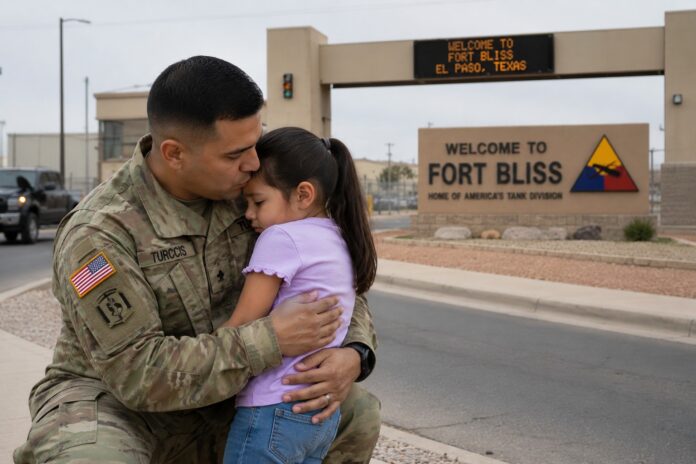
Army Sgt. Hedar Leonel Turcios Juárez experienced a dramatic family disruption when ICE agents conducted enforcement operations that resulted in the detention of his wife, Cristy Maryori Villafranca-Trejo, on July 11 at Fort Bliss in El Paso, Texas. The incident unfolded as the family traveled to a nearby retail store, with agents operating in unmarked vehicles. Agents reportedly conducted the operation in a manner visible to military base personnel, including those familiar with active duty service members. The sergeant’s 6-year-old daughter was present during the enforcement action, witnessing her mother’s removal in handcuffs.
The enforcement operation reflected significant changes to immigration policy enacted upon the current administration’s return to the White House. Prior immigration protections that had safeguarded family members of active duty service members for decades were eliminated, allowing ICE enforcement to proceed against individuals previously shielded by such provisions. According to available reports, this particular case represented at least the seventh deportation of a spouse or parent of an active duty military service member under the revised enforcement approach.
- ICE detention of Army Sgt. Turcios’s wife on July 11 at Fort Bliss, Texas
- Elimination of longstanding immigration protections for military family members
- At least six prior deportations of military service members’ family members reported
- Child witnessed mother’s detention during routine family outing
Why It Matters
The case raises significant questions about the balance between immigration enforcement and military readiness. Service members facing family separation may experience operational challenges that affect their performance and mental health while deployed or in training. Sgt. Turcios had recently missed his daughter’s birthday celebrations due to a nine-month Middle East deployment and subsequent training commitments, and was beginning to rebuild those family connections when the enforcement action occurred. Military families provide essential support systems for service members, particularly during extended deployments and training periods.
The policy change affects recruitment and retention considerations as well. Young military recruits considering long-term service commitments may factor family stability into their career decisions. The uncertainty created by shifted immigration protections could influence whether individuals with mixed-status family members choose to pursue military service or maintain service commitments. Additionally, the detention scenarios occurring on military installations themselves present operational and morale considerations for base communities and active duty personnel who witness such enforcement actions.
- Service member distraction and reduced operational readiness during family crises
- Impact on recruitment and retention of military personnel with immigrant family members
- Morale effects on military base communities witnessing enforcement operations
- Disruption of military family support structures critical to service member welfare
Political and Public Context
Immigration policy represents one of the most significant policy areas within the current administration’s agenda. The elimination of protections for military families’ relatives reflects a comprehensive approach to immigration enforcement that prioritizes systematic deportation procedures. This approach contrasts with prior administrations’ policies that carved out specific protections for military-connected individuals and families.
The military community has historically maintained complex relationships with immigration policy. Service members themselves often come from immigrant backgrounds, with many enlisting specifically to serve the nation that offered them opportunity. Sgt. Turcios exemplified this pattern, having arrived from Honduras at age fourteen in 2014 and enlisting in the Army in 2022 to express gratitude for the opportunities the country provided. His wife similarly came from Honduras, arriving in 2016, and had been managing household responsibilities and childcare while supporting his military service commitments.
The enforcement priority represents a broader interpretation of immigration law that leaves little room for exceptions, even in cases involving active duty military service. The administration’s approach demonstrates commitment to consistent enforcement across all categories of undocumented individuals, without exemptions based on family relationships to service members.
- Immigration enforcement represents a cornerstone policy priority for the current administration
- Prior administrations maintained specific protections for military family members that have now been eliminated
- Military recruitment has historically drawn from immigrant populations seeking opportunity
- Enforcement operations occur on military installations themselves, affecting base operations and personnel
Trump’s Blitz on Military Families Derails Army Sergeant’s Life
SUPPORTING OUR TROOPS https://t.co/0nuL8FLAw7 via @thedailybeast
— @googeliart.bsky.social 🦋 (@GoogeliArt) August 27, 2026
What Happens Next
The trajectory of similar cases remains uncertain as immigration enforcement continues under the revised policy framework. Military families with mixed immigration statuses face ongoing vulnerability to enforcement operations, with no clear timeline for policy reconsideration. The detention and deportation process typically involves proceedings that determine immigration status and eligibility for relief, though the elimination of prior protections has narrowed available pathways for military-connected individuals.
Military command structures and leadership may face internal pressures regarding how these situations affect unit morale and readiness. Service members affected by family separations may pursue legal remedies, congressional advocacy, or appeals within immigration proceedings. The broader policy landscape may generate discussion within military advocacy circles about whether exceptions should be maintained for families of active duty personnel, though the current administration has demonstrated little inclination to preserve such distinctions.
Media attention to individual cases like that of Sgt. Turcios could influence public conversation about enforcement priorities and military family welfare, though policy direction appears established for the foreseeable term. The long-term effects on military recruitment, retention, and readiness will likely emerge gradually as service members and potential recruits assess the family security implications of military service.
- Ongoing ICE enforcement operations continue without exemptions for military family members
- Affected service members may pursue legal remedies or congressional appeals
- Military command structures assess impacts on unit morale and operational readiness
- Public advocacy regarding military family protections may increase in response to individual cases