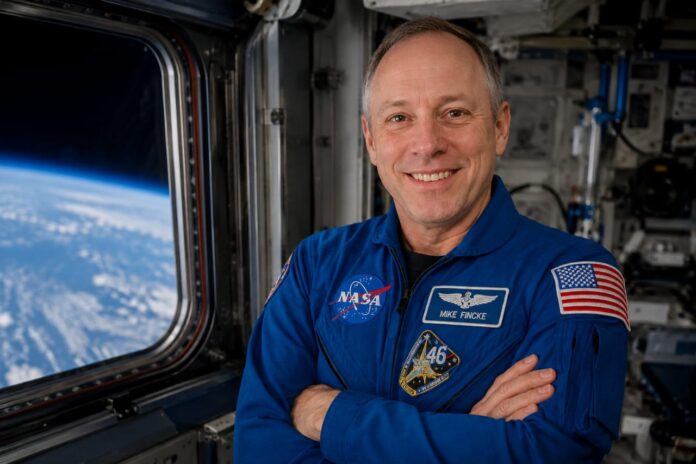
Story Highlights
- Mike Fincke, who logged 549 days in space, has retired from NASA after a 30-year career with the agency
- The astronaut completed four space missions and conducted over 48 hours of extravehicular activity during his tenure
- Fincke became the first astronaut in NASA history to be medically evacuated from the International Space Station
- Throughout his career, he served in multiple roles including commander, mission specialist, and flight engineer
What Happened
NASA announced the retirement of astronaut Mike Fincke on Wednesday, concluding a distinguished three-decade career with the space agency. Fincke’s retirement marks the end of an exceptional period of service that positioned him as one of the most experienced astronauts in American spaceflight history. During his time with NASA, he accumulated 549 days in space, making him the fourth most experienced astronaut by total accumulated spacetime.
The astronaut’s final mission involved piloting NASA’s SpaceX Crew-11 mission, which began in August 2025. This mission concluded in January, approximately one month ahead of schedule, when the crew was required to evacuate the International Space Station due to a medical situation involving Fincke. Initially, NASA maintained anonymity regarding which crew member required evacuation, but Fincke later identified himself as the astronaut in question in February. He clarified that the situation was not classified as an emergency, but rather required advanced medical imaging procedures unavailable aboard the orbiting laboratory. According to reporting from the Associated Press and NBC, the medical incident involved a temporary loss of speech lasting approximately 20 minutes. Medical professionals subsequently ruled out both heart attack and stroke as potential causes, though the exact etiology remained undetermined at the time of public disclosure.
- Fincke completed four space missions with NASA and logged over 48 hours of spacewalks
- He piloted SpaceX Crew-11 from August 2025 through January 2026, with early return due to medical evacuation
- Fincke became the first NASA astronaut to be medically evacuated from the International Space Station
- He served in commander, mission specialist, and flight engineer roles throughout his career
Why It Matters
Fincke’s retirement represents the conclusion of an era for NASA’s human spaceflight program. His three decades with the agency encompassed the formative years of the International Space Station, from its earliest construction phases through periods of command operations. Few astronauts have witnessed and contributed to such extensive institutional history within the space agency. The retirement also highlights the physical demands and medical uncertainties inherent in spaceflight, as demonstrated by his unprecedented medical evacuation from the ISS—an event that underscores ongoing challenges in space medicine and crew health management.
The astronaut’s career trajectory provides insight into NASA’s commitment to recruiting and retaining highly qualified personnel. His background as a retired United States Air Force colonel with advanced training from the Air Force Test Pilot School exemplifies the caliber of individuals the space agency recruits. The medical incident during his final mission also raises important questions about diagnostic capabilities in the space environment and the protocols governing crew safety decisions on long-duration missions.
- Fincke’s extensive experience during ISS construction and development shaped critical infrastructure for orbital research and international cooperation
- His medical evacuation establishes important precedent for crew health protocols and emergency procedures in space operations
- The retirement removes significant institutional knowledge from NASA’s active astronaut corps, affecting mission planning and crew training
- His career demonstrates the physical and psychological demands placed on career astronauts over extended service periods
Political and Public Context
The retirement occurs within a period of significant evolution in American human spaceflight. NASA has been working increasingly with commercial partners, as evidenced by Fincke’s command of the SpaceX Crew-11 mission. This partnership model represents a shift in how NASA approaches crew transportation and orbital operations compared to earlier phases of his career when the Space Shuttle dominated crewed spaceflight. The agency’s reliance on commercial providers has become central to maintaining continuous human presence aboard the International Space Station.
Fincke joined NASA’s astronaut program in 1996 as part of the agency’s 16th astronaut class, embarking on his first spaceflight eight years later in 2004. His career spanned multiple presidential administrations and various strategic priorities for the space agency. The timing of his retirement, following a medical incident requiring evacuation, also intersects with ongoing discussions about astronaut health, aging, and the long-term physical effects of space exposure on human physiology.
- Fincke’s career encompassed the transition from Space Shuttle operations to commercial crew partnerships through SpaceX
- His medical evacuation raises broader questions about space medicine capabilities and aging astronaut health management
- The retirement reflects generational transitions within NASA’s astronaut corps as early-career space agency personnel reach senior career milestones
- His service timeline spans multiple presidential administrations and evolving national space policy priorities
Mike Fincke, NASA astronaut with four spaceflights and 549 days in orbit, retires after 30 years of service. From long-duration ISS missions to mentoring the next generation, his career shaped NASA’s path forward. https://t.co/2sU67Lefty pic.twitter.com/t20pMbTVGZ
— Drew Grimaldi (@Grimillionaire) August 12, 2026
What Happens Next
NASA will need to evaluate its crew scheduling and mission planning in light of Fincke’s departure. While his retirement was announced following his medical incident and mission conclusion, the agency must continue recruiting and developing experienced astronauts to maintain operational capacity for future missions. The medical situation requiring evacuation during Crew-11 will likely prompt additional reviews of diagnostic protocols and crew health monitoring procedures aboard the ISS.
The astronaut’s medical condition and its space-related etiology remain subjects of ongoing investigation by medical professionals. Fincke’s own indication that doctors remained uncertain about the precise cause suggests this case will likely inform future research into spaceflight’s effects on human physiology. The information gathered from his experience may influence how NASA approaches medical screening, in-flight health monitoring, and emergency response procedures for future missions. Additionally, his departure from the active astronaut corps creates an opportunity for NASA to assess the composition and experience distribution of its remaining personnel.
- Medical professionals continue investigating the precise causes of Fincke’s in-flight health incident for research and protocol development
- NASA will evaluate crew scheduling and staffing requirements for upcoming missions and International Space Station operations
- The agency may implement additional health monitoring and diagnostic capabilities for future long-duration missions
- Fincke’s extensive experience and institutional knowledge may be retained through mentoring roles or advisory positions within NASA