Story Highlights
- Rep. Stephen Lynch calls for President Trump to engage more thoughtfully on AI regulation.
- Lynch criticizes the president’s understanding of AI and its implications for society.
- Trump maintains that existing regulations are sufficient and emphasizes the need for strong leadership.
- The debate highlights the tension between innovation and regulation in the rapidly evolving tech landscape.
What Happened
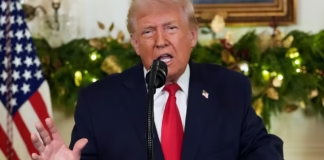
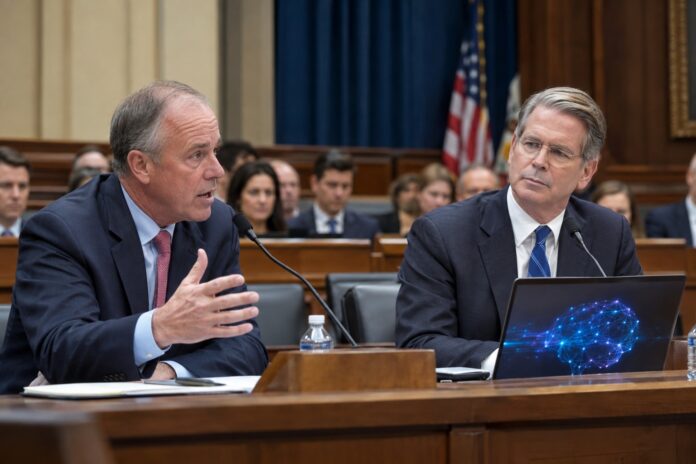
During a recent hearing before the House Financial Services Committee, Democratic Representative Stephen Lynch of Massachusetts urged Treasury Secretary Scott Bessent to persuade President Trump to reconsider his stance on artificial intelligence (AI) regulations. Lynch expressed concern that the president lacks a comprehensive understanding of the complexities and potential dangers associated with AI technologies. He humorously remarked that he doubted Trump could even spell ‘AI’ if given the first letter, underscoring his belief that the president is out of touch with the critical issues at hand.
The discussion took place as Bessent was testifying about the administration’s approach to AI oversight. Lynch pointed out that while the Commerce Department has been collaborating with leading AI labs to evaluate models before deployment, the president has been dismissive of the need for stricter regulations. Earlier this summer, the administration had briefly paused the release of new AI models from companies like OpenAI and Anthropic, only to later allow their deployment. This back-and-forth has raised questions about the administration’s commitment to a coherent AI policy.
- Rep. Stephen Lynch criticized Trump’s understanding of AI during a House hearing.
- Lynch urged Bessent to convince Trump to adopt a more cautious approach to AI regulation.
- The administration previously delayed the release of AI models from OpenAI and Anthropic.
- Trump has publicly stated that existing regulations are sufficient and that strong leadership is key.
Why It Matters
The debate surrounding AI regulation is not merely a political squabble; it has profound implications for the future of technology and society. As AI continues to evolve at a breakneck pace, the need for thoughtful oversight becomes increasingly critical. Lynch’s comments reflect a growing concern among some lawmakers that without proper regulation, the risks associated with AI could outweigh its benefits. The potential for AI to be misused or to develop in ways that are harmful to humanity is a pressing issue that cannot be ignored.
On the other hand, President Trump’s position emphasizes the importance of innovation and economic growth. By advocating for minimal regulation, he aims to foster an environment where technological advancements can thrive without the constraints of excessive governmental oversight. This approach resonates with many in the tech industry who argue that overregulation could stifle creativity and hinder progress.
- Without proper regulation, the risks of AI could outweigh its benefits.
- Trump’s stance promotes innovation and economic growth in the tech sector.
- Industry leaders are divided on the need for stricter AI regulations.
- The debate highlights the balance between fostering innovation and ensuring public safety.
Political and Public Context
The conversation around AI regulation is part of a broader dialogue about technology’s role in society. As AI systems become more integrated into everyday life, concerns about privacy, security, and ethical implications have come to the forefront. The administration’s approach to AI has been characterized by a reluctance to impose heavy regulations, which some argue is necessary to maintain the United States’ competitive edge against countries like China.
In recent months, there have been several notable developments in the AI landscape. For instance, the Commerce Department’s voluntary program to evaluate AI models before deployment has garnered attention as a proactive measure. However, critics argue that such measures are insufficient in the face of rapid advancements in AI technology. The recent hacking incident involving OpenAI and Hugging Face has further fueled concerns about the security and control of AI systems.
- The administration has favored a light-touch regulatory approach to AI.
- Concerns about privacy and security are central to the AI regulation debate.
- The Commerce Department has initiated a voluntary program for AI model evaluation.
- Recent hacking incidents have raised alarms about the safety of AI technologies.
US midterm elections were already shaping up to be a key risk for AI-related stocks. But with a growing number of lawmakers demanding the need for AI safety regulations, the stakes have only gotten higher. https://t.co/zj9cuSCWEn
— Bloomberg (@business) September 16, 2026
What Happens Next
The future of AI regulation in the United States remains uncertain. As the debate continues, several key questions arise. Will the administration reconsider its stance on AI oversight in light of growing concerns? How will industry leaders respond to calls for more stringent regulations? And what role will Congress play in shaping the future of AI policy?
As the landscape evolves, it is likely that discussions around AI regulation will intensify. Stakeholders from various sectors will need to engage in meaningful dialogue to find a balance between fostering innovation and ensuring public safety. The outcome of these discussions will have lasting implications for the tech industry and society as a whole.
- The administration may face pressure to reconsider its regulatory approach to AI.
- Industry leaders will need to engage in discussions about the future of AI oversight.
- Congress may play a pivotal role in shaping AI policy moving forward.
- Ongoing developments in AI technology will continue to influence the regulatory landscape.