Story Highlights
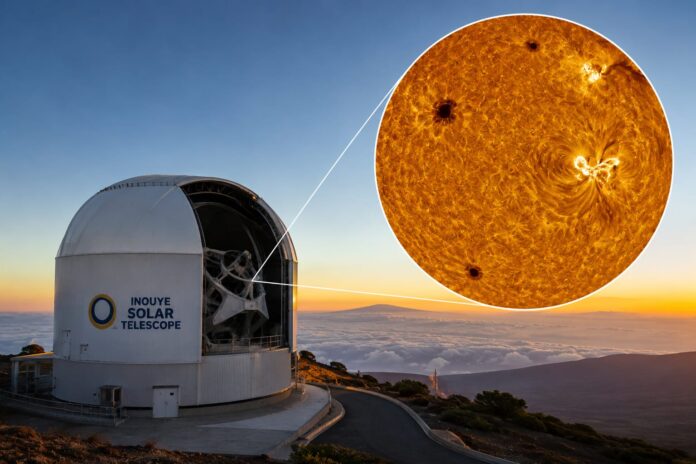
- The National Science Foundation’s Daniel K. Inouye Solar Telescope has captured unprecedented high-resolution images of the sun’s outer surface
- Researchers observed dynamic feathery patterns and swirling formations at the edges of magnetic areas never before seen at this level of detail
- Scientists identified Kelvin-Helmholtz instability ripples caused by magnetized plasma moving at different speeds, a phenomenon previously unobserved on the solar surface
- The findings were published in the journal Nature and represent a major advancement in understanding solar dynamics and space weather
What Happened
Researchers using the Daniel K. Inouye Solar Telescope, located on the island of Maui in Hawaii, have successfully captured images of the sun’s surface with unprecedented clarity and detail. The telescope, operated by the National Science Foundation, revealed the sun’s bright outer shell at a resolution significantly higher than any previous observations. Scientists initially conducted these observations to fine-tune and test the capabilities of the sophisticated instrument, but the resulting images unveiled discoveries that exceeded expectations regarding the sun’s dynamic surface features.
The images revealed an intricate solar landscape filled with small-scale and dynamic swirls concentrated at the edges of magnetic areas. The most striking discovery involved the identification of strange feathery patterns rippling across the surface, created by ripples of instability in the sun’s plasma. These ripples result from magnetized plasma moving past each other at different speeds, similar to wave patterns that form when wind gusts blow across water. This phenomenon, known as the Kelvin-Helmholtz instability, has been observed on Earth and other planets such as Jupiter and Saturn, but had never been detected at this scale on the solar surface.
- Daniel K. Inouye Solar Telescope located on Maui, Hawaii captured the images
- Observations revealed feathery patterns and dynamic swirls at magnetic area edges never before seen at this resolution
- Kelvin-Helmholtz instability ripples identified as caused by magnetized plasma moving at different speeds
- Findings published in the journal Nature on Wednesday
Why It Matters
Understanding the sun’s inner workings and surface dynamics carries significant implications for Earth’s technological infrastructure and daily operations. The discoveries made through these high-resolution observations provide crucial insights into massive bursts of energy known as coronal mass ejections, which can travel from the sun toward Earth. When these ejections reach Earth, they trigger solar storms capable of disrupting GPS communications systems and affecting satellite operations. The improved understanding of these phenomena allows scientists to better predict and prepare for space weather events that could impact navigation, telecommunications, and power grid systems.
The advanced capability to observe small-scale processes on the solar surface represents a watershed moment in solar physics research. For decades, scientists have sought to observe vortices and dynamic patterns at the microscopic scales where they actually occur, but the technological limitations prevented such detailed observation. The Inouye Solar Telescope’s four-meter mirror combined with state-of-the-art optical systems now delivers the resolving power necessary to reveal these ultrafine details. This breakthrough enables researchers to study the fundamental processes driving solar and stellar plasma dynamics, opening pathways to discoveries that were previously beyond technological reach.
- Better understanding of coronal mass ejections helps predict solar storms that affect GPS and satellite communications
- Discoveries advance knowledge of solar and stellar plasma dynamics and evolution
- High-resolution observations enable study of small-scale processes previously unresolvable by earlier telescope technology
- Improved forecasting of space weather events protects critical infrastructure dependent on satellite systems
Political and Public Context
The Daniel K. Inouye Solar Telescope represents a significant investment by the National Science Foundation in advancing American scientific capabilities and infrastructure. The facility, named after the late United States Senator Daniel K. Inouye, stands as a testament to the importance placed on solar research and understanding fundamental processes affecting Earth. Solar observation and space weather research have become increasingly vital as society’s dependence on satellite technology and electronic systems grows. Government agencies, including the National Oceanic and Atmospheric Administration and the U.S. Air Force, rely heavily on accurate space weather predictions to protect national security and critical infrastructure.
The international scientific community has long recognized solar research as essential to understanding not only our own star but also the broader principles governing stellar physics. Previous solar observatories, including earlier NASA and NSF facilities, have contributed incrementally to solar knowledge, but the Inouye telescope represents a generational leap in observational capability. The publication of these findings in the prestigious journal Nature underscores the significance of the research within the global scientific community. The collaborative nature of solar research, involving scientists from universities and research institutions across the country, reflects the widespread recognition of space weather’s importance to national interests and public welfare.
- National Science Foundation operates the Inouye Solar Telescope on Maui, Hawaii
- Facility named after U.S. Senator Daniel K. Inouye reflects government commitment to solar research
- Space weather forecasting critical for protecting satellite systems and infrastructure
- Research involves collaboration among Stanford University, National Solar Observatory, and other institutions
Researchers were able to peek at the sun's scorching surface with the help of the National Science Foundation's Daniel K. Inouye Solar Telescope, located on the island of Maui in Hawaii. https://t.co/s37pXIsgRR
— CBS Miami (@CBSMiami) August 6, 2026
What Happens Next
The Inouye Solar Telescope will continue conducting observations aimed at advancing understanding of solar dynamics and surface phenomena. Scientists plan to utilize the detailed images and data already collected to conduct further analysis and develop more sophisticated numerical simulations of solar processes. The telescope’s advanced capabilities position it to make additional discoveries regarding the mechanisms driving solar activity, magnetic field dynamics, and energy transport processes within the sun’s atmosphere. Researchers will focus on correlating the observed Kelvin-Helmholtz instability patterns with coronal mass ejections and other solar phenomena to improve predictive models.
Future research will emphasize applying these discoveries to enhance space weather forecasting capabilities. Scientists will work to integrate the new understanding of small-scale surface processes into larger models that predict when and how coronal mass ejections may occur and impact Earth. Space agencies and national laboratories will likely incorporate these findings into their space weather monitoring and prediction systems. The telescope may also be utilized to observe other stars and stellar phenomena, potentially revealing whether the patterns observed on the sun are universal characteristics of stellar physics or unique to our particular star.
- Continued observations planned using the Inouye Solar Telescope to study additional solar phenomena
- Development of improved numerical simulations incorporating new discoveries about plasma dynamics
- Integration of findings into space weather forecasting models and prediction systems
- Potential expansion of research to observe other stars and understand universal stellar physics principles