Story Highlights
- Federal authorities charged five men in connection with an alleged plan to attack the White House UFC Freedom 250 event.
- Investigators said the suspects discussed using explosive drones and sniper fire against government officials and spectators.
- The disruption highlights the growing security threat posed by inexpensive drones at large presidential and public events.
What Happened
Federal authorities say a rapid multi-state security operation prevented an alleged mass-casualty attack during UFC Freedom 250 at the White House.
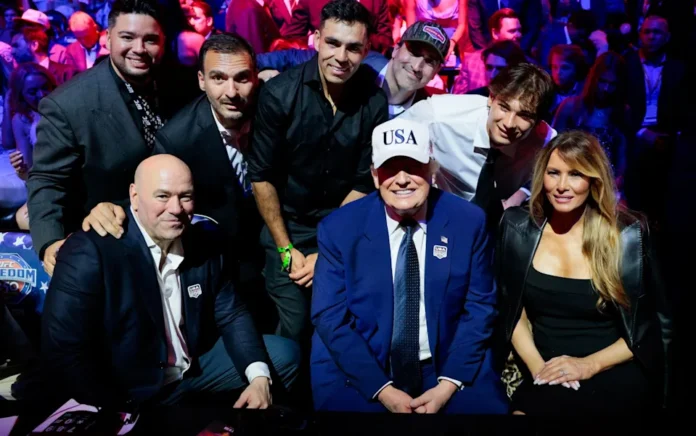
The event was held on the South Lawn during President Donald Trump’s 80th birthday celebration and included government officials, military personnel, athletes and thousands of invited guests.
The Justice Department announced charges against five men accused of participating in a conspiracy targeting officials and members of the crowd.
- The FBI learned about the potential threat on June 10.
- Arrests were made in Ohio, California, Missouri and Nebraska.
- The investigation remains active and may involve additional individuals.
The five defendants were identified as Tycen C. Proper, Bryan Omar Roa, Michael Alan Thomas, Daniel K. Eskridge and Abraham Hermosillo Alvarez.
According to court documents, investigators uncovered encrypted communications describing a coordinated attack using drones carrying explosive devices.
The alleged plan called for the drones to create panic and force attendees toward areas where armed participants could fire on the crowd.
Investigators also described discussions involving an attempted assault against a White House access point.
Authorities said the plot was disrupted before the suspects could carry out the alleged attack, and the UFC event proceeded without a major security incident.
FBI Director Kash Patel praised federal, state and local law-enforcement agencies for acting quickly after receiving information about the threat.
Why It Matters
The case demonstrates the scale of the security challenge surrounding major events attended by the president and other senior government officials.
Large outdoor gatherings are particularly difficult to protect because they involve extensive public spaces, multiple entry points and crowds extending beyond secured buildings.
Small commercially available drones have added another layer of risk because they can move above conventional barriers and potentially carry dangerous payloads.
- Drones can approach crowded areas from directions that are difficult to secure physically.
- Coordinated attacks can use panic and evacuation routes as part of the threat.
- Encrypted communications allow alleged conspirators in different states to organize remotely.
The successful disruption provides the Trump administration and the FBI with a strong example of intelligence-led prevention.
Law enforcement did not wait for the suspects to arrive near the White House before intervening.
Instead, investigators used tips, digital evidence, surveillance and coordinated arrests to break up the alleged conspiracy before the event began.
The neutral concern is that preventing one plot does not eliminate the wider threat.
The case may reveal how easily extremist individuals can combine commercially available technology, online radicalization and firearms into a plan aimed at a symbolic national event.
Political and Public Context
The plot emerged during a period of heightened concern about political violence and threats against elected officials.
Trump has faced multiple security threats during his political career, including assassination attempts and repeated warnings involving campaign events and government facilities.
The White House UFC event presented an especially prominent target because it combined the president, senior officials, military personnel and a large public audience at one location.
- The event carried strong political and national symbolism.
- The White House grounds created exceptional security demands.
- The alleged suspects were U.S. citizens with no confirmed foreign direction.
That domestic character is important.
The allegations suggest the threat developed from anti-government radicalization and fringe conspiracy theories rather than from a foreign terrorist organization.
Republicans are likely to highlight the disruption as evidence of effective federal law enforcement under Trump.
They may also argue that agencies need stronger authority and technology to detect drones, monitor violent networks and protect public events.
Democrats and civil-liberties advocates may support the prosecutions while warning against using one conspiracy to justify overly broad surveillance or restrictions on lawful political speech.
The central policy challenge will be distinguishing credible operational threats from protected expression while responding rapidly when planning crosses into criminal conduct.
What Happens Next
Federal prosecutors will continue presenting evidence against the five defendants while investigators examine the broader network described in court documents.
Authorities will attempt to determine which additional people actively participated in the alleged conspiracy and which individuals were only mentioned or loosely connected.
Digital evidence, weapons purchases and travel records are likely to play a major role in the prosecutions.
- Watch for additional arrests or federal charges.
- Monitor the release of further court documents and evidence.
- Follow congressional reviews of drone defenses around federal sites.
- Track changes to security planning for future White House events.
Congress may consider expanding federal counter-drone authority or increasing funding for detection and interception systems.
The Secret Service and FBI will also review whether the security measures used during UFC Freedom 250 should become standard for other large presidential events.
Prosecutors must still prove the allegations in court, and all defendants are entitled to the presumption of innocence unless convicted.
For Trump, the case underscores the risks attached to staging large public events at highly symbolic government locations.
For federal law enforcement, it provides an important test of whether early intelligence, interagency coordination and digital investigations can prevent emerging threats before they reach the attack stage.