Story Highlights
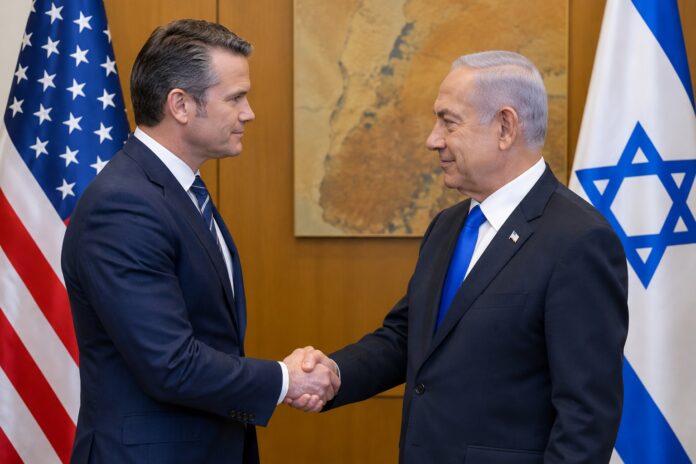
- Defense Secretary Pete Hegseth conducted an unannounced visit to Israel to meet with Prime Minister Benjamin Netanyahu
- The trip occurred one day after President Trump publicly endorsed Netanyahu ahead of parliamentary elections
- The visit underscores the Trump administration’s strong commitment to supporting Israel during a critical political period
- Netanyahu’s coalition faces potential loss of its governing majority in the upcoming parliamentary vote
What Happened
Defense Secretary Pete Hegseth made an unannounced trip to Israel on Monday to meet directly with Prime Minister Benjamin Netanyahu, according to reporting by Axios citing sources with knowledge of the visit. The timing of the high-level diplomatic mission proved significant, coming just one day after President Trump publicly endorsed Netanyahu in advance of Israel’s upcoming parliamentary election scheduled for the following week. This represents the nation’s first electoral vote since the devastating Hamas attack on October 7, 2023, which triggered a cascading series of military conflicts across the region.
The Pentagon and Israel’s embassy in Washington did not provide immediate responses to requests for comment regarding the specifics of the meeting or its agenda. Nevertheless, the visit carried substantial symbolic weight, demonstrating the Trump administration’s willingness to conduct high-profile diplomatic engagement with Israel’s leadership at a moment when the country faces both external security challenges and internal political uncertainty.
- Defense Secretary Hegseth conducted an unannounced Monday visit to Israel
- Meeting with PM Netanyahu occurred one day after Trump’s public endorsement
- Parliamentary election scheduled for the week following Hegseth’s arrival
- Visit follows October 7, 2023 Hamas attack and subsequent regional conflicts
Why It Matters
The Hegseth visit represents a concrete demonstration of the Trump administration’s strategic commitment to Israel during a pivotal moment in the nation’s political calendar. By dispatching the Defense Secretary on short notice to meet directly with Netanyahu, the White House signaled unmistakably that the United States stands firmly alongside Israel regardless of the political composition of its government. This approach contrasts with previous administrations’ more cautious stances toward Israeli leadership during sensitive electoral periods.
The strategic importance of such high-level engagement cannot be overstated. Israel currently operates under significant external pressures, managing military operations across multiple fronts while navigating internal political divisions. The presence of the Defense Secretary in Jerusalem sends a reassuring message to Israeli officials, military leaders, and the broader public that American support remains unwavering. Additionally, the visit provides an opportunity for direct military and strategic dialogue between defense officials of both nations, ensuring alignment on regional security matters and counterterrorism efforts.
For Netanyahu’s coalition, the timing of both the presidential endorsement and the Defense Secretary’s visit carries potential domestic political implications. International support, particularly from the United States, can influence voter perceptions and bolster the standing of an incumbent government facing electoral challenges. The convergence of these diplomatic signals may provide Netanyahu with additional credibility in the eyes of voters concerned about Israel’s security and international standing.
- Demonstrates unwavering U.S. support for Israel during internal political instability
- Provides direct military and strategic dialogue between defense leadership of both nations
- May strengthen Netanyahu’s position ahead of parliamentary elections through international endorsement
- Signals to regional actors that U.S.-Israel alliance remains robust and prioritized
Political and Public Context
Netanyahu’s religious-nationalist coalition currently faces significant electoral headwinds, with opinion polling suggesting the government may lose its parliamentary majority in the upcoming vote. This political vulnerability creates a complex domestic environment in which the prime minister must simultaneously address security concerns, manage coalition politics, and contend with potential electoral defeat. The arrival of America’s Defense Secretary during this delicate period carries clear implications for how voters and international observers perceive Netanyahu’s standing.
The Trump administration’s approach to Israel reflects a broader geopolitical philosophy that prioritizes strong alliances with democratic nations in strategically important regions. President Trump’s explicit endorsement of Netanyahu, combined with the Defense Secretary’s unannounced visit, demonstrates consistency in administration messaging and commitment. This stands in marked contrast to diplomatic approaches that seek to distance themselves from particular political figures or parties, instead anchoring support directly to Israel as a nation and strategic partner.
The security environment in which this visit takes place remains volatile. Israel continues managing military operations in Gaza and Lebanon while monitoring threats from Iran, all while attempting to maintain domestic stability and democratic processes. The convergence of security crises and electoral competition creates unprecedented pressure on Israeli leadership, making international reassurance and support particularly valuable.
- Netanyahu’s coalition projects to lose parliamentary majority according to opinion polls
- Trump administration emphasizes alliance strength over distance from particular political figures
- Israel manages simultaneous military operations in Gaza, Lebanon, and Iranian threat
- First election since October 7, 2023 attack reflects post-war political realignment
AXIOS: Secretary of War Hegseth made an unannounced visit to Israel meeting with PM Netanyahu amid US-Israeli discussions about potentially resuming major combat operations against Iran. pic.twitter.com/KmOKXw1YES
— KolHaolam (@KolHaolam) October 19, 2026
What Happens Next
The parliamentary election scheduled for the week following Hegseth’s visit will determine whether Netanyahu’s coalition can maintain governing authority or whether opposition parties can successfully form an alternative government. The election results will have significant implications not only for Israeli domestic politics but also for U.S.-Israel relations and broader Middle Eastern strategy under the Trump administration. A successful Netanyahu reelection would likely reinforce the current trajectory of close U.S.-Israel coordination, while an electoral defeat could require the administration to recalibrate its diplomatic approach.
Beyond the immediate electoral outcome, the Hegseth visit establishes a precedent for hands-on engagement by Trump administration officials with Israeli leadership. Additional high-level visits and military coordination efforts should be anticipated as the administration seeks to leverage its relationship with Israel for regional stability objectives. The Defense Department will likely intensify bilateral military planning, intelligence sharing, and strategic cooperation initiatives in the months ahead.
The broader question of how the Trump administration will manage its Middle East strategy, particularly regarding Iran and regional non-state actors, remains open. The visible support for Netanyahu and Israel may encourage closer coordination on responses to threats emanating from Tehran and its allied forces. Future diplomatic and military initiatives will likely reflect the administration’s clear prioritization of the U.S.-Israel alliance as central to its regional strategy.
- Parliamentary election results expected within one week of Hegseth’s visit
- Electoral outcome will determine trajectory of Netanyahu coalition or opposition government formation
- Defense Department anticipated to intensify bilateral military planning and coordination
- Administration expected to deepen strategic cooperation on Iran and regional security threats